What RFP Software Is Best for Content Library Management?
The best RFP software for content library management does more than store old answers.
Yash Kumar
The best RFP software for content library management does more than store old answers. It should make approved content easy to find, prevent stale information from being reused, support ownership and review workflows, and let AI draft from trusted sources. In 2026, strong options include Inventive AI, Loopio, Responsive, AutoRFP.ai, and QorusDocs. You can also compare the broader category in HAKKEN's AI RFP Software 2026 guide.
The right choice depends on how your company manages knowledge. Loopio and Responsive provide mature, structured content-library workflows. Inventive AI and AutoRFP.ai put more emphasis on connected company knowledge, AI retrieval, and automated content governance. QorusDocs combines governed proposal content with a Microsoft 365-centered workflow.
What is an RFP content library?
An RFP content library is a centralized, searchable repository of reusable proposal information. It commonly contains approved RFP answers, product information, security and compliance responses, company descriptions, case studies, policies, supporting documents, boilerplate language, and previous proposal content.
A useful library solves three problems at the same time: finding the right answer, knowing whether the answer is still valid, and knowing whether it has been approved for customer use.
For example, imagine your security team changes a data-retention policy. A basic answer library may still return the old response because it matches the buyer's question. A well-governed RFP content management system should either update that answer, flag it for review, identify a newer source, or warn the proposal team that conflicting information exists.
That distinction becomes more important when AI starts drafting responses automatically. Fast retrieval is useful only when the underlying material can be trusted. Similar knowledge-search considerations also appear in HAKKEN's modern intranet software buyer's guide.
Which RFP software has the strongest content library capabilities?
There is no single platform that fits every proposal team. These five products take different approaches to RFP knowledge management.
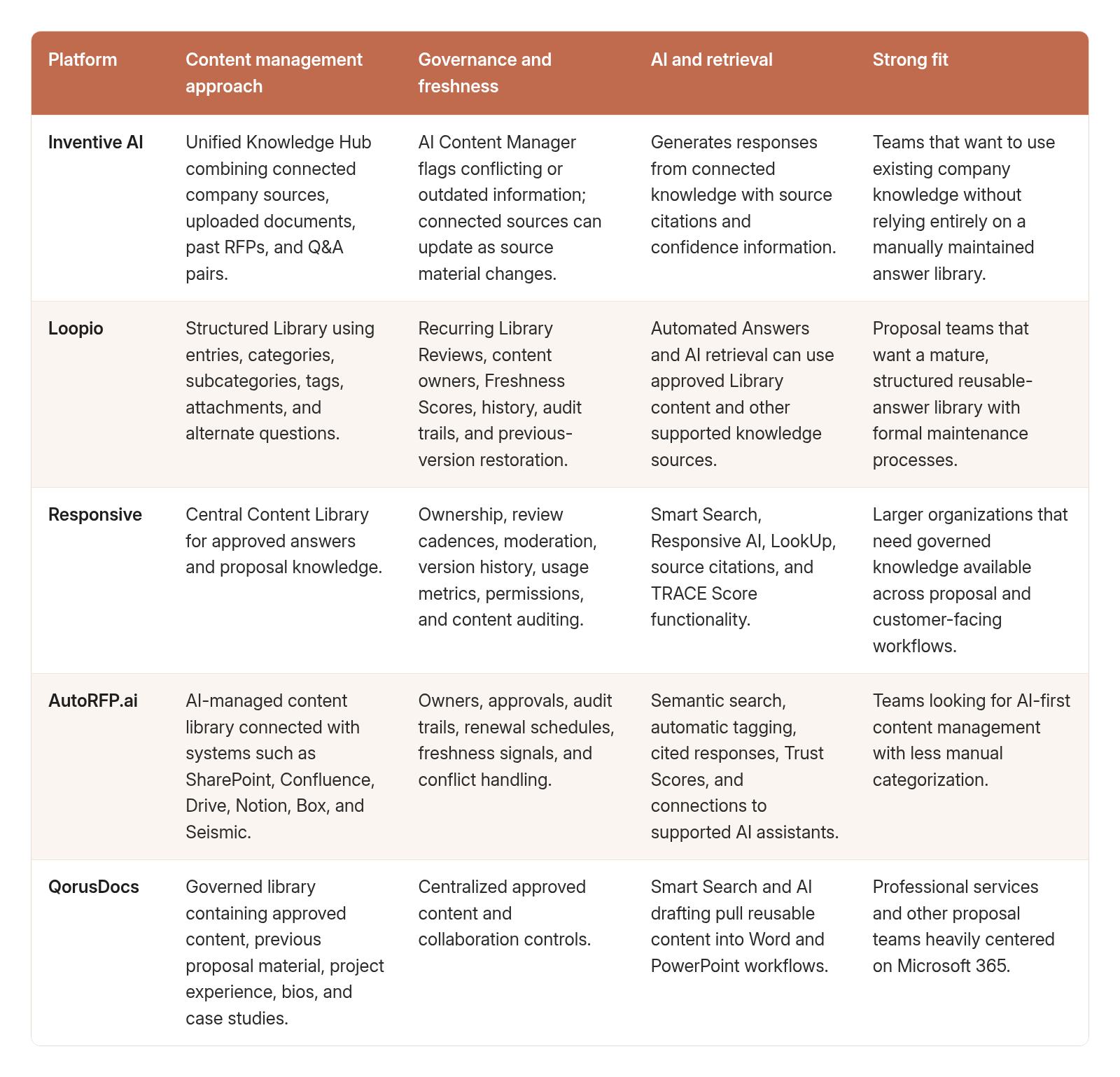
Product capabilities above are based on current vendor documentation reviewed in September 2026. Features and packaging can change, so buyers should confirm required functionality during evaluation. Inventive describes live knowledge connections and automated conflict or outdated-content detection. Loopio documents Library Reviews, review cycles, Freshness Scores, entry history, audit trails, and version restoration. Responsive documents content ownership, review cadences, version history, Smart Search, source citations, and library access through LookUp. AutoRFP.ai describes ownership, approvals, review schedules, semantic search, automatic tagging, and integrations with company knowledge sources. QorusDocs describes a governed content library, Smart Search, approved content reuse, and proposal creation inside Microsoft 365.
Inventive AI: Best suited to connected knowledge and automated content governance
Inventive AI takes a broader approach than a conventional RFP answer library. Its Knowledge Hub and RFI response workflow can connect sources such as SharePoint, Google Drive, Notion, Confluence, and other company systems while also supporting uploaded documents, historical responses, and Q&A pairs.
That architecture can reduce the need to copy every useful piece of company information into a separate proposal content library.
Its AI Content Manager is designed to detect outdated or conflicting information across knowledge sources. Inventive also states that generated answers include source citations, allowing reviewers to trace a proposed response back to the material used to create it.
Consider a company where product information lives in Notion, security documentation lives in SharePoint, historical RFPs sit in Google Drive, and the proposal team has its own Q&A collection. A connected knowledge model can search across those sources rather than forcing the team to maintain identical information in several places.
This model is particularly relevant for organizations where information changes frequently or where proposal teams do not have a dedicated content librarian.
Teams that prefer detailed manual taxonomy and traditional category-by-category content reviews should compare Inventive's governance workflow directly with structured library systems such as Loopio and Responsive during a live evaluation.
Loopio: Strong structured RFP answer library management
Loopio's Library is built specifically around reusable proposal content. A Library Entry stores a question-and-answer pair, and teams can organize entries with categories, subcategories, tags, alternate questions, attachments, and related metadata.
Its content-maintenance capabilities are particularly detailed.
Loopio lets teams establish one-time reviews or recurring Library Review Cycles. Review cycles can be configured at the individual entry, category, or subcategory level and assigned to reviewers. Entries under review are visibly marked so responders know that the content may require verification before reuse.
Each entry also receives a Freshness Score based on factors including use and review history. Teams can sort content by freshness to find material that may need attention.
Version management is another useful feature. Loopio records entry history, identifies changes and contributors, provides an audit trail, and allows users to revert to earlier versions.
For proposal teams with an established content-management discipline, this gives content owners precise control over reusable answers. The tradeoff is organizational rather than purely technical: structured libraries still depend on good ownership, review schedules, and maintenance practices.
Responsive: Strong enterprise knowledge governance and access
Responsive combines a centralized Content Library with broader knowledge-management and response workflows.
Its current guidance describes ownership rules, review cycles, version history, usage metrics, tagging, duplicate detection, and tools for identifying material that should be updated or retired.
Responsive also offers several ways to retrieve that knowledge.
Content Library Smart Search supports natural-language questions, ordinary keywords, filters, and structured searches. A user can, for example, search for content awaiting review or look for security-related material with specific metadata without manually browsing the library hierarchy.
Responsive LookUp extends access to approved content into tools including Word, Excel, PowerPoint, browsers, Slack, and Teams. Its Ask functionality can generate responses using library information while providing source citations and TRACE Score information for reviewers.
This combination makes Responsive relevant when knowledge needs to serve more people than the central proposal team. Sales, solutions, security, and other customer-facing teams can retrieve approved information without each maintaining a separate answer collection.
Organizations considering Responsive should evaluate which governance, AI, workflow, and cross-application features they actually need, particularly if their RFP operation is relatively small.
AutoRFP.ai: AI-first library management with semantic search
AutoRFP.ai combines an answer library with connections to existing company content.
The platform says approved responses can be automatically added to its library and categorized with AI. Teams can assign content owners, use approvals, configure review cycles, and track freshness. Its semantic search is designed to find relevant material based on meaning rather than requiring exact keyword matches.
AutoRFP.ai also connects with knowledge systems including Confluence, Notion, SharePoint, Seismic, Box, and Google Drive.
An interesting part of its current content management workflow is support for MCP connections. AutoRFP.ai says approved content can be made available to compatible AI assistants such as ChatGPT, Claude, Copilot, and Gemini through its MCP server, with answers tied back to approved RFP knowledge.
This can suit organizations trying to make proposal knowledge available outside the RFP platform itself while retaining a governed source. HAKKEN's article on the AI-native CEO stack covers the broader move toward connected company knowledge and AI workflows.
QorusDocs: Strong proposal content reuse inside Microsoft 365
QorusDocs approaches content management through the broader proposal creation process.
Its proposal software uses a governed content library containing approved proposal material such as case studies, project experience, resumes, and previous content. Smart Search is designed to retrieve relevant approved material, while proposal teams work primarily inside familiar Microsoft 365 applications.
That makes QorusDocs particularly relevant to professional services, legal, consulting, AEC, and similar organizations where proposal content involves far more than question-and-answer pairs. A proposal may require project sheets, personnel biographies, experience records, branded layouts, and past-client material alongside ordinary written answers.
Teams focused primarily on highly structured RFP and security-questionnaire answer libraries should compare its content-governance workflow with dedicated RFP library platforms. Teams that spend substantial time producing polished Word and PowerPoint deliverables may value the Microsoft-centered approach more heavily.
What features should an RFP content library have?
A strong RFP content library needs more than storage and search.
First, look at retrieval quality. Your team should be able to find an answer even when the buyer phrases a question differently from previous RFPs. Semantic or natural-language search is increasingly useful here.
Next, test content freshness. Ask what happens six months after implementation when product specifications, security policies, company statistics, or approved positioning have changed. The platform should make stale material visible before it reaches a customer.
Ownership is equally important. High-risk content should have identifiable owners. A security response may belong to InfoSec, contractual language to Legal, and product functionality to Product or Engineering.
Version history also matters. Proposal teams need to know what changed, who changed it, and which version was sent to a customer. For regulated organizations, that audit trail may matter as much as search speed.
Finally, test AI against imperfect content. Give each vendor a realistic collection containing duplicates, an outdated answer, two partially conflicting documents, and a question the knowledge base cannot answer. The resulting behavior tells you much more than a polished demo built around ideal data.
How does AI RFP software find answers from a content library?
Modern AI RFP software generally retrieves relevant company information before generating the final response.
The system analyzes the question, searches approved answers or connected documents for relevant material, selects supporting content, and then creates a response suited to the question. Better implementations also show the underlying sources or provide confidence information so reviewers can inspect the evidence.
This is different from asking a general-purpose language model to produce an answer from its general training data.
For an RFP question such as “Describe your incident-response process,” the useful information should come from your organization's current security documentation and approved responses. If that information is missing, a trustworthy workflow should surface the gap for human review instead of quietly creating a plausible policy.
How do proposal teams keep RFP content libraries up to date?
There are two main approaches in current RFP software.
The traditional model uses content ownership and recurring review schedules. A security answer might be sent to the security owner every quarter, while relatively static corporate information might receive a less frequent review. Loopio and Responsive both document structured review mechanisms of this type.
The newer model adds automated monitoring of connected knowledge. Inventive AI, for example, describes detecting outdated or conflicting information and updating its Knowledge Hub as connected source material changes. AutoRFP.ai similarly describes freshness signals, ownership, renewal schedules, and conflict handling.
Many enterprise teams will use elements of both. Automation can identify likely problems, while accountable subject-matter experts remain responsible for approving sensitive claims.
What is the difference between an RFP content library and a knowledge base?
An RFP content library is usually narrower and more purpose-built.
It often contains reusable, customer-ready proposal content that has already been reviewed and approved. The content may be organized around questions, answers, products, industries, regions, or response topics.
A company knowledge base is broader. It may contain product documentation, internal policies, help-center articles, technical specifications, sales material, training documents, meeting information, and other operational knowledge that was never written specifically for an RFP.
Modern RFP platforms increasingly connect the two concepts.
Instead of requiring every useful fact to be manually converted into a Q&A entry, some AI RFP software can search existing company knowledge while still retaining an approved answer library for material that requires tighter governance.
Should you centralize RFP content inside the RFP platform?
Not necessarily.
A centralized RFP answer library works well when your organization has established content owners, relatively controlled approved language, and a proposal team responsible for maintaining the repository.
A connected-source approach may work better when product, technical, and policy content already has authoritative owners elsewhere. Copying that information into another repository can create duplicate maintenance.
The important question during software selection is therefore not simply, “Does it have a content library?”
Ask: Where will the authoritative version of each answer live, how does the RFP system know that it is current, and what happens when two sources disagree?
Those three questions expose major differences between RFP knowledge-management platforms.
How should you evaluate RFP software for content library management?
Use your own content during the evaluation.
Import or connect a representative set of historical RFP answers, product documents, security material, case studies, and policies. Include some clean content and some deliberately difficult material.
Then test how quickly your team can find an approved answer, identify its source, see when it was last reviewed, discover conflicting information, update it, track the change, and reuse it in a new response.
Also test a question for which no approved answer exists. You want to understand whether the AI clearly reports insufficient information, produces a low-confidence draft for review, or generates unsupported language.
The best RFP software for content library management is the platform whose knowledge model matches how your organization actually maintains information. A technically powerful library becomes a liability if your team does not have the time or ownership model required to maintain it.
Frequently Asked Questions
What is the best RFP software for managing reusable content?
Loopio and Responsive offer mature, structured content-library systems with formal review and governance workflows. Inventive AI and AutoRFP.ai are worth considering when you want AI to work directly with connected company knowledge as well as reusable responses. QorusDocs is particularly relevant when Microsoft 365 proposal creation is central to the workflow.
What RFP software is best for keeping proposal content current?
The answer depends on your preferred governance model. Loopio uses review cycles and Freshness Scores, while Responsive supports ownership, review cadences, version history, and content audits. Inventive AI emphasizes automated detection of outdated or conflicting knowledge, while AutoRFP.ai combines review schedules, ownership, freshness indicators, and connected sources.
How does RFP software organize approved answers?
Traditional RFP content libraries commonly use categories, subcategories, tags, metadata, owners, review states, and Q&A entries. Newer platforms may add semantic search, automatic categorization, or retrieval directly from connected documents and company systems.
Can AI RFP software search existing company knowledge?
Yes. Current platforms including Inventive AI, Loopio, AutoRFP.ai, Arphie, and others document connections to external company knowledge sources. The supported integrations and the way each platform governs retrieved content vary, so buyers should test the specific systems they use.
How does RFP content library software handle version control?
Version control varies by platform. Loopio, for example, records entry history and lets authorized users review previous changes and restore earlier versions. Responsive uses version history alongside ownership, review processes, and usage information. Connected-source systems may rely more heavily on the current authoritative source while using governance tools to detect conflicts.
How do proposal teams manage outdated RFP answers?
Assign clear owners, define review cadences according to the risk and rate of change, track content age and usage, and archive material that should no longer be reused. AI-based conflict and freshness detection can reduce the amount of material teams need to inspect manually, but sensitive answers should still have accountable reviewers.
Is a content library better than searching SharePoint or Google Drive?
They solve different problems. A dedicated proposal content library gives teams tightly controlled, reusable, customer-ready responses. SharePoint, Google Drive, Notion, Confluence, and similar systems may contain more current source information but can be harder to search and govern specifically for RFP reuse. Some current RFP platforms combine both approaches.
What should enterprise teams prioritize in RFP knowledge management software?
Enterprise buyers should test permissions, content ownership, review workflows, version history, auditability, source citations, integration with existing knowledge systems, semantic search, AI behavior when information is missing, and support for conflicting sources. These factors determine whether a centralized RFP content library remains reliable as the volume of content and contributors grows.
Final consideration
Content library management is becoming less about storing the largest possible collection of historical answers and more about maintaining a dependable body of knowledge that people and AI can safely reuse.
Loopio and Responsive provide established approaches to structured RFP library governance. Inventive AI and AutoRFP.ai put greater emphasis on retrieving current knowledge from connected sources and using AI to reduce manual maintenance. QorusDocs takes a proposal-centric approach built closely around Microsoft 365.
Before buying, run the same real-world knowledge test with every shortlisted platform. Give each vendor outdated content, duplicate answers, current source documents, and an unanswered question. Then compare what the software retrieves, what it flags, what it cites, and what your team has to maintain manually.
That test will tell you far more about RFP content management quality than the size of a feature list.
Disclosure
HAKKEN is published by Nakama.