Hire AI Engineers in India: Costs, Skills & Where to Hire (2026)
Compare 7 ways to hire AI engineers in India in 2026: TechCospace, Flexiple, Turing, Toptal, Upwork, Arc, and LinkedIn, with costs and skills.
SEO and GEO Specialist
Businesses looking to hire AI engineers in India can consider TechCospace, Flexiple, Turing, Toptal, Upwork, Arc, and LinkedIn. These services support different requirements, from permanent technical recruitment and dedicated developers to freelance projects and enterprise AI implementation.
Hiring costs depend on the engineer's experience, technical specialization, location, and employment arrangement. Companies should compare permanent employee compensation, freelance rates, recruitment fees, and fully managed development costs separately.
An AI engineer may work on machine learning applications, large language model (LLM) integrations, retrieval-augmented generation (RAG), intelligent automation, or the infrastructure required to deploy AI systems reliably.
This guide explains current 2026 compensation benchmarks, essential technical skills, seven hiring options, and a practical process for evaluating candidates. It also covers hiring contracts, security considerations, and the costs employers may overlook.
Where Can You Hire AI Engineers in India?
The right hiring service depends on whether you need an individual employee, a contractor, additional engineering capacity, or responsibility for delivering an entire AI application.
- TechCospace: Best suited for: Structured technical recruitment in India. Primary hiring approach: AI-assisted sourcing, technical screening, and recruiter verification.
- Flexiple: Best suited for: India-based contract and permanent engineers. Primary hiring approach: Vetted technical talent, managed teams, and workforce support.
- Turing: Best suited for: Enterprise AI implementation and specialized engineering. Primary hiring approach: Embedded engineering and managed enterprise AI services.
- Toptal: Best suited for: Experienced freelance AI specialists. Primary hiring approach: Screened professional talent network.
- Upwork: Best suited for: Flexible freelance AI projects. Primary hiring approach: Open freelancer marketplace with hourly and fixed-price contracts.
- Arc: Best suited for: Screened remote AI developers. Primary hiring approach: Developer recruitment, technical vetting, and remote hiring support.
- LinkedIn: Best suited for: Direct permanent recruitment. Primary hiring approach: Professional candidate search and employer-managed hiring.
For permanent hiring, an external recruitment partner or direct sourcing channel may be appropriate. For ongoing development, dedicated engineers can provide continuity without requiring an immediate local hiring operation.
Freelance marketplaces work particularly well for projects with defined deliverables. When a business needs complete architecture, development, deployment, and maintenance, a managed AI development provider may be more suitable than hiring one engineer.
How We Evaluated These Hiring Services
This comparison considers publicly available service descriptions, hiring processes, published prices, geographic coverage, and suitability for AI engineering roles.
Each provider was assessed against five practical criteria:
- India-based talent availability: Whether the service specializes in India or operates an international talent network.
- Hiring model: Whether it supports permanent recruitment, freelance work, dedicated engineers, or managed delivery.
- Candidate evaluation: What technical screening, interviews, or professional assessments the provider describes.
- Pricing transparency: Whether fees are published or require a custom quote.
- Operational suitability: Which employers and projects are likely to benefit from the service.
Provider descriptions and published hiring claims are based on information supplied by the respective companies. They do not constitute independent testing of recruitment outcomes or individual engineering performance.
Pricing and service availability may change. Employers should confirm all commercial terms before signing an agreement.
How Much Does It Cost to Hire AI Engineers in India in 2026?
The cost of hiring AI engineers in India varies substantially across permanent employment, freelance contracting, and managed outsourcing.
Permanent employees are generally evaluated using annual compensation or cost to company (CTC). Freelancers typically quote hourly or fixed-project rates, while staff augmentation and managed engineering arrangements may use monthly contracts.
These figures measure different things and should not be treated as interchangeable.
AI Engineer Salaries in India by Experience
An analysis published by Masai School on November 11, 2026, citing AmbitionBox salary reporting, provides the following experience-level benchmarks.
- 1–3 years: Reported annual average-salary band: ₹10.4–₹11.5 lakh. Practical hiring consideration: Defined implementation tasks with appropriate supervision.
- 3–6 years: Reported annual average-salary band: ₹15.3–₹16.9 lakh. Practical hiring consideration: Ownership of individual features and engineering components.
- 6+ years: Reported annual average-salary band: Insufficient data for a reliable universal benchmark. Practical hiring consideration: Assess architecture experience, specialization, and delivery responsibility.
- Specialized AI infrastructure, LLM, or MLOps roles: Reported annual average-salary band: No single dependable rate. Practical hiring consideration: Obtain compensation benchmarks for the exact role and employer category.
Important: The figures above are reported average-salary bands for experience groups. They are not the minimum and maximum salaries that individual candidates can earn.
The underlying salary information is self-reported, and the available samples become smaller at higher experience levels. Compensation can also differ between IT services businesses, software product companies, startups, and global capability centers.
For another perspective, Levels.fyi's India AI engineer compensation data reported median annual total compensation of approximately ₹16.9 lakh, or $17,808, on November 16, 2026.
Levels.fyi includes base salary, stock compensation, and bonuses in its total compensation calculations. Consequently, its figures should not be compared directly with basic salary estimates.
Employers should use these benchmarks to establish an initial budget, then validate it against comparable job openings, recruiter feedback, candidate expectations, and actual offers.
How Much Do Freelance AI Engineers Charge in India?
Freelance pricing depends on technical specialization, previous project experience, contract duration, and the type of work required.
According to Upwork Insights' India AI engineer rate analysis, updated November 13, 2026, the following advertised rates appeared among 79 India-based AI engineering freelancers with at least $10,000 in publicly reported Upwork earnings.
- 25th percentile: Advertised hourly rate: $20.
- Median: Advertised hourly rate: $25.
- 75th percentile: Advertised hourly rate: $40.
- 90th percentile: Advertised hourly rate: $50 or more.
These numbers represent advertised profile rates from a limited marketplace sample. They are not verified transaction rates, and the sample excludes freelancers who had not reached the specified public earnings threshold.
Actual project quotes may differ. An engineer designing AI infrastructure or handling production security could price work differently from someone implementing a basic API integration.
For example, a freelancer quoting $35 per hour for 160 billable hours would cost:
$35 × 160 hours = $5,600
This is the engineering charge before client marketplace fees, taxes, software services, cloud usage, and other project expenses.
A full-time contractor should not automatically be assumed to provide 160 productive development hours every month. Meetings, documentation, incident response, and other responsibilities must be considered when estimating delivery capacity.
What Else Should Employers Budget For?
The engineer's quoted compensation is only one part of the total expense.
Employers may also need to pay for recruitment fees, benefits, equipment, onboarding, cloud infrastructure, AI model APIs, security reviews, and project supervision.
Before comparing offers, request a written breakdown of what each price includes and excludes.
What Skills Should an AI Engineer Have?
AI engineers need a combination of software development, data handling, AI concepts, deployment experience, and problem-solving ability.
The required technical skills depend on what the company plans to build.
A business implementing a document-search assistant may need a Python engineer experienced with LLM APIs and retrieval systems. A company developing forecasting models may require stronger statistical modeling, machine learning, and data engineering experience.
Essential AI Engineering Skills
- Programming: Technologies and competencies: Python, SQL, APIs, Git. Why it matters: Building and integrating AI-powered software.
- Machine learning: Technologies and competencies: Scikit-learn, PyTorch, TensorFlow. Why it matters: Training, testing, and evaluating models.
- Generative AI: Technologies and competencies: LLM APIs, transformers, structured outputs. Why it matters: Developing applications powered by language models.
- RAG development: Technologies and competencies: Embeddings, vector search, retrieval, reranking. Why it matters: Connecting model responses to relevant documents and data.
- Data engineering: Technologies and competencies: SQL, ETL, validation, data pipelines. Why it matters: Preparing reliable information for AI systems.
- Infrastructure: Technologies and competencies: AWS, Azure, Google Cloud, Docker. Why it matters: Deploying and operating applications.
- MLOps: Technologies and competencies: CI/CD, monitoring, MLflow, automated testing. Why it matters: Maintaining production AI systems.
- Security: Technologies and competencies: Identity management, secrets, access control, threat modeling. Why it matters: Protecting applications and sensitive information.
- Collaboration: Technologies and competencies: Documentation, code reviews, communication. Why it matters: Working effectively across engineering and product teams.
Candidates do not need advanced expertise in every listed framework.
A strong hiring process identifies mandatory technical requirements and distinguishes them from skills that can be learned after joining.
Generative AI and LLM Engineering Skills
Companies hiring generative AI engineers should evaluate more than prompt-writing ability.
Relevant experience may include integrating hosted or self-hosted LLMs, building RAG pipelines, designing structured outputs, managing tool-calling workflows, and evaluating response quality.
An experienced LLM engineer should understand when retrieval is preferable to fine-tuning. For example, a customer support application that must reference regularly updated policy documents may benefit from retrieval rather than attempting to store changing facts through model training.
Candidates should also be able to explain:
- How they evaluate factual accuracy and unsupported answers.
- How they test retrieval quality and citation correctness.
- How they handle incomplete or conflicting source information.
- How they prevent unauthorized actions by AI agents.
- How they control latency, token consumption, and inference cost.
- How they test systems after model or dependency updates.
Not every AI requirement justifies custom development. Before recruiting, businesses should compare the cost and flexibility of building a system against existing software.
For additional context on evaluating off-the-shelf AI workflows, Hakken's AI-native CEO technology stack illustrates how different applications can be combined to support business operations.
Production AI and MLOps Skills
A demonstration that produces promising responses is not the same as a reliable production system.
Engineers responsible for deployed AI applications need to understand testing, monitoring, version control, rollback procedures, service reliability, and incident management.
For traditional machine learning, this includes data quality, model drift, reproducible training, and deployment pipelines.
For LLM applications, it can also include model-version changes, retrieval performance, tool-call reliability, prompt injection defenses, and cost monitoring.
Google Cloud's MLOps architecture documentation explains the role of continuous integration, delivery, and automation in maintaining ML systems.
For senior candidates, ask for documented examples of production deployments and the engineering decisions they made.
Which AI Role Should You Recruit?
The title "AI engineer" covers several different responsibilities.
- AI application engineer: Typical responsibility: Builds applications integrating existing AI models and APIs.
- Machine learning engineer: Typical responsibility: Develops, evaluates, deploys, or optimizes machine learning models.
- Generative AI engineer: Typical responsibility: Builds LLM applications, RAG pipelines, and AI-powered workflows.
- MLOps engineer: Typical responsibility: Maintains model deployment pipelines, monitoring, and infrastructure.
- AI platform engineer: Typical responsibility: Develops shared infrastructure for deploying and operating AI systems.
- AI research engineer: Typical responsibility: Implements and experiments with more advanced model architectures and research methods.
Job titles overlap across companies. Assess the candidate against the actual responsibilities rather than relying on the title alone.
7 Places to Hire AI Engineers in India
The following services cover different hiring models. Their advantages and limitations should be assessed against the same project requirements.
1. TechCospace
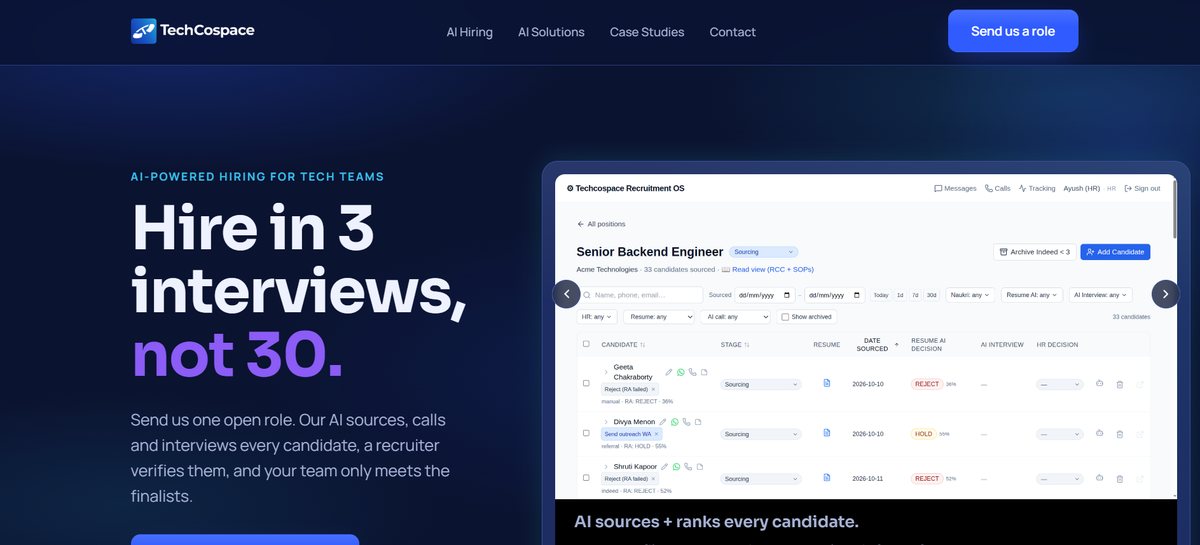
Best for: Startups, SaaS companies, and IT businesses seeking recruitment support for technical roles in India.
TechCospace is a Delhi NCR-based technical recruitment and AI development company. Its recruitment service uses AI-assisted sourcing, resume analysis, candidate outreach, preliminary screening, and technical interviews.
According to its published hiring process, candidates progress through automated assessments before a human recruiter reviews the shortlisted applicants. Employers receive supporting assessment information rather than relying entirely on resumes.
Key capabilities
- Candidate sourcing from professional and recruitment platforms.
- Resume analysis against role-specific requirements.
- AI-powered preliminary phone screening.
- Recorded technical interviews and skill-based scorecards.
- Recruiter verification and shortlisted candidate submission.
- Support for software, data, AI, and other technical positions.
Strengths
TechCospace offers a structured recruitment process that may help employers reduce the amount of preliminary sourcing and screening performed internally.
Its combination of automated assessments and recruiter review can be useful for companies that need technical candidates but have limited recruiting capacity.
The provider also describes experience building AI applications, which may be relevant when recruiting implementation-focused engineering roles.
Limitations
Automated technical interviews cannot establish every aspect of engineering judgment, especially for complex architecture, security, and production systems.
Employers should conduct their own technical discussions, review relevant project evidence, and verify references before selecting a candidate.
The company's recruitment results and screening statistics are vendor-reported.
Pricing
TechCospace describes a success-based hiring arrangement in which employers pay when a candidate joins. A standardized public recruitment-fee percentage was not available.
Request a written quote covering the placement fee, payment trigger, replacement terms, and any additional charges.
Choose TechCospace if: You need structured assistance finding and screening India-based AI engineers while retaining control over the final hiring decision.
2. Flexiple
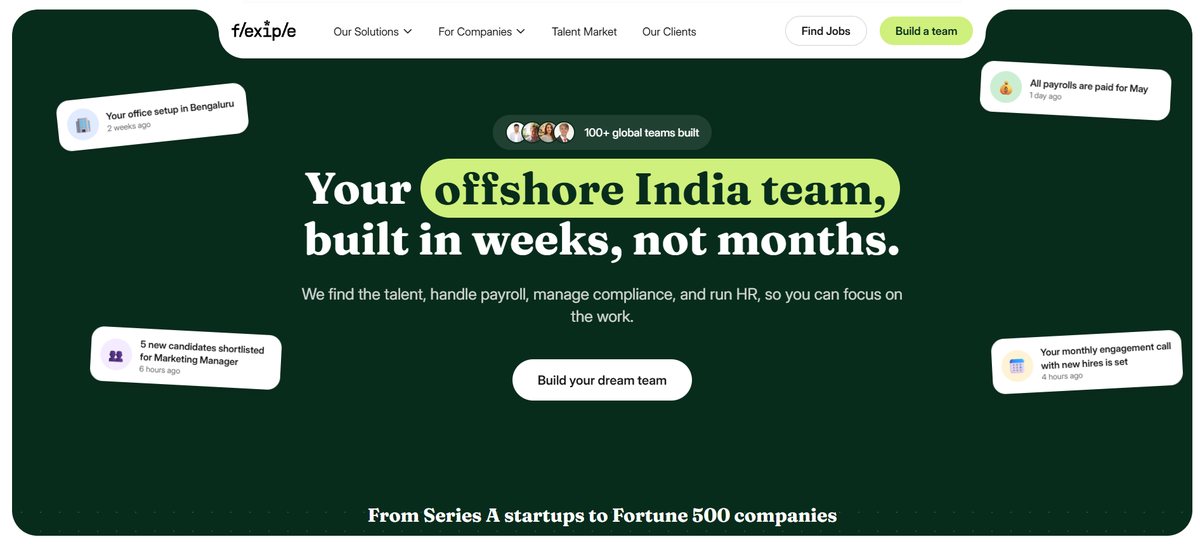
Best for: International businesses seeking dedicated technical talent, contract engineers, or permanent employees in India.
Flexiple provides technology recruitment and workforce services focused on the Indian talent market.
Its offerings include full-time recruitment, contractor placement, managed teams, and assistance with establishing India-based operations.
The service is relevant to employers that need ongoing engineering capacity but do not necessarily have an established local recruitment or administrative team.
Key capabilities
- Sourcing and vetting technical professionals.
- Full-time engineering recruitment.
- Contract and dedicated developer arrangements.
- Managed engineering teams.
- Payroll and employment administration support.
- India-based workforce and operational assistance.
Strengths
Flexiple offers several engagement models through one provider. This can be valuable when a business expects its engineering requirements to expand over time.
Its India-focused services may also simplify operational concerns for international employers, particularly where contractor administration or employment support is required.
Limitations
Businesses seeking only a brief freelance assignment may not need the broader managed hiring arrangements.
Employers should confirm each proposed engineer's AI specialization, availability, and production experience. A general software engineering assessment may not be sufficient for a technically demanding machine learning or LLM role.
Pricing
Flexiple publicly lists full-time hiring fees of 8.33%–12% of annual CTC per joined employee.
Contract engineers are quoted individually through a fully loaded monthly rate. Additional employment-management services have separate published terms.
Choose Flexiple if: You need dedicated India-based engineering capacity and want a provider that can support both recruitment and longer-term workforce administration.
3. Turing
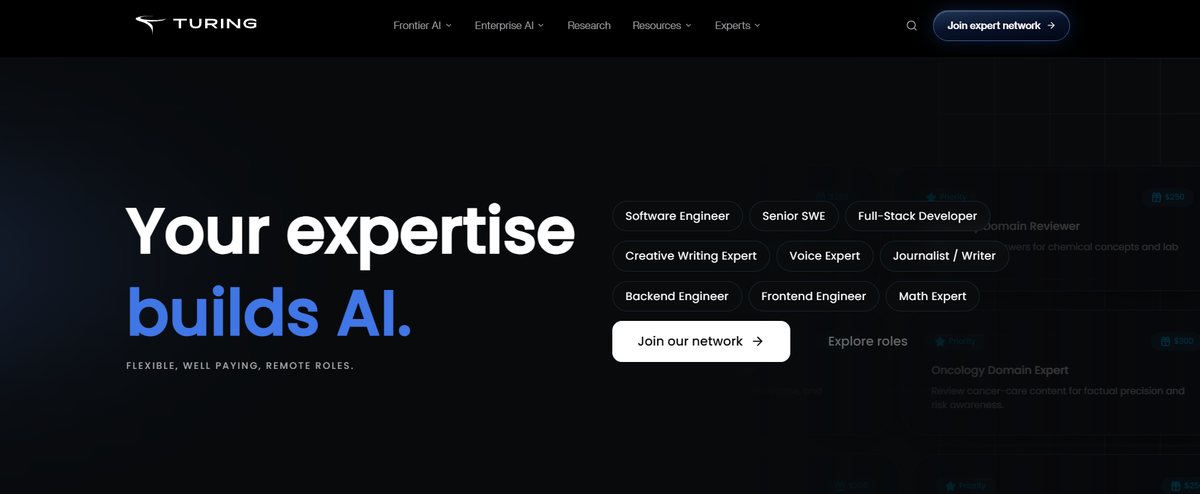
Best for: Organizations evaluating embedded AI engineering support, enterprise AI implementation, or specialized technical expertise.
Turing has historically provided remote engineering talent matching and technical vetting services.
Its current enterprise AI offering places greater emphasis on forward-deployed engineers who work with organizations to build and operate AI agents, alongside infrastructure for deploying and managing those systems.
Turing also provides specialized expertise and services supporting advanced AI development and model evaluation.
Key capabilities
- Forward-deployed engineering for enterprise AI applications.
- Development and operation of AI agents.
- AI application deployment and management.
- Access to technical and domain specialists for qualifying engagements.
- Services supporting advanced AI development and evaluation.
Strengths
Turing is relevant to organizations that need more than an individual freelance developer.
Its enterprise AI model can suit companies looking for engineering support connected to broader AI deployment and operational responsibilities.
Businesses with complex projects may benefit from a provider that combines specialized technical resources with implementation services.
Limitations
Turing should not automatically be treated as an India-specific AI recruitment agency.
Its current public offering emphasizes enterprise and frontier AI services. Employers looking to recruit a single Indian AI engineer directly should confirm that the required placement model, candidate geography, and contractual structure are available.
The degree of control a customer has over individual engineers may also differ from ordinary staff augmentation.
Pricing
Commercial pricing depends on the service and engagement. A universal India-specific AI engineer hourly rate was not identified.
Request a proposal detailing engineering scope, staffing arrangements, deliverables, service ownership, and ongoing charges.
Choose Turing if: You are evaluating enterprise AI delivery or specialized embedded engineering and want to discuss a managed technical engagement rather than assuming a conventional recruitment arrangement.
4. Toptal
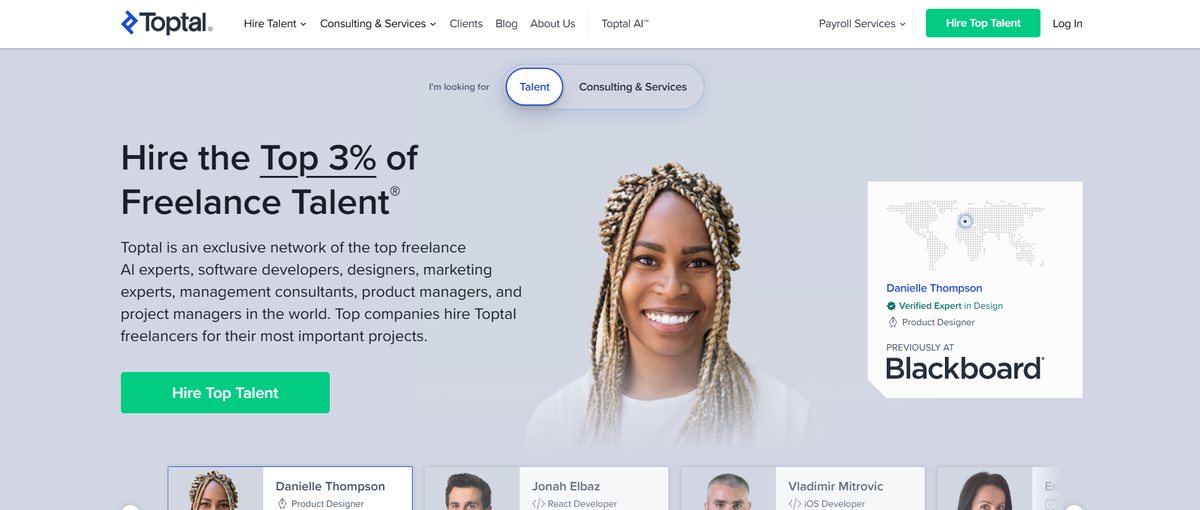
Best for: Businesses requiring experienced AI professionals for specialized projects, technical assessments, or complex implementation work.
Toptal operates a screened freelance professional network with categories covering artificial intelligence, machine learning, software development, and related engineering disciplines.
Companies can describe their requirements and work with Toptal to identify professionals whose experience may suit the project.
Its AI talent offering includes areas such as natural language processing, machine learning, computer vision, and related technologies.
Key capabilities
- Access to screened freelance technical professionals.
- Matching based on project requirements.
- AI and machine learning specialization.
- Flexible professional engagements.
- Trial arrangements for evaluating a working relationship.
Strengths
Toptal can be useful when engineering judgment and specialist experience are central to the assignment.
For example, a company may need an experienced contractor to review an LLM architecture, improve a machine learning pipeline, or solve a technically difficult integration problem.
Limitations
Toptal operates internationally rather than exclusively in India. Employers who need India-based engineers should specify location, working hours, and contractual requirements.
Its curated matching model may be less suitable for companies that want to browse a large number of freelancers independently or prioritize the lowest available rate.
Pricing
Rates depend on the professional and engagement. Obtain a quote for the exact skills, duration, and availability required.
Choose Toptal if: You need a specialized freelance AI professional and prefer a provider-assisted matching process.
5. Upwork
Best for: Startups, small businesses, and engineering teams hiring freelancers for defined AI development assignments.
Upwork is a global freelance marketplace with AI developers, machine learning engineers, automation specialists, and technical consultants.
Employers can search for India-based professionals, review profiles, compare work histories, and hire through hourly or fixed-price contracts.
This makes the platform useful for projects that need a specific skill but do not justify permanent recruitment.
Key capabilities
- Searchable freelancer profiles.
- Geographic and skills-based candidate discovery.
- Portfolio and work-history visibility.
- Hourly and milestone-based agreements.
- Project communication and payment tools.
- Access to professionals across different AI disciplines.
Strengths
Upwork provides flexibility for prototypes, API integrations, automation projects, and targeted technical assistance.
Employers can compare proposals, discuss deliverables, and begin with a limited engagement before extending the relationship.
Limitations
Technical vetting remains primarily the employer's responsibility.
A strong freelancer rating does not necessarily indicate experience managing sensitive data, implementing enterprise security controls, or maintaining production AI infrastructure.
Well-defined project scopes and milestone acceptance criteria are particularly important.
Pricing
Freelancers set their own hourly or project prices.
Upwork also charges applicable client marketplace fees and may charge a contract initiation fee, depending on the engagement and account terms.
Confirm the full amount before accepting a proposal.
Choose Upwork if: You need flexible access to India-based freelance AI engineers and can supervise technical evaluation and project delivery.
6. Arc
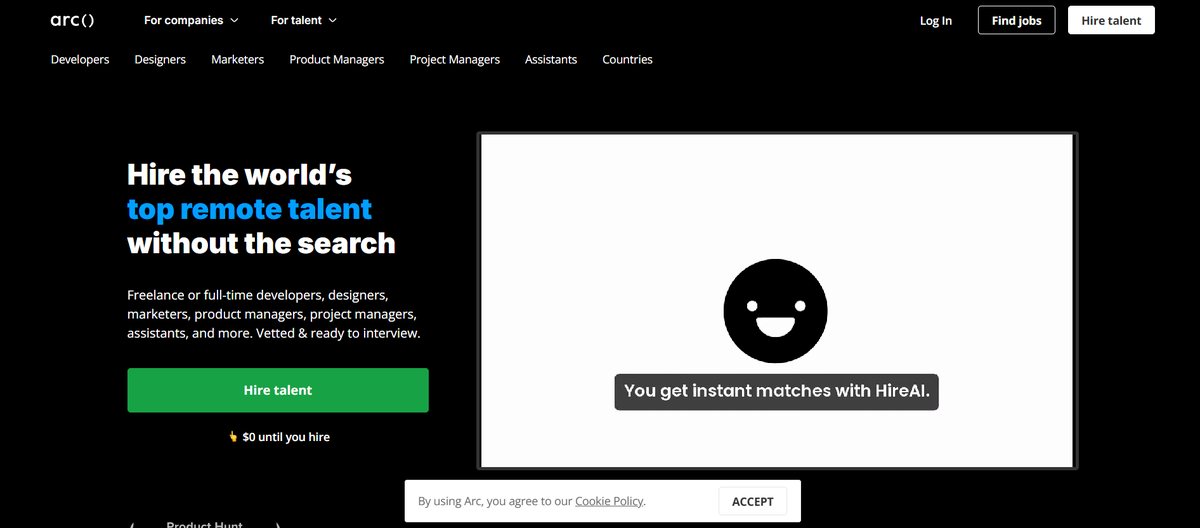
Best for: Remote-first businesses looking for technical candidates through an assisted recruitment process.
Arc provides services for recruiting remote software engineers, including developers with artificial intelligence and machine learning experience.
Its platform combines candidate sourcing, technical screening, communication assessments, and recruitment support.
Companies can use Arc for freelance or permanent recruitment, depending on the engagement.
Key capabilities
- AI-assisted candidate sourcing and screening.
- Technical and communication assessments.
- Freelance developer recruitment.
- Permanent engineering recruitment.
- Dedicated recruitment assistance.
- International remote candidate discovery.
Strengths
Arc offers a more structured process than searching an unrestricted freelance marketplace independently.
Its combination of sourcing assistance and technical screening may help employers narrow a candidate pool before conducting their own interviews.
The availability of both contract and permanent arrangements also provides flexibility.
Limitations
Arc's developer network is international, not exclusively Indian.
Employers should confirm the location and availability of candidates before proceeding. They should also assess specific AI engineering capabilities beyond the platform's general software development screening.
Pricing
Arc publicly lists freelance developer rates of $15–$110+ per hour across its marketplace.
It lists a standard full-time recruitment fee of 20% of annual salary.
These are platform-level figures and should not be interpreted as India-specific AI engineering rates.
Choose Arc if: You want screened remote engineering candidates and need flexibility between freelance and permanent recruitment.
7. LinkedIn

Best for: Employers building an internal AI engineering team and managing recruitment directly.
LinkedIn provides professional networking, candidate search, job advertising, and recruitment tools.
Employers can look for AI engineers working in India using information about professional experience, technical skills, location, and employment history.
For companies with internal recruitment teams, LinkedIn can support direct candidate discovery and relationship building.
Key capabilities
- Candidate search by skills, role, and location.
- Job advertising.
- Direct candidate outreach.
- Recruitment pipeline management.
- Recruiter collaboration.
- AI-assisted features within applicable recruiting products.
Strengths
LinkedIn offers employers substantial control over sourcing and communication.
It can help identify experienced professionals who are not actively applying through freelance marketplaces.
The platform is particularly suitable for organizations planning ongoing recruitment or building long-term internal engineering capabilities.
Limitations
LinkedIn does not automatically provide a fully verified technical shortlist.
Employers remain responsible for screening, technical interviews, reference checks, compensation negotiations, and onboarding.
Its paid recruitment tools may also be unnecessary for businesses making only an occasional hire.
Pricing
LinkedIn offers free and paid hiring options.
LinkedIn Recruiter pricing depends on organizational requirements, plan selection, region, hiring volume, and contract terms.
Choose LinkedIn if: You have internal recruitment and engineering assessment capabilities and want direct control over permanent hiring.
Full-Time vs. Freelance vs. Dedicated AI Engineers
Choosing the employment or delivery model is often more important than selecting a particular hiring platform.
- Full-time employee: Most suitable for: Long-term AI product development. Cost structure: Annual compensation, benefits, recruitment costs. Main trade-off: Greater hiring and employment commitments.
- Freelance engineer: Most suitable for: Short projects and specialist assignments. Cost structure: Hourly or fixed-price contracts. Main trade-off: Availability and continuity can vary.
- Dedicated remote engineer: Most suitable for: Ongoing development capacity. Cost structure: Monthly or contracted rate. Main trade-off: Requires clear management responsibilities.
- Staff augmentation: Most suitable for: Expanding an existing engineering team. Cost structure: Contracted engineering services. Main trade-off: Internal leadership remains responsible for delivery.
- AI development agency: Most suitable for: End-to-end application development. Cost structure: Fixed-price, milestone, or retainer arrangements. Main trade-off: Less direct control over individual engineering resources.
When Should You Hire a Full-Time AI Engineer?
Permanent hiring is appropriate when AI capabilities are central to the company's products or ongoing operations.
For example, a SaaS business developing AI-powered features may benefit from engineers who continually improve the application, understand its architecture, and maintain production services.
Full-time engineers can accumulate product knowledge and take responsibility for long-term improvements.
However, recruiting and retaining permanent employees requires compensation planning, management capacity, and an ongoing workload that justifies the position.
When Does Freelance AI Development Make Sense?
Freelancers are suitable for assignments with defined objectives, deliverables, and timelines.
A business might hire a freelancer to build a document classification prototype, integrate an LLM API, or evaluate an existing machine learning pipeline.
The contract should define the expected output, documentation, ownership, test requirements, and completion criteria.
Freelance arrangements become less attractive when the system requires continuous maintenance but no clear ongoing support arrangement exists.
When Should You Hire Dedicated AI Developers in India?
Dedicated engineering arrangements are useful when a company needs several months of development support without immediately establishing its own local employment operations.
The engineer may work within the customer's existing codebase, engineering processes, and delivery schedule.
Before signing, confirm whether the assigned professional works exclusively on the project, who supervises daily tasks, how absences are managed, and what happens if a replacement is needed.
When Is an AI Development Agency Better?
An agency may be more appropriate when the business needs delivery of a complete system rather than additional engineering capacity.
For example, implementing predictive maintenance for industrial equipment could involve data collection, data engineering, machine learning, application integration, cloud infrastructure, and operational monitoring.
These responsibilities may exceed the capabilities or available time of one engineer.
When evaluating agencies, compare their proposed architecture, project management, security practices, testing methodology, acceptance criteria, and maintenance arrangements.
How to Hire AI Engineers in India: Step-by-Step
A structured recruitment process helps employers select candidates based on their ability to deliver relevant work rather than familiarity with fashionable technologies.
Step 1: Define the Business Problem
Begin with the result the organization needs.
Examples include:
- A customer support assistant that references approved documentation.
- A RAG application for internal knowledge retrieval.
- A demand forecasting system.
- An automated document classification service.
- An AI-powered voice application connected to business software.
Document the intended users, available data, expected outputs, security constraints, and deployment environment.
Also identify how the business will determine whether the system is successful.
For example, an internal knowledge assistant should be evaluated not only for whether it generates an answer, but whether it retrieves appropriate information, respects access permissions, and avoids unsupported statements.
Step 2: Write a Role-Specific Job Description
The job description should explain the actual engineering responsibilities.
For a generative AI engineer, relevant requirements might include Python, API development, retrieval systems, structured outputs, cloud deployment, testing, and monitoring.
For a machine learning engineer, model evaluation, data pipelines, experimentation, and deployment experience may be more important.
Specify the expected seniority, work arrangement, location requirements, compensation budget, and collaboration expectations.
Avoid requiring expertise in every available AI framework. Excessive requirements can make hiring more difficult without improving candidate quality.
Step 3: Select the Appropriate Hiring Channel
Choose a sourcing service based on the type of engagement.
For example, a company with an internal recruitment team may use LinkedIn. A business needing structured India-based recruitment support could evaluate TechCospace or Flexiple.
Upwork may be suitable for a defined freelance project, while Arc or Toptal may be worth considering when screened remote professionals are preferred.
For broader enterprise AI deployment, evaluate providers such as Turing separately from individual staffing services.
Ask vendors for comparable proposals that explain candidate experience, fees, location, availability, and contractual obligations.
Step 4: Assess Practical Technical Ability
A realistic technical assessment is often more useful than a long list of theoretical questions.
For an LLM application role, consider asking candidates to design a small document assistant using an approved sample dataset.
The exercise should evaluate whether the engineer can:
- Explain the proposed architecture.
- Retrieve information from the correct sources.
- Recognize unsupported or conflicting information.
- Evaluate answer quality.
- Handle sensitive information appropriately.
- Manage latency and API usage.
- Document implementation decisions.
For senior candidates, architecture discussions and reviews of prior production work may be more informative than generic programming tests.
Where a practical exercise involves significant productive work, consider making it a paid assessment.
Step 5: Evaluate Communication and Ownership
Remote AI engineering requires clear communication, especially when product managers and engineering teams operate across different time zones.
Ask candidates to describe a project they delivered, a technical decision they reconsidered, and a production issue they investigated.
Look for specific explanations of what the candidate personally contributed.
Also confirm working-hour overlap, documentation expectations, code review practices, and how blockers will be communicated.
Step 6: Begin With Measurable Milestones
For contractors and development partners, divide the project into deliverables that can be evaluated objectively.
A possible sequence is:
- Architecture review and requirements confirmation.
- Prototype development using representative test data.
- Quality and security evaluation.
- Production integration.
- Monitoring, documentation, and handover.
Each milestone should define what will be delivered, how acceptance will be determined, and who is responsible for approval.
This reduces ambiguity and helps identify technical problems before they become expensive.
Technical Interview Questions for AI Engineers
Interviews should assess engineering judgment, problem-solving ability, and experience with real implementation constraints.
- When would you use RAG instead of fine-tuning?: What a strong answer should demonstrate: Understanding of retrieval, changing knowledge, and model adaptation.
- How would you reduce unsupported LLM answers?: What a strong answer should demonstrate: Grounding, evaluation datasets, validation, and uncertainty handling.
- How would you evaluate a forecasting model?: What a strong answer should demonstrate: Appropriate metrics, representative data, and error analysis.
- How would you monitor a deployed AI system?: What a strong answer should demonstrate: Observability, performance measurement, alerts, and rollback planning.
- How do you manage LLM API expenses?: What a strong answer should demonstrate: Usage monitoring, token efficiency, caching, and model selection.
- How would you reduce prompt injection risks?: What a strong answer should demonstrate: Trust boundaries, restricted permissions, input handling, and adversarial testing.
- How would you investigate a production model failure?: What a strong answer should demonstrate: Structured diagnosis, incident ownership, and communication.
- How would you explain an architecture trade-off?: What a strong answer should demonstrate: Ability to balance quality, complexity, latency, security, and cost.
Example: Evaluating a RAG Engineer
Suppose the business needs an internal assistant that searches company documents.
Give the candidate a representative document collection and a set of test questions, including questions that cannot be answered from the supplied material.
Ask the candidate to explain how the system will:
- Retrieve the appropriate passages.
- Respect document access permissions.
- Connect generated answers to their supporting sources.
- Recognize when the available information is insufficient.
- Measure retrieval and response quality.
- Record failures without exposing sensitive information.
A candidate who can identify where the proposed system may fail demonstrates useful engineering judgment.
For senior roles, evaluate architecture decisions, production ownership, and incident response experience in addition to implementation ability.
Best Indian Cities to Search for AI Engineers
India has established technology employment markets across several major cities.
The following locations provide practical starting points for recruitment, although they are not a ranking of engineer quality.
- Bengaluru: Relevant hiring ecosystem: Software product companies, SaaS businesses, AI development, and research.
- Hyderabad: Relevant hiring ecosystem: Enterprise software, cloud engineering, and global capability centers.
- Pune: Relevant hiring ecosystem: Software development, analytics, and engineering services.
- Delhi NCR: Relevant hiring ecosystem: Startups, IT services, consulting, and technology recruitment.
- Chennai: Relevant hiring ecosystem: Enterprise software, industrial technology, and engineering services.
- Mumbai: Relevant hiring ecosystem: Financial technology, analytics, and enterprise applications.
The most suitable location depends on the required skills, hiring budget, workplace arrangement, and candidate availability.
Remote recruitment can expand access beyond these technology centers.
However, employers should not assume that developers outside major metropolitan areas necessarily charge lower rates or have less advanced technical expertise.
When location is not essential, hiring based on demonstrated skills and working-hour compatibility may be more productive than restricting the search to one city.
Hidden Costs of Hiring or Outsourcing AI Development
An inexpensive engineering quote can become costly when important responsibilities are excluded.
Employers should evaluate the full cost of delivering and maintaining the finished AI solution.
Recruitment and Replacement Fees
Recruitment agencies and hiring platforms use different fee structures.
Depending on the provider, charges may include placement fees, platform fees, service subscriptions, or ongoing workforce-management costs.
Ask when payment becomes due and whether the contract provides replacement assistance if the candidate leaves shortly after joining.
Cloud Infrastructure and Model Usage
AI applications may require cloud hosting, model inference, vector databases, storage, monitoring, GPUs, and external software services.
These costs can increase as the application moves from prototype to production.
Ask engineers to explain expected resource usage, monitoring requirements, and cost-control measures.
For usage-based AI services, establish appropriate budgets and alerts before deployment.
Engineering Supervision and Maintenance
AI developers need product direction, code reviews, deployment approvals, and incident-management processes.
A company without technical leadership may need additional engineering oversight.
The maintenance budget should also account for dependency updates, model changes, security fixes, evaluation, and documentation.
Security, Data Privacy, and Intellectual Property
Before sharing proprietary data or production access, review the proposed security and contractual arrangements.
Important considerations include:
- Confidentiality and nondisclosure obligations.
- Intellectual property assignment and source-code ownership.
- Data access and processing restrictions.
- Secure handling of credentials and API keys.
- Open-source and third-party licensing obligations.
- Production deployment approval.
- Incident reporting responsibilities.
- Contract termination and knowledge transfer.
- Applicable employment, tax, privacy, and contractor classification requirements.
The NIST AI Risk Management Framework provides a voluntary approach to identifying and managing risks associated with AI systems.
For applications using large language models, the OWASP Top 10 for LLM and Generative AI Applications provides useful security considerations, including prompt injection, sensitive information disclosure, and excessive system permissions.
International employers should obtain appropriate legal and tax advice for the relevant jurisdictions rather than assuming that a standard freelance agreement is sufficient.
How to Choose the Right AI Hiring Platform
The final decision should depend on the engineering responsibilities, hiring model, and the amount of management your business can provide.
For permanent recruitment: Compare TechCospace, Flexiple, and LinkedIn based on sourcing support, technical screening, recruitment fees, and employer involvement.
For dedicated India-based engineering capacity: Flexiple may be relevant, particularly when contractor administration or workforce support is required. Other staffing providers should be evaluated against the same requirements.
For specialized freelance assignments: Compare Toptal, Upwork, and Arc based on candidate experience, cost, contract flexibility, and technical fit.
For enterprise AI implementation: Consider providers such as Turing and specialist AI development agencies. Confirm whether the agreement covers delivery of a functioning system or simply provides engineering resources.
A Practical Vendor Evaluation Scorecard
Employers can score providers using a consistent assessment framework.
- Relevant technical expertise: Suggested weight: 30%.
- Demonstrated production experience: Suggested weight: 25%.
- Communication and collaboration: Suggested weight: 15%.
- Cost and contract transparency: Suggested weight: 15%.
- Security and documentation: Suggested weight: 10%.
- Availability and working-hour compatibility: Suggested weight: 5%.
- Total: Suggested weight: 100%.
These weights are an illustrative decision-making framework, not an industry-standard assessment model.
For example, a financial services company handling sensitive customer information may choose to place greater emphasis on security and operational controls.
A startup developing a short-lived internal prototype may prioritize project fit, availability, and cost.
Use the same scoring criteria for every shortlisted candidate or provider, and record evidence supporting each rating.
Questions to Ask Before Signing
Before committing to a recruitment service or development partner, confirm:
- Who is responsible for technical evaluation and final candidate approval?
- What experience does the engineer have with similar production systems?
- What fees, minimum commitments, and additional charges apply?
- Who owns the code, documentation, and other deliverables?
- How are confidential data and production credentials protected?
- What happens if the engineer becomes unavailable or the project is delayed?
- Who handles maintenance, incident response, and handover?
Answers to these questions are often more useful than promotional claims about hiring speed or network size.
Frequently Asked Questions
How Much Does It Cost to Hire an AI Engineer in India?
The cost depends on experience, specialization, employer type, and hiring arrangement.
November 2026 salary reporting cited in this guide shows typical average-salary bands of ₹10.4–₹11.5 lakh annually for AI engineers with 1–3 years of experience and ₹15.3–₹16.9 lakh for those with 3–6 years.
These figures are not guaranteed offer ranges. Senior technical specialists may require significantly different compensation.
Freelance rates and agency charges should be evaluated separately.
Where Can I Hire AI Engineers in India?
TechCospace, Flexiple, Turing, Toptal, Upwork, Arc, and LinkedIn are options worth evaluating, although they provide different types of services.
TechCospace and Flexiple offer recruitment-related services with an India focus. LinkedIn supports direct sourcing. Upwork, Toptal, and Arc support freelance or remote technical recruitment.
Turing's current emphasis is broader enterprise AI delivery and specialist engineering services.
Confirm India-based candidate availability and the precise engagement model before selecting a provider.
What Skills Should I Look for When Hiring an AI Engineer?
Important skills commonly include Python, APIs, data engineering, testing, cloud deployment, and relevant machine learning concepts.
For generative AI projects, additional competencies include LLM integration, RAG architecture, evaluation, security, and inference cost management.
The required skills should reflect the actual role. A specialist in model training may not be the best choice for an application integration project, and vice versa.
How Much Do Freelance AI Engineers in India Charge?
A November 13, 2026 Upwork Insights sample reported a $25 median advertised hourly rate among 79 India-based AI engineering freelancers with at least $10,000 in public marketplace earnings.
The middle half of these profiles advertised $20–$40 per hour.
These are marketplace asking rates rather than universal hiring prices. Actual costs depend on the professional, project, negotiations, and applicable platform fees.
Should I Hire a Dedicated AI Engineer or an Agency?
Hire a dedicated engineer when your business already has technical leadership and needs additional development capacity.
Consider an AI development agency when the project requires multiple disciplines and you want a provider to take responsibility for planning, implementation, testing, and deployment.
In either case, define delivery ownership, documentation requirements, and ongoing maintenance responsibilities.
How Long Does It Take to Hire an AI Engineer in India?
Hiring time depends on sourcing, technical interviews, candidate availability, notice periods, and onboarding requirements.
A provider may produce a shortlist quickly, but that does not mean the selected candidate can begin working immediately.
Permanent recruitment can involve longer joining periods than contracting an available freelancer.
Ask for a realistic joining date and confirm it before committing to project milestones.
Can AI Engineers in India Work With US and European Companies?
Yes. India-based professionals can work remotely with international companies under appropriate employment or contracting arrangements.
Employers should clarify payment terms, working hours, intellectual property ownership, confidentiality, data processing, and applicable legal requirements.
Cross-border arrangements may require additional attention to taxation, privacy, and employment classification.
Final Verdict
Hiring AI engineers in India can provide access to professionals working in machine learning, generative AI, automation, data engineering, and AI infrastructure.
However, the right hiring decision depends on technical capability and delivery requirements rather than salary alone.
TechCospace is an option for structured technical recruitment with AI-assisted screening. Flexiple is relevant for dedicated India-based engineers and workforce support. Turing focuses on enterprise AI implementation and specialized engineering services.
Toptal provides screened freelance professionals, Upwork offers flexible marketplace hiring, Arc combines technical vetting with remote recruitment, and LinkedIn supports direct candidate sourcing.
Before selecting a service, answer three questions:
- What must the engineer deliver? Establish clear technical responsibilities and measurable outcomes.
- Who will manage the work? Determine whether your business needs an employee, contractor, dedicated engineer, or managed development provider.
- What is the total cost of delivery? Include recruitment, engineering, infrastructure, security, supervision, and maintenance.
The most reliable hiring process is one that validates technical expertise, uses transparent commercial terms, protects company information, and establishes clear delivery responsibilities from the beginning.