Grok vs ChatGPT in 2026: What Actually Differs
In 2026, Grok differs from ChatGPT on retrieval: Grok can search X as a first-party tool, and ChatGPT cannot. ChatGPT remains the broader workplace assistant; there is no universal best, only whether your work lives on X or at the daily desk.
Nikita Dwivedi
Grok and ChatGPT can both search the web, write and debug code, analyze files, generate images, and handle everyday AI work. The practical difference in 2026 is where they retrieve information, how their surrounding tools work, and which workflows they fit best. Grok stands out for first-party X Search and its growing coding and agent ecosystem. ChatGPT is generally the broader choice for research, productivity, coding, business work, and ongoing knowledge workflows.
There is no useful universal winner. Someone following a breaking conversation on X may get more value from Grok, while someone researching across the web, working with files, building a project, or using AI throughout the workday may prefer ChatGPT. The comparison is less about which chatbot produces the cleverest isolated response and more about which system gives you the right information and tools for the job.
Key takeaways
- Grok's clearest differentiator is first-party X Search. Grok can combine ordinary web retrieval with a dedicated search tool for X, which matters when information, reactions, or conversations are developing on the platform itself. ChatGPT offers web search, but OpenAI does not document a comparable first-party X Search tool.
- ChatGPT has a broader general-purpose work environment. Its product extends beyond chat into web research, file analysis, Projects, custom GPTs, memory, Deep Research, Codex, apps, and business workspace capabilities. For users who want one AI environment for multiple kinds of work, that breadth remains an important advantage.
- Both companies now compete well beyond basic chat. xAI has Grok Build, Grok Bot, Imagine, voice, office integrations, API models, and a particularly close relationship with Cursor. OpenAI has Codex, advanced research tools, image generation, voice, business workspaces, and its GPT-5.6 model family.
- Model benchmarks do not settle the comparison. xAI says Grok 4.6 matches GPT-5.6 Sol on the Artificial Analysis Intelligence Index, but one benchmark cannot establish that either assistant is universally better. Real-world usefulness also depends on retrieval, reliability, tools, latency, and cost.
- Price matters, but workflow fit matters more. ChatGPT Plus remains $20 per month, while Grok's published individual pricing includes SuperGrok at $30 per month and SuperGrok Plus at $100 per month. Higher-priced plans mainly make sense when their additional limits or features solve work you actually have.
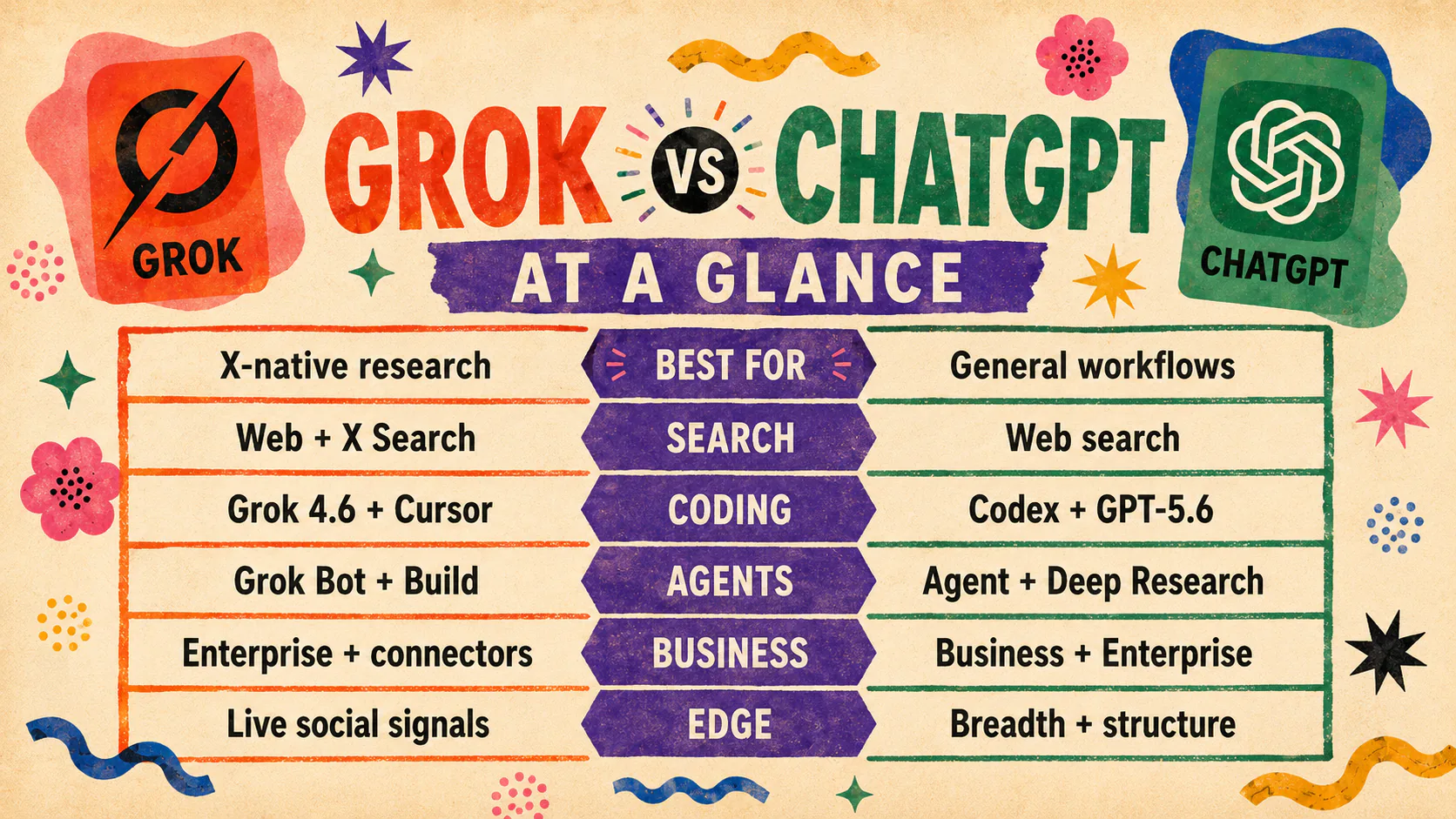
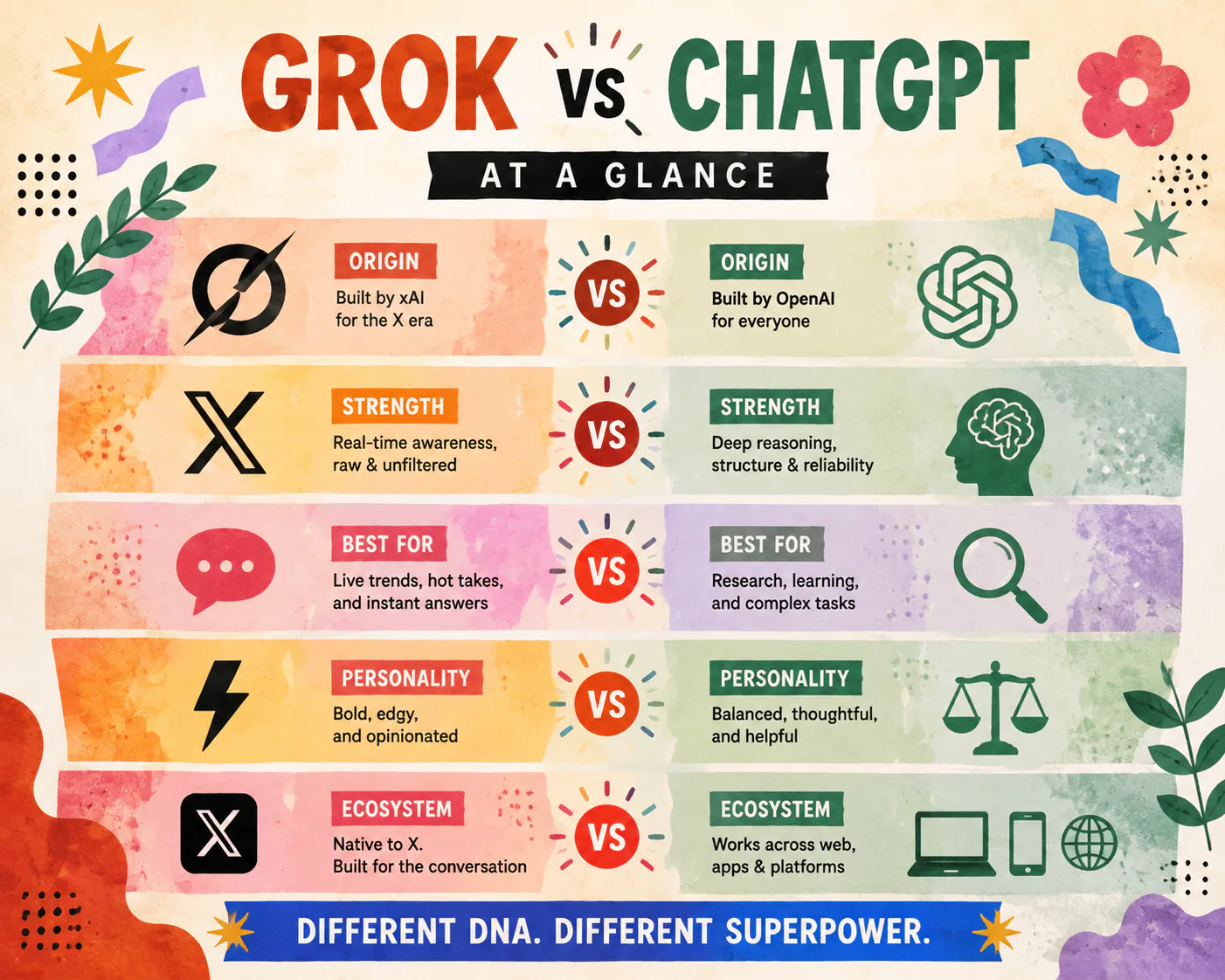
Grok vs ChatGPT at a glance
What are Grok and ChatGPT?
ChatGPT is OpenAI's general-purpose AI assistant, while Grok is xAI's assistant and model ecosystem with a particularly strong connection to X and developer tooling. Both have expanded far beyond the original idea of typing a question into a chatbot.
ChatGPT combines conversational AI with web search, file analysis, image generation, voice, Projects, memory, custom GPTs, Deep Research, apps, Codex, and workplace capabilities. OpenAI's current GPT-5.6 family includes Sol as its flagship model, Terra as a balanced option for everyday professional workloads, and Luna as the lower-cost model for faster or higher-volume tasks.
Grok is the AI assistant and model family originally developed by xAI. It is available through Grok's web and mobile products and X, while Grok models also appear across developer and partner environments. The current flagship, Grok 4.6, was released in August 2026 with an emphasis on coding, knowledge work, long-running agents, and interactive tasks.
One source of confusion is that the word Grok now refers to several related but distinct experiences. Grok is the main assistant and model ecosystem. Grok Bot is a separate product built around persistent AI teammates that can use their own computer and continue working across applications. Grok inside Cursor refers to Grok models being used within Cursor's development environment rather than a separate chatbot family.
That distinction matters when somebody says that "Grok can do X." The answer may depend on whether they mean the consumer chatbot, Grok Build, Grok Bot, an API model, or Grok running inside another developer product.
What is the biggest difference between Grok and ChatGPT?
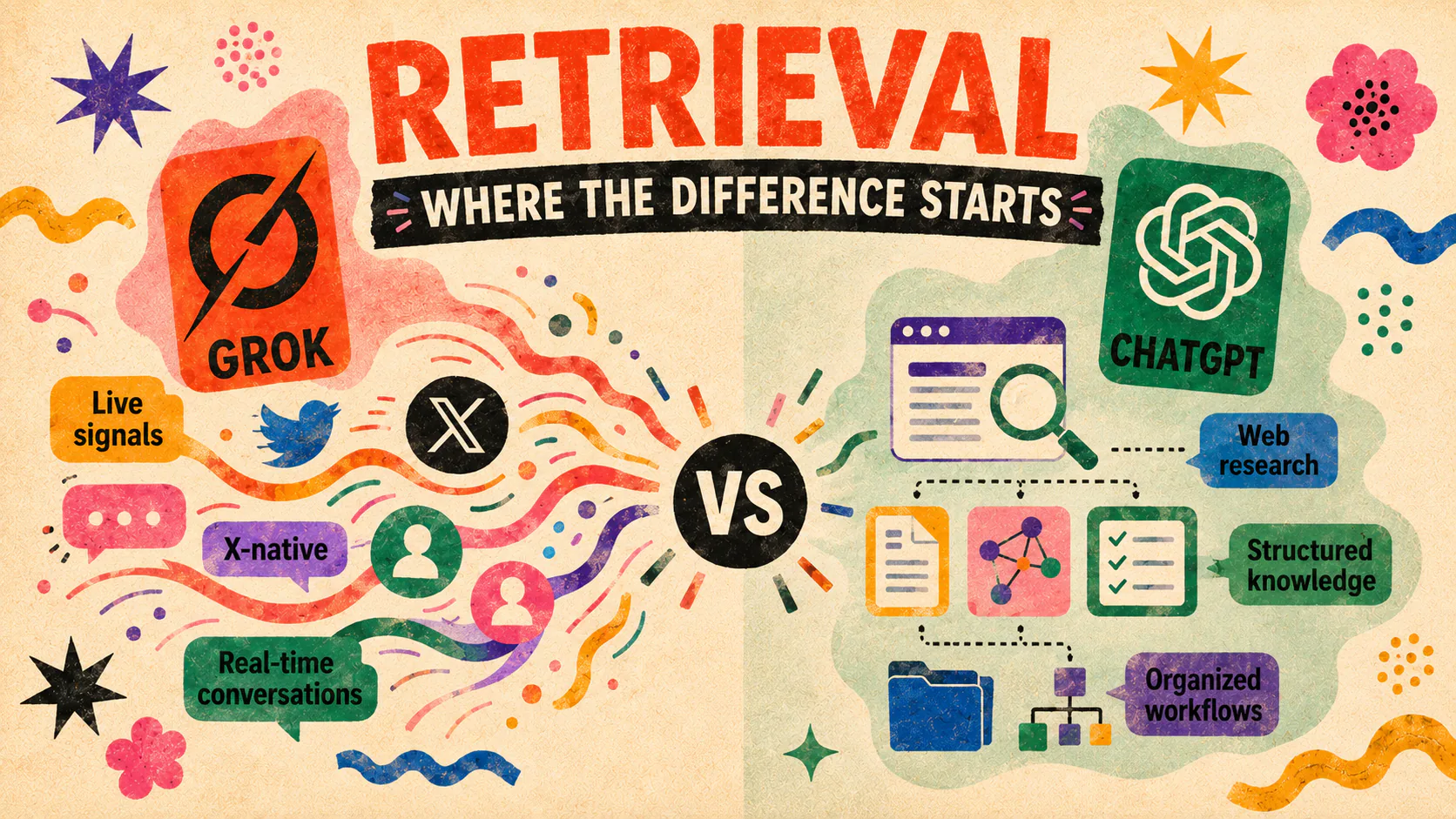
The clearest product difference is retrieval: Grok has a dedicated first-party X Search capability in addition to web search, while ChatGPT's documented search product is centered on the broader web.
Grok's product and developer materials explicitly describe real-time web and X search, giving it a direct route into conversations occurring on X rather than relying only on ordinary web indexing.
This can matter when you are researching:
- Breaking conversations on X. If an event is unfolding through posts and replies before it has been widely reported elsewhere, Grok can search that environment directly.
- Statements from X-first sources. Some public figures, creators, founders, journalists, and organizations publish important updates on X before other channels.
- Fast-moving public sentiment. Social and communications teams may want to understand how people are reacting to an event, announcement, product launch, or controversy.
- Conversation chains. Sometimes the sequence of posts and replies is itself part of what needs to be understood.
ChatGPT Search, by contrast, is documented by OpenAI as web search. It can retrieve timely information, cite web sources, and use external search partners, but OpenAI does not document a dedicated first-party X Search capability comparable to Grok's.
That does not mean Grok is automatically better for current information. If you are looking for a regulatory filing, court decision, research paper, company documentation, government page, or detailed article, the wider web may matter more than direct access to social conversations.
The useful distinction is therefore not "Grok is real time and ChatGPT is not." Both can retrieve current information. The difference is that Grok has a privileged retrieval route into X itself.
Grok vs ChatGPT models: Is Grok 4.6 better than GPT-5.6?
There is not enough independent evidence to call Grok 4.6 or GPT-5.6 the universal winner. Both are frontier model families designed for demanding coding, reasoning, and knowledge-work tasks, and benchmark results should be treated as evidence about specific tests rather than a final ranking.
Grok 4.6 launched on August 12, 2026. xAI positions it for long-running agents, coding, knowledge work, and ambitious interactive tasks.
On the xAI API, Grok 4.6 supports a 500,000-token context window, though context limits differ on partner surfaces. Cursor, for example, documents a 256,000-token context window for its Grok 4.6 implementation, a reminder that model specifications should always be read in the context of the product surface where the model is being used.
GPT-5.6 launched more broadly in July 2026. The family contains three durable tiers:
- GPT-5.6 Sol is OpenAI's flagship option for complex professional work and advanced reasoning.
- GPT-5.6 Terra balances capability and cost for everyday workloads.
- GPT-5.6 Luna is designed for lower-cost, high-volume tasks where the strongest model is unnecessary.
OpenAI currently lists all three for developer use, with tool support varying by product and implementation.
As the key takeaways note, xAI reports that Grok 4.6 matches GPT-5.6 Sol on the Artificial Analysis Intelligence Index. That single result should not become the headline conclusion, since benchmark performance depends heavily on the evaluation, configuration, and task being tested.
For users, the more practical questions are: Which model can use the tools I need? How well does it stay on task? What information can it retrieve? How much does sustained usage cost? And where does it fit into my existing work?
A leaderboard cannot answer all five.
Grok vs ChatGPT for coding and agents
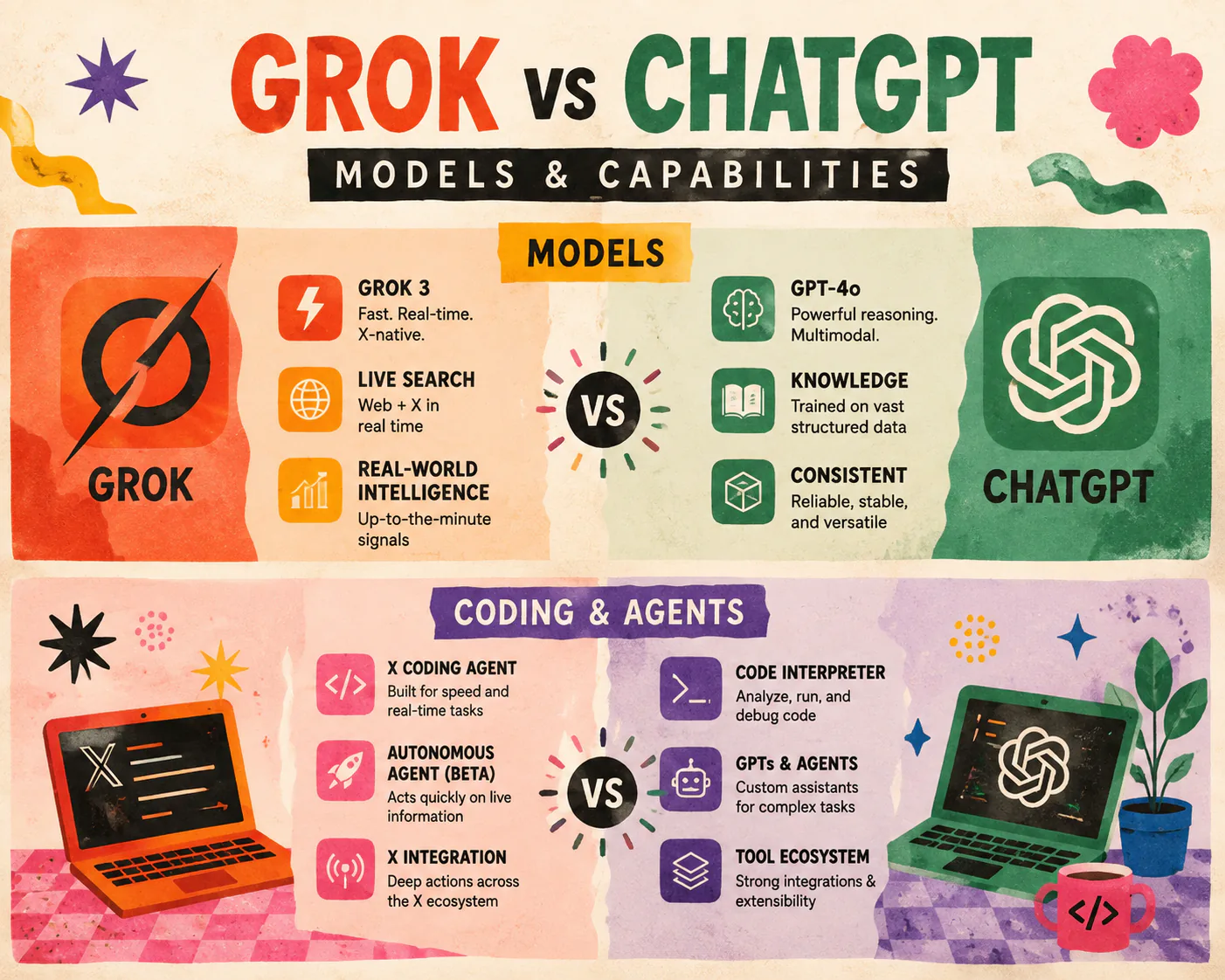
Both are serious coding systems in 2026, but their developer ecosystems take different shapes. ChatGPT is closely tied to Codex, while Grok 4.6 has become unusually intertwined with Cursor and is also available through other developer platforms.
OpenAI positions GPT-5.6 Sol as a frontier model for complex professional work, including coding, while Codex provides the agentic layer for working across codebases and longer implementation tasks.
Grok's developer story is increasingly tied to longer agent runs. Grok 4.6 is available through Grok Build, Cursor, GitHub Copilot, the xAI API, and other supported environments. Cursor describes Grok 4.6 as a first-party Cursor model developed closely with SpaceXAI for coding and knowledge work.
The corporate relationships around these products have also tightened. SpaceX announced the acquisition of xAI in February 2026, and Cursor announced in August 2026 that it had been acquired by SpaceX after an earlier model-training partnership.
For a developer, the comparison is increasingly about the harness around the model, not just raw model output.
Choose ChatGPT or Codex for an OpenAI-centered development workflow, especially when your work already involves ChatGPT, files, research, or other OpenAI tools. Consider Grok when you work heavily inside Cursor, want to test Grok 4.6 directly, or want a model connected to the broader Grok Build and Grok Bot ecosystem.
The model matters, but so do the editor, agent loop, permissions, context handling, available tools, and the point at which the AI asks you to intervene.
Grok vs ChatGPT for research and everyday work
ChatGPT is the more broadly structured general-purpose work environment, while Grok has become more competitive as xAI adds workplace tools, connectors, and autonomous agents.
A modern ChatGPT workflow can involve searching the web, analyzing uploaded documents, working inside Projects, carrying relevant context through memory, running Deep Research, generating images, using voice, building with Codex, and connecting to business information through workplace features. For someone moving between research, writing, analysis, coding, documents, and planning during the same day, that range can matter more than the performance of one individual model.
Grok's product surface is also much wider than its reputation as "the chatbot on X" suggests. xAI now offers Grok Build, connectors, office integrations, image and video generation through Imagine, voice, web and X search, and Grok Bot. Its 2026 product releases also show a deliberate push into everyday office and developer workflows.
The gap is therefore narrower than it used to be. If you are an analyst, marketer, researcher, founder, or general professional looking for one AI environment to handle many forms of work, ChatGPT remains the more natural default. If your workflow combines X, coding, autonomous agents, or the newer Grok integrations, Grok becomes substantially more compelling than a simple chatbot comparison would suggest.
Grok vs ChatGPT for images, video, voice, and memory
Both products are multimodal, but their strengths are packaged differently. Grok is pushing Imagine, video generation, and voice alongside the rest of its ecosystem, while ChatGPT integrates image creation, voice, and memory into a broader assistant workflow.
Grok's paid plans advertise image and video generation through Imagine, with higher tiers offering increased capabilities and limits, which makes Grok particularly relevant for users who want media generation alongside search, chat, and agent features.
ChatGPT includes native image generation through ChatGPT Images and voice capabilities across supported plans. Memory is also a core part of the experience, allowing ChatGPT to carry relevant information between conversations when the feature is enabled.
A creator primarily interested in experimenting with generated media may care more about image and video capabilities and usage limits. A professional using AI throughout the day may care more about whether past work, files, preferences, and project context remain connected across tasks.
Grok vs ChatGPT pricing in 2026
ChatGPT currently has the lower-priced mainstream paid entry point, while Grok's published paid consumer plans start higher. Heavy users should compare limits, included tools, and actual workflow value rather than monthly price alone.
Grok pricing
xAI also displays additional plan categories, including Lite, Heavy, Business, and Enterprise options, though public dollar pricing is not shown consistently across every tier.
ChatGPT pricing
ChatGPT Plus remains one of the clearest mainstream paid entry points at $20 per month. Go provides a cheaper step above Free, while Pro tiers are aimed at users who need substantially more capacity.
API pricing
For developers, the comparison is different. Grok 4.6 starts at $2 per million input tokens and $6 per million output tokens below the higher-context pricing threshold, and xAI's pricing increases for prompts at or above 200,000 tokens.
OpenAI currently lists GPT-5.6 Sol at $4 per million input tokens and $20 per million output tokens, Terra at $2/$12, and Luna at $0.20/$1.20. OpenAI describes the current Sol pricing as promotional through at least November 21, 2026.
Those numbers are useful for developers, but they do not prove which model is cheaper for a completed task. Token use, retries, reasoning effort, tool calls, context size, and success rate can all change the real cost.
Grok vs ChatGPT for business use
For a typical organization choosing one broadly deployed AI assistant, ChatGPT currently offers the more established general workplace proposition. Grok becomes more attractive when X intelligence, Grok's agent tools, or its developer ecosystem are strategically important.
ChatGPT Business brings features such as Projects, apps, company knowledge, ChatGPT Agent, Deep Research, Codex, and shared workspace capabilities into a managed environment. Enterprise options add further administrative and organizational controls.
Grok now has Business and Enterprise offerings, team management capabilities, connectors, office integrations, and enterprise-oriented controls. Its recent product direction also shows that xAI is targeting everyday knowledge work rather than limiting Grok to social media and developer audiences.
For buyers, the comparison should include:
- Data handling and governance. Organizations need to understand how company information is stored, processed, and controlled.
- Integrations. The best AI platform is often the one that fits the tools employees already use.
- Administrative controls. IT and security teams need predictable access, permissions, and oversight.
- Usage economics. A cheap seat can still be expensive if employees repeatedly hit limits or require another product for important tasks.
- Employee adoption. A technically stronger model has limited value if the workflow around it is difficult or employees avoid using it.
- The value of X retrieval. For some communications, media, trading, research, or social teams, direct X access may genuinely influence the purchasing decision.
A company choosing an AI platform should evaluate these operational questions before comparing benchmark charts.
What are the limitations of Grok and ChatGPT?
Neither Grok nor ChatGPT should be treated as an unquestionable authority. Search results can be incomplete, sources can be misunderstood, generated content can be wrong, and agentic tools can take incorrect actions if they are not appropriately supervised.
For research, the safest workflow is to inspect the underlying sources rather than accepting a generated summary simply because it contains citations. For coding, tests and human code review still matter. For business automation, permissions and approval steps matter. For legal, medical, financial, and other high-stakes decisions, qualified human review remains necessary.
Grok also has a public safety history that matters when evaluating the product. In July 2025, posts generated by Grok on X were removed after the system produced antisemitic content and praise for Hitler.
In January 2026, Grok's image-editing capabilities drew further scrutiny. Reuters reported that Grok said lapses in its safeguards had resulted in images depicting minors in minimal clothing. Additional restrictions were subsequently introduced around image editing and the generation of people in revealing clothing.
Those incidents do not establish that every Grok response is unsafe, just as the absence of an equivalent incident in this comparison would not establish that ChatGPT is risk-free. They matter because product philosophy, safeguards, moderation, and deployment choices are part of the comparison, particularly for organizations using AI at scale.
Is Grok better than ChatGPT?
Grok is better for some workflows, especially when direct access to X or Grok's developer ecosystem is central. ChatGPT is the stronger all-round choice for many users who want one assistant spanning research, writing, files, coding, and professional work.
Choose Grok if a meaningful part of your work happens on X, if live social conversations are a research input, or if you want the Grok 4.6, Cursor, Grok Build, and Grok Bot ecosystem.
Choose ChatGPT if you want one general-purpose environment for research, writing, coding, files, projects, business knowledge, and everyday professional work.
Neither recommendation needs to become a permanent allegiance. These products change quickly, and the best option can shift as new models, tools, integrations, and pricing arrive.
Who should use Grok?
Grok is most compelling when X-native retrieval or the surrounding ecosystem creates a real advantage for the work you do.
A journalist following an event that is developing through posts and replies may benefit from direct X Search. A social or communications team may use it to understand rapidly changing public conversations. Developers working extensively in Cursor may care more about Grok 4.6's close integration with that environment than a general chatbot comparison suggests.
Grok can also make sense for users who specifically want to explore xAI's image, video, voice, Build, or Bot products instead of purchasing a subscription only for chat.
Who should use ChatGPT?
ChatGPT suits people who want one broadly capable assistant that can move between different types of professional work without the workflow being centered on a single social platform.
That includes writers working across drafts and research, marketers analyzing documents and creating assets, developers using Codex, analysts working with files and web sources, students researching complex topics, and teams working with shared business knowledge.
ChatGPT's advantage is less about one exclusive feature and more about the range of the environment surrounding the model.
Should you use both Grok and ChatGPT?
Using both can be rational when their different retrieval sources or tools improve the quality of your work. For example, a researcher could use Grok to investigate the conversation happening on X, use ChatGPT to research the broader web and analyze longer documents, then compare the underlying sources before drawing a conclusion. Similarly, a developer may prefer one system for a particular coding environment and another for general research, planning, or document work.
A second model is not automatically a fact-checker. Two AI systems can repeat the same incorrect information. The useful part of the second opinion is having another retrieval path, another reasoning process, and another opportunity to inspect the evidence.
Frequently asked questions
What is the main difference between Grok and ChatGPT?
The clearest difference is retrieval and ecosystem. Grok combines ordinary web search with a dedicated first-party X Search capability, making it particularly useful for information and conversations developing on X. ChatGPT focuses on broader web search and a larger general-purpose productivity environment that includes research, files, coding, Projects, memory, and business tools.
Is Grok better than ChatGPT for real-time information?
Grok can be better when the information you need is developing specifically on X, because of its first-party X Search. ChatGPT can also retrieve current information from the web, so Grok's edge is not being "real time" in general terms. It is direct access to X as a distinct source.
Is ChatGPT better than Grok for research?
ChatGPT is generally the stronger all-round research environment because web search can be combined with files, Deep Research, Projects, and broader productivity workflows. Grok may have an advantage when X posts and conversations are important primary inputs to the research.
Which is better for coding, Grok or ChatGPT?
Both are credible coding options. ChatGPT users can work through Codex and GPT-5.6, while Grok 4.6 is closely integrated with Cursor and also available through Grok Build, GitHub Copilot, and developer APIs. The better option depends heavily on your development environment and the kind of agent workflow you prefer.
Is Grok free?
Yes. Grok has a $0 Free tier with usage limits. Its published individual paid pricing currently includes SuperGrok at $30 per month and SuperGrok Plus at $100 per month.
Is ChatGPT free?
Yes. ChatGPT has a Free plan. Paid consumer options include Go, Plus, and Pro tiers, while Business and Enterprise plans are designed for organizations.
Is Grok 4.6 better than GPT-5.6 Sol?
There is no reliable basis for calling either model universally better. As covered above, xAI reports that Grok 4.6 matches GPT-5.6 Sol on one composite benchmark, but that depends on the evaluation, model configuration, and task. Real-world usefulness also depends on tools, retrieval, reliability, latency, cost, and the surrounding product.
Which is better for business, Grok or ChatGPT?
ChatGPT is likely the more natural default for organizations that want a broad general-purpose workplace assistant. Grok can be the better fit for businesses whose work depends heavily on X, xAI's developer stack, or its newer agent and office integrations. Security, governance, data handling, and actual employee workflows should be evaluated before either product is rolled out broadly.
Grok vs ChatGPT: The final verdict
For most people looking for a single general-purpose AI assistant in 2026, ChatGPT is the more rounded choice. For users whose work depends on X-native information, Grok offers a differentiator ChatGPT does not currently replicate with a first-party X Search tool.
Grok is no longer simply the less-filtered chatbot attached to X. It has grown into an ecosystem spanning search, coding, agents, images, video, voice, and workplace integrations, and ChatGPT is no longer simply a conversational interface either; it has become a broader environment for research, files, coding, content creation, business knowledge, and sustained professional work.
So the decision does not need a trophy. If the story is moving on X, Grok may be the first window worth opening. If the task is broader research, analysis, creation, or everyday professional work, ChatGPT will often be the more practical starting point. And when the answer genuinely matters, the strongest workflow may still be to use more than one tool and verify the sources yourself.