Peakon Alternatives in 2026: 7 Employee Listening Platforms Compared
Compare 7 Peakon alternatives: HubEngage, Culture Amp, Qualtrics EmployeeXM, Viva Glint, Perceptyx, WorkTango, and Leapsome, with features and pricing.
SEO and GEO Specialist
The Peakon alternatives worth comparing in 2026 are HubEngage, Culture Amp, Qualtrics EmployeeXM, Microsoft Viva Glint, Perceptyx, WorkTango, and Leapsome. Each supports employee feedback and engagement measurement, but they differ in survey delivery, analytics, action planning, integrations, and pricing.
HubEngage is particularly relevant to organizations with frontline and distributed employees. Culture Amp focuses on engagement measurement and people science, while Qualtrics EmployeeXM and Perceptyx support complex enterprise listening programs. Microsoft Viva Glint fits organizations using Microsoft 365, WorkTango combines surveys with recognition, and Leapsome connects engagement with performance and development.
This guide compares all seven platforms, explains their limitations, and provides a practical framework for choosing a replacement for Workday Peakon Employee Voice.
Last updated: November 19, 2026
Markets considered: United States, United Kingdom, Canada, Australia, and global enterprises
Research basis: Public vendor documentation, official product pages, and published pricing information
What Is Continuous Employee Listening, and Why Does It Matter?
Continuous employee listening is the process of collecting, analyzing, and responding to employee feedback throughout the year rather than relying entirely on annual engagement surveys.
A continuous listening program may combine pulse surveys, employee engagement assessments, onboarding and exit questionnaires, confidential feedback channels, and sentiment analysis.
The purpose is not simply to collect more responses. It is to identify workplace problems, understand employee experiences, assign responsibility for improvements, and communicate what has changed.
According to Gallup's State of the Global Workplace 2026 report, 20% of employees worldwide were engaged in 2025. Although this figure highlights a widespread workplace challenge, introducing employee listening software does not automatically improve engagement.
The CIPD's employee voice guidance similarly emphasizes the importance of employees being able to express their views and influence decisions at work.
For HR teams, effective listening requires three connected activities:
- Collect feedback: Give employees accessible, trustworthy ways to share their experiences.
- Interpret findings: Identify recurring concerns, differences between groups, and changes over time.
- Take action: Assign improvements to responsible managers and explain the results to employees.
An organization conducting monthly surveys but never responding to the findings may achieve less than one conducting quarterly surveys with a consistent follow-up process.
It is also useful to distinguish employee experience from employee engagement. Employee experience concerns the conditions and interactions people encounter at work, while engagement concerns their connection and commitment to their work.
Which Peakon Alternative Should You Consider?
The following comparison highlights the main use case, distinguishing capability, limitation, and publicly available pricing information for each platform.
- HubEngage: Best suited for: Frontline and distributed workforces. Main strength: Multichannel surveys and employee communications. Key limitation: Broader platform may be unnecessary for survey-only needs. Pricing: Custom quote.
- Culture Amp: Best suited for: HR teams emphasizing engagement measurement. Main strength: People-science-based surveys, benchmarks, and AI Coach. Key limitation: Product selection and service tiers affect total cost. Pricing: Custom annual quote.
- Qualtrics EmployeeXM: Best suited for: Large organizations with complex employee experience programs. Main strength: Multiple listening methods and enterprise analytics. Key limitation: Advanced capabilities can require more configuration and governance. Pricing: Custom quote.
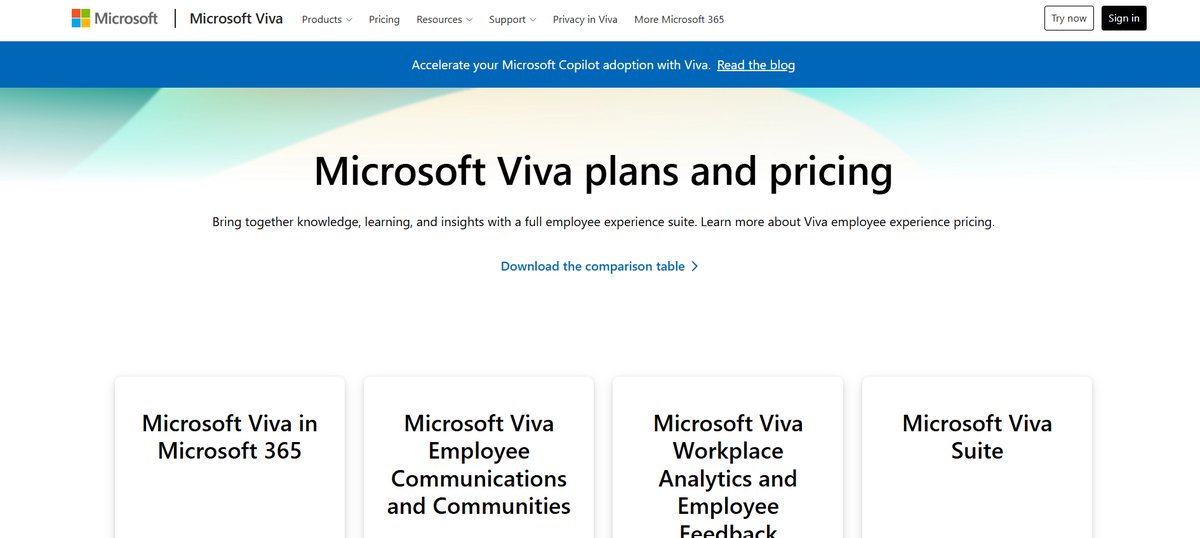
- Microsoft Viva Glint: Best suited for: Microsoft 365 organizations. Main strength: Enterprise engagement surveys and manager action planning. Key limitation: Microsoft licensing prerequisites and feature entitlements. Pricing: $2/user/month, paid yearly.
- Perceptyx: Best suited for: Advanced enterprise listening programs. Main strength: Conversational listening, analytics, and action workflows. Key limitation: Requires planning around data governance and adoption. Pricing: Custom quote.
- WorkTango: Best suited for: Organizations combining listening and recognition. Main strength: Surveys, anonymous conversations, and optional rewards. Key limitation: Bundled functionality may exceed listening requirements. Pricing: Custom quote; 12-month minimum contract.
- Leapsome: Best suited for: Growing organizations connecting engagement and talent management. Main strength: Engagement surveys alongside reviews, goals, and development. Key limitation: Modular pricing and platform requirements affect total cost. Pricing: €4/employee/month for Engagement Surveys, plus applicable platform costs.
Pricing note: The figures reflect public vendor information available on November 19, 2026. Currency, geographic region, employee count, contract terms, purchased modules, and promotions can affect final quotations. Advertised module prices should not be treated as complete implementation costs.
How We Evaluated These Peakon Alternatives
This comparison focuses on capabilities that matter when evaluating or replacing Workday Peakon Employee Voice.
Each platform was assessed using six criteria:
- Survey capabilities: Engagement surveys, pulse checks, lifecycle surveys, and feedback frequency.
- Employee accessibility: Mobile access, distribution channels, multilingual support, and suitability for frontline workers.
- Analytics and AI: Reporting, comment analysis, engagement trends, and action recommendations.
- Integrations: Compatibility with HR information systems and workplace applications.
- Privacy and action planning: Confidentiality controls, reporting access, and tools for responding to findings.
- Commercial transparency: Published pricing, required modules, and licensing considerations.
The platform descriptions are based on publicly documented capabilities. Recommendations reflect potential organizational fit, not independent performance rankings.
This is a documentation-based comparison, not a hands-on software test. No vendor-specific implementation trials, independent response-rate measurements, or unpublished customer experiences are claimed.
Peakon Alternatives: Detailed Reviews
1. HubEngage
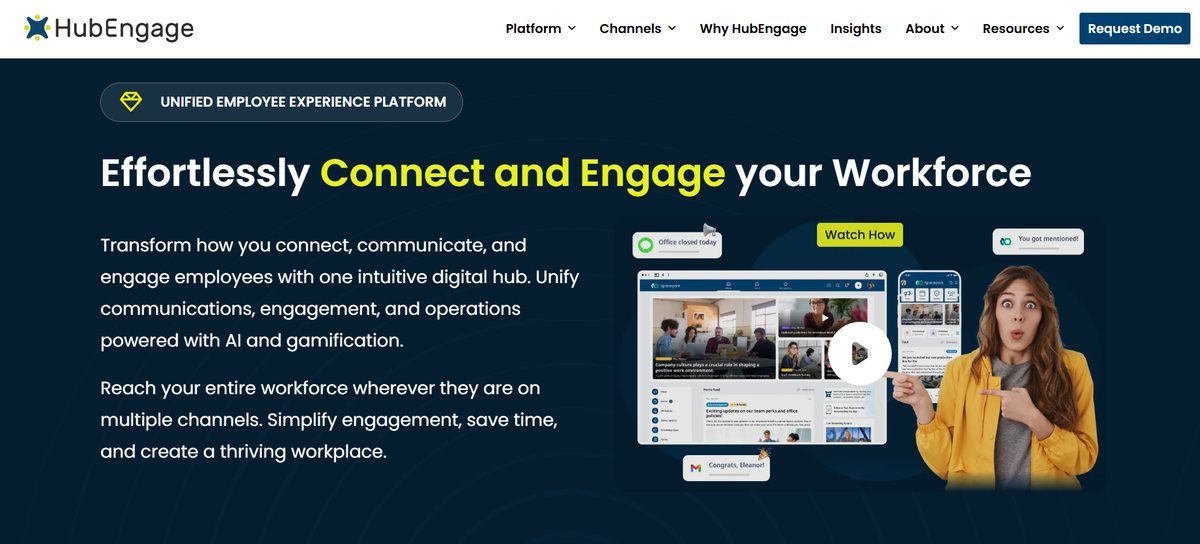
Best for: Organizations with frontline, deskless, hybrid, or geographically distributed employees that need employee feedback alongside internal communication.
HubEngage combines employee surveys with communications, recognition, and other engagement tools. Its main distinction from more survey-focused platforms is the range of channels available to reach employees.
Key features
According to HubEngage's employee survey documentation, the platform supports:
- Engagement and recurring pulse surveys
- Anonymous survey responses and eNPS measurement
- Mobile app, web, SMS, and email distribution
- QR-code access through posters and digital signage
- AI-supported sentiment and thematic analysis
- Multilingual surveys, reminders, and reporting by employee segment
- HRIS and other workplace integration options
These capabilities can be particularly useful for organizations where employees do not regularly use corporate email or desktop computers.
For example, a company employing office staff, warehouse employees, and field technicians may need different survey delivery methods. Corporate employees might respond through email, while shift workers could access a survey through a mobile device or QR code.
HubEngage's broader platform also provides communication channels that can help employers distribute survey findings and explain planned changes.
Strengths
HubEngage's primary advantage is its combination of employee accessibility and feedback collection.
Instead of expecting every employee to use the same channel, employers can distribute surveys through methods that better match working conditions.
Recurring surveys, automated reminders, segmentation, and sentiment analysis can also support ongoing listening programs.
Its communication features may be useful when the same organization wants to publish updates explaining what managers have done in response to employee feedback.
Limitations
Organizations looking exclusively for sophisticated survey research may not need HubEngage's wider communications and engagement capabilities.
Buyers should verify reporting confidentiality thresholds, available statistical analysis, HRIS integration requirements, and how survey capabilities are packaged.
Multichannel access should also be tested with actual employee groups rather than assumed from feature availability.
Pricing
HubEngage uses custom pricing. A standardized public price for a comparable survey-only deployment was not verified.
Consider HubEngage if: Reaching frontline and distributed employees is a major obstacle, and your organization wants to connect employee feedback with broader communication activities.
For related implementation guidance, see what multichannel employee communication involves.
2. Culture Amp
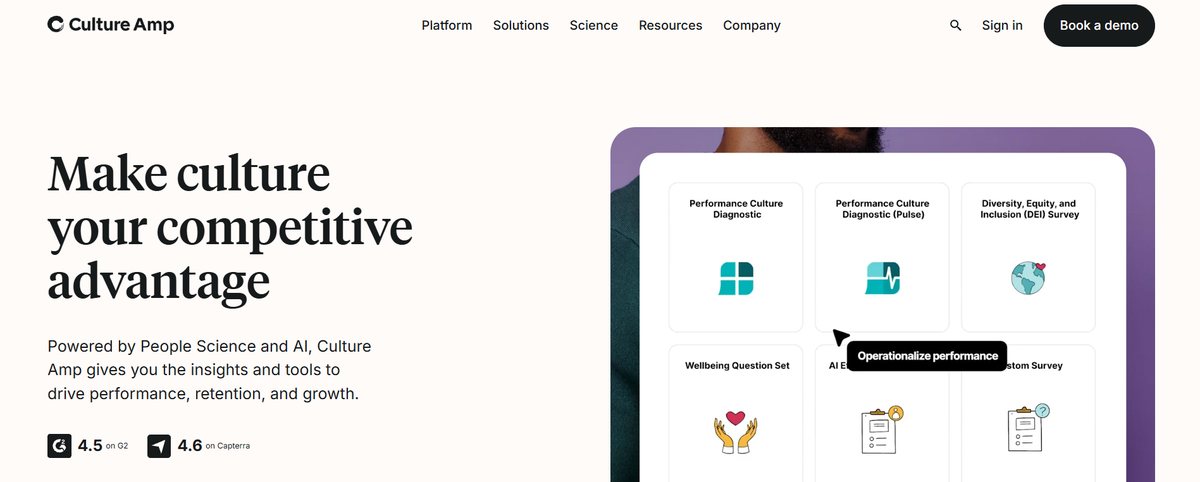
Best for: HR teams seeking established survey frameworks, engagement benchmarks, manager coaching, and repeatable improvement planning.
Culture Amp emphasizes employee engagement measurement supported by people science, analytics, and management guidance.
Its Engage offering helps organizations conduct engagement surveys, interpret patterns, and identify improvements.
Key features
Culture Amp's official pricing and product overview documents capabilities including:
- Employee engagement and pulse surveys
- Onboarding and offboarding feedback
- Engagement benchmarking
- AI-assisted comment summaries
- Retention-related insights
- Recommended action plans
- AI Coach for interpreting findings and supporting managers
- HRIS, Slack, and Microsoft Teams integration options
Culture Amp also offers performance management and development capabilities through its broader platform.
AI Coach is relevant to organizations where managers need support moving from survey results to practical action.
For example, a department manager may identify communication and career development as recurring concerns. Instead of reviewing engagement scores alone, the manager can use available guidance to identify focus areas and structure follow-up discussions.
Strengths
Culture Amp is well suited to organizations that want consistent engagement measurement across departments or survey cycles.
Its benchmarking capabilities provide additional context for interpreting scores, while action-planning tools help managers prioritize responses.
Organizations already investing in performance management or development programs may also benefit from evaluating Culture Amp's broader product ecosystem.
Limitations
Culture Amp may not suit organizations whose main requirement is reaching employees through specialized communication channels rather than running structured engagement programs.
Buyers should also confirm which capabilities are included in Engage, which belong to other products, and what level of support is included.
AI-generated recommendations still require managerial judgment and knowledge of the workplace.
Pricing
Culture Amp uses annual, quote-based pricing determined by employee count, selected products, and service tiers.
Consider Culture Amp if: Your priority is consistent engagement measurement, benchmarking, and helping managers turn feedback into action.
3. Qualtrics EmployeeXM
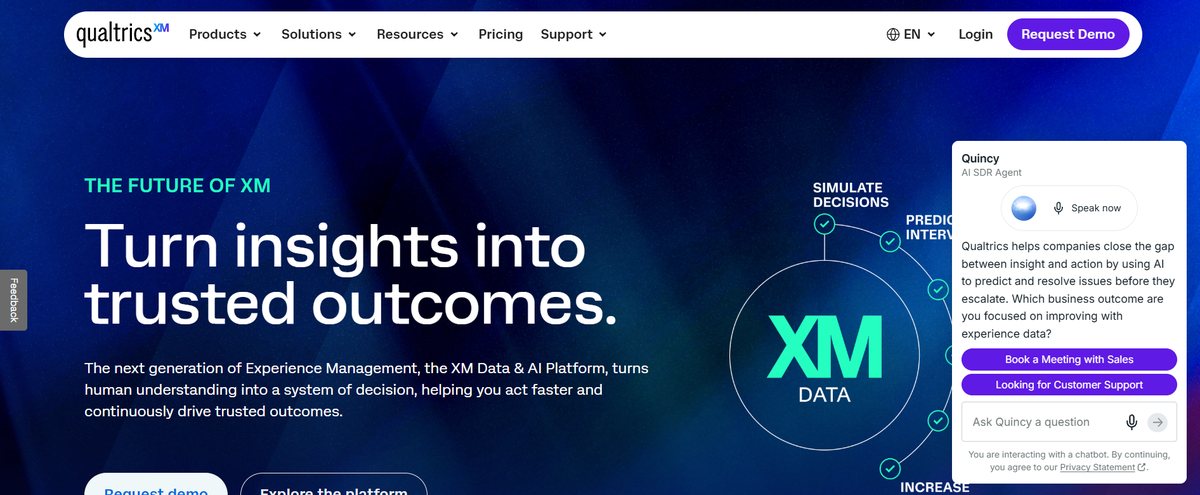
Best for: Large organizations managing multiple employee listening programs across locations, business units, and employee lifecycle stages.
Qualtrics EmployeeXM is part of the broader Qualtrics Employee Experience platform.
Its scope extends beyond periodic engagement surveys to include listening across different stages of the employee journey and additional sources of feedback.
Key features
The Qualtrics Employee Experience platform supports:
- Employee engagement surveys and pulse checks
- Onboarding and exit feedback
- Continuous employee listening
- Employee experience analytics
- AI-supported analysis of structured and unstructured feedback
- Workforce segmentation
- Employee lifecycle measurement
- Action planning and reporting
Qualtrics also provides capabilities for analyzing feedback from different interaction channels.
The company's Employee Experience product terms explain that certain continuous listening functions use interaction-based entitlements. This distinction matters when organizations are evaluating the volume and types of feedback they intend to process.
Strengths
Qualtrics offers flexibility for organizations running several employee experience programs simultaneously.
A multinational employer might want to compare onboarding experiences, employee engagement, organizational changes, and exit feedback while maintaining consistent reporting across regions.
Qualtrics can support this broader approach, particularly when organizations have dedicated employee experience or people analytics teams.
It is also relevant when listening data needs to inform wider organizational decision-making rather than individual engagement initiatives alone.
Limitations
Its breadth can increase implementation and administrative complexity.
Organizations should establish clear governance around survey design, access permissions, data interpretation, and reporting.
Buyers also need to distinguish employee-based licensing from interaction allowances, professional services, and any additional modules included in a proposal.
Pricing
Qualtrics provides custom enterprise pricing. Its published pricing information describes employee-count-based pricing for Employee Experience products.
Additional entitlements and services may affect the final agreement.
Consider Qualtrics EmployeeXM if: You need a broad enterprise employee experience platform with multiple listening approaches and substantial analytics requirements.
4. Microsoft Viva Glint
Best for: Organizations using Microsoft 365 that want employee engagement measurement connected to existing workplace technology.
Microsoft Viva Glint provides enterprise employee listening, reporting, and manager action-planning capabilities.
It is particularly relevant to organizations looking for engagement tools within the Microsoft Viva ecosystem.
Key features
According to Microsoft's Viva product and pricing documentation, Viva Glint provides:
- Organization-wide engagement surveys
- Employee lifecycle survey templates
- Interactive reporting dashboards
- Internal and external benchmarking
- Recommended actions
- Manager-guided team conversations
- Web and mobile survey access
- Survey results export and sharing
- Copilot-supported survey analysis, subject to applicable licensing and feature availability
Microsoft also offers Viva Pulse, which serves a different listening purpose.
Viva Glint focuses on organization-wide employee feedback programs, while Viva Pulse supports shorter feedback requests initiated by managers and team leaders.
Organizations evaluating Microsoft should confirm which product supports their intended survey workflow.
Strengths
Microsoft ecosystem compatibility is a major consideration for organizations already relying on Microsoft workplace applications.
Glint provides structured engagement measurement and manager-focused reporting without requiring organizations to adopt an entirely separate workplace technology ecosystem.
Its benchmarking and recommended-action features can support recurring employee listening programs.
Limitations
Viva Glint requires qualifying Microsoft licensing.
Organizations should verify prerequisite subscriptions, employee eligibility, administrator licensing, and feature availability.
They should also distinguish Glint from Viva Pulse and confirm whether their intended Copilot functionality is included.
For employers with large deskless populations or unusual survey distribution requirements, practical accessibility testing remains important.
Pricing
Microsoft's US pricing lists Viva Glint at $2 per user per month, paid yearly.
The company also lists broader Microsoft Viva packages. Final costs depend on prerequisites and selected subscriptions.
Consider Microsoft Viva Glint if: Your organization already uses Microsoft 365 and wants enterprise engagement surveys aligned with its existing workplace applications.
5. Perceptyx
Best for: Enterprises that treat employee listening as an ongoing organizational capability and need advanced analytics, conversational feedback, and structured follow-up.
Perceptyx focuses on understanding employee experiences through multiple feedback methods and connecting those findings to management actions.
Its platform supports listening across different stages of employment and provides AI-assisted tools for interpreting feedback.
Key features
Perceptyx's continuous listening platform includes:
- Engagement and point-in-time surveys
- Employee lifecycle feedback
- 360-degree feedback
- Crowdsourcing and conversational listening
- AI-supported narrative and theme analysis
- Cross-survey analytics
- Manager-oriented action workflows
- Enterprise reporting and integration capabilities
Its Conversational Listening Agent provides an alternative to relying exclusively on conventional questionnaires.
Perceptyx also documents integrations with HR systems including Workday, SAP SuccessFactors, and Oracle HCM, alongside APIs and webhooks for connecting data to analytical tools.
Strengths
Perceptyx is suitable for organizations that want to investigate patterns across several types of employee feedback.
For example, an enterprise might compare engagement results with onboarding feedback and employee lifecycle events to better understand where workplace concerns emerge.
Its conversational listening and analytics capabilities may help identify themes that fixed-response survey questions do not fully capture.
The platform's action-oriented workflows are also relevant to organizations trying to improve what happens after results are shared.
Limitations
Advanced listening programs require governance, not just advanced software.
Organizations need to define what information is collected, who can access it, how employees are protected, and who is responsible for responding to the findings.
Employers with limited HR analytics resources should evaluate implementation effort and ongoing administration carefully.
Buyers should also confirm which AI agents, integrations, and action-planning capabilities are included in their contracts.
Pricing
Perceptyx uses custom enterprise pricing. A standardized public subscription rate for a comparable deployment was not verified.
Consider Perceptyx if: Your organization needs comprehensive listening, multiple feedback methods, and analytics connected to operational improvements.
6. WorkTango
Best for: Organizations seeking employee engagement surveys alongside employee recognition and rewards.
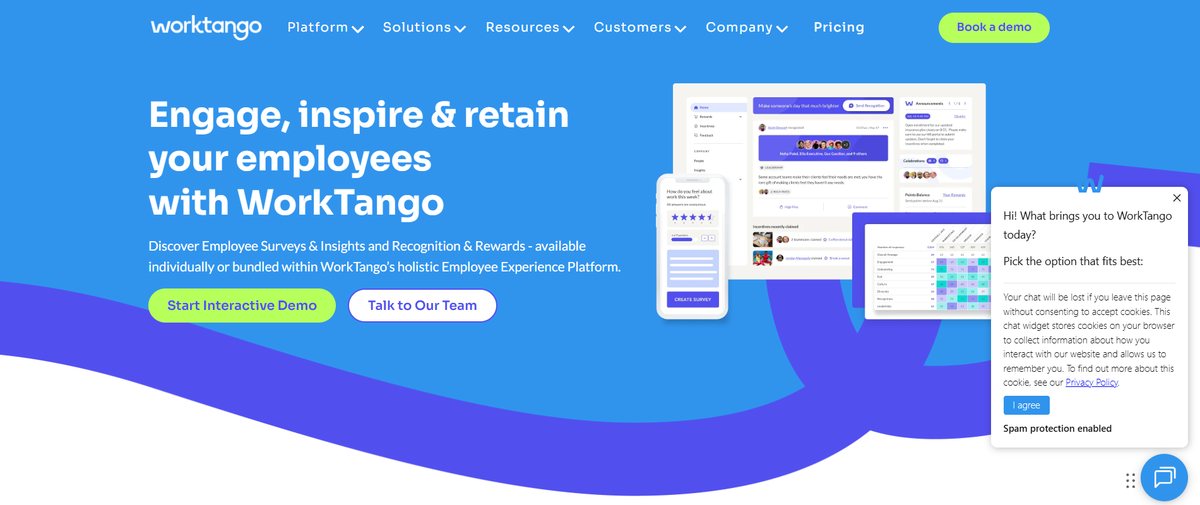
WorkTango offers Employee Surveys & Insights and Recognition & Rewards as separate products, as well as a combined employee experience platform.
This modular structure allows buyers to evaluate listening independently or alongside recognition initiatives.
Key features
According to WorkTango's official pricing page, its Surveys & Insights product includes:
- Unlimited surveys
- Employee engagement and eNPS measurement
- Configurable dashboards
- Survey templates
- Confidential feedback
- Anonymous Conversations
- AI-supported insights and recommended actions
- People analytics
- HRIS integrations
- Mobile surveys
Its separate Recognition & Rewards offering supports employee recognition, awards, incentives, and rewards administration.
Employers can evaluate the combined platform when they want feedback and recognition data within a connected employee experience program.
Strengths
WorkTango is relevant to HR teams working on both listening and recognition.
An organization might use engagement surveys to understand whether employees feel appreciated and review recognition activity alongside survey findings.
This can provide useful context for workplace initiatives, although correlations between recognition activity and engagement should not automatically be interpreted as causation.
Its ability to offer survey and recognition products separately provides buyers with some flexibility.
Limitations
Organizations needing only survey software may not benefit from purchasing recognition functionality.
Buyers should compare survey-only and bundled quotations, paying attention to reporting, integration capabilities, rewards administration, and any additional spending commitments.
Employers should also review how anonymous conversations are managed and which administrators can access responses.
Pricing
WorkTango uses quote-based pricing and publishes a minimum contract length of 12 months.
Survey and recognition products can be purchased separately.
Consider WorkTango if: Your organization wants structured engagement measurement and may also benefit from employee recognition capabilities.
For additional recognition options, see this comparison of employee recognition and rewards platforms.
7. Leapsome
Best for: Growing and midsize organizations seeking to connect employee engagement surveys with performance management, development, and HR workflows.
Leapsome provides employee engagement measurement as part of a broader people management platform.
Its modular structure allows organizations to combine surveys with performance reviews, goals, learning, and other employee management functions.
Key features
The Leapsome engagement survey platform provides:
- Science-backed survey questions
- Employee engagement and pulse surveys
- Onboarding and offboarding surveys
- Industry and regional benchmarking
- Survey analytics
- Post-survey action planning
- Employee feedback and engagement insights
Leapsome also offers performance reviews, goals and OKRs, learning, and HR functionality through additional modules.
These capabilities can help organizations maintain related people management activities within one software environment.
Strengths
Leapsome offers a practical option for organizations seeking both engagement measurement and broader talent management tools.
For example, HR teams may want to understand how employees perceive management support while also maintaining performance and development workflows.
Connecting these activities within one platform may reduce the need for separate applications and duplicate employee data administration.
Its modular offering also allows organizations to focus on capabilities relevant to their current priorities.
Limitations
Leapsome may not meet every requirement of a highly specialized enterprise listening program.
Organizations should assess its analytical depth, supported survey workflows, confidentiality controls, and integration requirements.
When engagement feedback is housed alongside identifiable performance information, access permissions and separation of sensitive data deserve careful evaluation.
Adding modules can increase the total subscription cost.
Pricing
Leapsome's published euro pricing lists Engagement Surveys at €4 per employee per month.
Leapsome also requires a platform foundation. Its November 2026 pricing page advertises a time-limited foundation offer that may reduce the initial cost for qualifying purchases.
The complete price depends on the foundation, additional modules, promotion eligibility, and contract terms.
Consider Leapsome if: You want employee engagement surveys alongside performance management and development within a connected people management platform.
How to Choose the Right Peakon Alternative
The right Peakon replacement should preserve the listening capabilities your organization needs while addressing shortcomings in its current process.
A platform with more AI features or survey templates is not necessarily a better choice.
The following criteria are more useful when building a shortlist.
1. Match Survey Access to Your Workforce
Start by identifying how employees actually access workplace information.
For frontline workers, examine mobile access, supported languages, SMS delivery, QR codes, and whether employees need corporate email accounts.
For office-based employees, Microsoft workplace integrations, reporting capabilities, and structured survey programs may matter more.
Consider an organization with 5,000 employees distributed between offices, factories, and field locations.
If office employees receive surveys reliably but shift workers rarely participate, the main problem may be accessibility rather than survey analytics.
In that case, multichannel distribution should be a primary evaluation criterion.
HubEngage deserves consideration for this use case. Culture Amp and Microsoft Viva Glint are relevant when structured engagement measurement is the primary requirement, while Qualtrics and Perceptyx warrant evaluation for complex enterprise programs.
These are starting points, not automatic exclusions. Each vendor should be assessed against the same requirements.
2. Evaluate Confidentiality and Employee Trust
Employee listening platforms often process sensitive workplace opinions.
Organizations should examine:
- Whether surveys are anonymous, confidential, or identifiable
- Minimum response thresholds for reporting
- Permissions for accessing comments and demographic breakdowns
- Risks of identifying employees in small teams
- Employee data retention and deletion controls
- Data export and access logging
- Regional data protection requirements
Anonymous and confidential surveys are not necessarily equivalent.
An anonymous survey may be designed not to associate responses with identifiable participants. A confidential survey may retain identifying information while restricting who can view it.
Both approaches require clear employee communication about how the information will be used.
During demonstrations, ask vendors to show what happens when a manager filters survey results to a very small department.
The platform should have appropriate safeguards against exposing individual responses.
3. Assess AI Analysis Without Assuming It Is Always Accurate
AI-supported employee listening tools can summarize comments, identify recurring subjects, classify sentiment, and suggest areas requiring attention.
These functions may save time when organizations receive substantial volumes of open-ended feedback.
However, AI analysis has limitations.
Short responses may lack sufficient context. Sarcasm, ambiguous language, cultural differences, and mixed sentiments can also complicate classification.
Before buying, ask vendors to demonstrate:
- How themes are identified and grouped
- Whether managers can review underlying feedback safely
- How the system handles multilingual responses
- Whether AI-generated summaries can be corrected or challenged
- What safeguards exist against unsupported conclusions
- Whether recommendations require human approval
Do not treat an AI-generated retention-risk signal as proof that a particular employee intends to resign.
Use aggregate insights to guide further investigation and responsible management action.
4. Calculate the Full Cost of Ownership
Public subscription prices rarely capture every cost involved in replacing an employee listening platform.
A realistic budget should consider licensing, implementation, HRIS integration, data migration, training, support, and optional modules.
A simple comparison formula is:
Annual total cost = Subscription fees + Implementation + Integrations + Migration + Support and training + Additional modules
For example, Microsoft Viva Glint's advertised subscription price should be evaluated alongside Microsoft licensing prerequisites.
Likewise, Leapsome's Engagement Surveys module price should not be compared directly with an all-inclusive enterprise quotation without accounting for foundation costs and other requirements.
Request quotations for the same number of employees, contract duration, features, and support services.
5. Compare What Happens After Feedback Is Collected
Employee listening programs need a defined process for turning feedback into action.
Evaluate whether managers can:
- Identify the most important improvement opportunities
- Assign actions and responsibilities
- Record progress
- Share findings with their teams
- Reassess issues in later survey cycles
A platform that helps managers follow through may be more valuable than one offering additional dashboards that are rarely used.
For companies with mixed workforces, a documented internal communications plan for desk and frontline staff can help ensure employees hear what changed after participating in surveys.
What to Check Before Switching From Workday Peakon
Replacing Peakon involves more than choosing another survey application.
Workday's Peakon Employee Voice platform supports ongoing employee listening, engagement analytics, benchmarking, and lifecycle feedback.
Before migrating, identify which capabilities your organization currently uses and which historical information must remain available.
Step 1: Audit Your Existing Listening Program
Document current surveys, question libraries, reporting structures, employee segments, and management workflows.
Identify which processes are working and which problems are motivating the change.
For example, replacing Peakon may not solve low participation if employees lack trust in how management handles feedback.
Step 2: Review Historical Data and Survey Comparability
Determine whether existing survey results, question-level data, comments, and organizational structures can be exported.
Ask prospective vendors what historical information they can import and how they handle incomplete records.
Do not assume survey scores will remain directly comparable after migration.
Changes in question wording, response scales, survey frequency, or employee population can alter results.
Where comparisons are no longer valid, establish a new baseline rather than presenting an artificial historical trend.
Step 3: Validate HRIS Integration
Confirm how the new platform will receive employee information, organizational reporting lines, and demographic attributes.
Evaluate supported integrations with your specific HR system.
Test employee changes such as transfers, new hires, departures, and manager changes.
A vendor advertising HRIS compatibility does not automatically guarantee that every required data field or workflow is supported.
Step 4: Run a Controlled Pilot
Request a demonstration or limited pilot using anonymized sample data and realistic survey workflows.
Evaluate how the platform handles:
- Survey distribution across employee groups
- Confidentiality thresholds
- Multilingual responses
- Reporting by department or location
- Manager action planning
- HRIS synchronization
- Employee communications
Include HR, IT, data protection, and representative managers in the evaluation.
Where appropriate, gather feedback from employees who will actually complete the surveys.
Step 5: Prepare Employees for the Change
Explain why the organization is changing platforms, how employees will access surveys, and what protections apply to their responses.
Avoid claiming complete anonymity unless the chosen survey configuration genuinely supports it.
Communicate how survey results will be reviewed, which actions may follow, and when employees can expect updates.
Organizations can also evaluate internal newsletter software when deciding how to communicate survey findings and workplace improvements.
Practical Vendor Evaluation Checklist
Before signing a contract, ask each shortlisted provider to complete the same evaluation.
- Employee access: Questions to ask: Can frontline employees participate without corporate email?
- Survey design: Questions to ask: Can we replicate our essential Peakon questions and survey cadence?
- Confidentiality: Questions to ask: What minimum reporting thresholds and comment protections are available?
- Analytics: Questions to ask: Can we compare teams, locations, and historical periods appropriately?
- AI capabilities: Questions to ask: How are insights generated, reviewed, and explained?
- HRIS integration: Questions to ask: Which specific systems, fields, and synchronization methods are supported?
- Action planning: Questions to ask: Can managers assign actions, track progress, and communicate updates?
- Migration: Questions to ask: What data can be transferred, and what cannot?
- International use: Questions to ask: Which languages, hosting options, and regional requirements are supported?
- Commercial terms: Questions to ask: What is included in the quotation, and which capabilities cost extra?
A consistent evaluation prevents vendors with the most polished demonstrations from receiving an unfair advantage.
An effective procurement process should compare the same real-world workflows across every shortlisted platform.
Frequently Asked Questions About Peakon Alternatives
What are the strongest Peakon alternatives in 2026?
HubEngage, Culture Amp, Qualtrics EmployeeXM, Microsoft Viva Glint, Perceptyx, WorkTango, and Leapsome are relevant alternatives.
HubEngage is particularly suitable for consideration when multichannel workforce access matters. Culture Amp emphasizes engagement measurement, while Qualtrics and Perceptyx address complex enterprise listening requirements.
Microsoft Viva Glint fits Microsoft-oriented organizations, WorkTango combines listening with optional recognition, and Leapsome connects engagement with broader talent management.
How does Culture Amp compare with Workday Peakon?
Culture Amp emphasizes structured engagement measurement, benchmarking, people science, and manager coaching.
Workday Peakon Employee Voice focuses on continuous employee listening, engagement drivers, benchmarks, and actionable workforce insights.
The decision should depend on survey methodology, reporting needs, integration requirements, and how managers act on results.
Is Qualtrics EmployeeXM better than Peakon?
Not necessarily.
Qualtrics may be more suitable for organizations seeking broader enterprise employee experience programs and multiple listening channels.
Peakon remains relevant for organizations satisfied with its continuous listening methodology, benchmarking, and existing Workday-related workflows.
Neither product is universally superior.
What is the difference between Microsoft Viva Glint and Peakon?
Microsoft Viva Glint provides enterprise engagement measurement and action planning within the Microsoft Viva ecosystem.
Workday Peakon is a dedicated employee listening platform with survey methodology, benchmarking, sentiment analysis, and lifecycle feedback.
Microsoft licensing requirements and existing HR technology should be important considerations when comparing them.
Which Peakon alternatives offer AI-supported feedback analysis?
HubEngage, Culture Amp, Qualtrics EmployeeXM, Microsoft Viva Glint, Perceptyx, WorkTango, and Leapsome offer AI-supported analysis, insights, or related functionality.
However, the type and depth of AI features differ.
Buyers should confirm whether they need comment summarization, thematic analysis, sentiment classification, predictive indicators, or action recommendations, and verify which are included in the proposed plan.
Which Peakon alternative suits an organization with 5,000 employees?
Qualtrics, Perceptyx, Culture Amp, and Microsoft Viva Glint are relevant options for an organization of this size.
HubEngage is also worth evaluating when a substantial portion of the workforce is frontline or geographically dispersed.
The best choice depends on reporting complexity, employee accessibility, privacy requirements, integration needs, and available internal resources rather than employee count alone.
How much do Peakon alternatives cost?
Pricing varies by platform and contract.
Microsoft advertises Viva Glint at $2 per user per month with annual billing, while Leapsome lists Engagement Surveys at €4 per employee per month, subject to platform requirements and commercial terms.
HubEngage, Culture Amp, Qualtrics, Perceptyx, and WorkTango require quotations for comparable deployments.
Can Peakon alternatives integrate with existing HR systems?
The platforms reviewed provide different HRIS integration options, including supported connectors, APIs, and data synchronization methods.
Compatibility should be validated for the specific HR system, employee hierarchy, required data fields, security settings, and purchased subscription.
Final Verdict
There is no single Peakon alternative that fits every organization.
HubEngage deserves consideration when employee accessibility and multichannel communication are priorities. Culture Amp suits organizations emphasizing structured engagement measurement and management guidance.
Qualtrics EmployeeXM and Perceptyx are relevant for complex enterprise listening requirements, while Microsoft Viva Glint is a practical candidate for organizations already invested in Microsoft 365.
WorkTango is worth evaluating when recognition and employee surveys are both priorities. Leapsome fits organizations seeking engagement measurement alongside performance and development workflows.
Before choosing, shortlist two or three platforms and compare them using the same survey scenarios, employee groups, confidentiality requirements, integration needs, and total-cost assumptions.
The most useful employee listening platform is not necessarily the one with the most features. It is the one your employees can trust and access, your managers can use effectively, and your organization can turn into meaningful workplace improvements.