Local Marketing Platform Buyer's Guide for Multi-Location Brands
Compare 7 local marketing platforms for multi-location brands: Synup, Yext, Uberall, SOCi, Birdeye, Reputation, and BrightLocal, with pricing.
Sandeep Kumar
A local marketing platform helps multi-location businesses manage business listings, Google Business Profiles, customer reviews, local SEO, location pages, social media, and location-level marketing performance through centralized software.
For US businesses managing dozens, hundreds, or thousands of locations, seven platforms worth comparing in 2026 are Synup, Yext, Uberall, SOCi, Birdeye, Reputation, and BrightLocal.
Each addresses a different combination of business requirements. Synup combines local marketing tools with agency workflows. Yext emphasizes structured business information, Uberall focuses on location visibility and engagement, and SOCi specializes in enterprise marketing automation. Birdeye and Reputation offer substantial customer feedback capabilities, while BrightLocal concentrates on local SEO operations.
The right platform depends on location count, required functionality, governance, integrations, and total cost.
This guide compares the seven vendors, explains their strengths and limitations, and provides a practical framework for evaluating software before committing to a contract.
Key Takeaways
- No single local marketing platform suits every organization. Enterprise retailers, franchise networks, healthcare organizations, and marketing agencies have different operational requirements.
- Accurate location information is foundational. Listings on Google, Apple Maps, Bing, and relevant industry directories should be reliable before investing heavily in advanced automation.
- Governance matters as much as features. Bulk updates, role-based permissions, approval workflows, integrations, and audit histories become increasingly important as location portfolios grow.
- AI capabilities require practical evaluation. Confirm whether AI only recommends changes or can execute them, what requires human approval, and how its outputs are checked.
- Publisher counts are not a complete measure of quality. The relevant question is whether a vendor supports the specific directories, fields, and synchronization workflows your locations need.
- Compare the total cost of ownership. Subscription rates alone rarely capture implementation, integrations, add-ons, AI usage, support, and internal administration.
Quick Comparison: Local Marketing Platforms in 2026
- Synup: Best suited for: Agencies and multi-location brands seeking integrated workflows. Main capabilities: Listings, reviews, social, local SEO, location pages, AI visibility, white labeling. Pricing approach: From $49/month; enterprise custom.
- Yext: Best suited for: Enterprises requiring structured location-data governance. Main capabilities: Knowledge Graph, listings, pages, reviews, social, analytics. Pricing approach: Enterprise quotations.
- Uberall: Best suited for: Retail, restaurant, franchise, and distributed-location networks. Main capabilities: Listings, reviews, local social, location pages, AI visibility. Pricing approach: Package-based custom pricing.
- SOCi: Best suited for: Large franchises and enterprise marketing organizations. Main capabilities: AI-assisted local search, reviews, social, pages, automation. Pricing approach: Custom pricing by location and selected agents.
- Birdeye: Best suited for: Businesses prioritizing reputation and customer engagement. Main capabilities: Reviews, listings, social, surveys, pages, AI agents. Pricing approach: Customized quotations.
- Reputation: Best suited for: Enterprises connecting customer feedback with operational insights. Main capabilities: Listings, reviews, surveys, analytics, social, customer experience. Pricing approach: From $80/location/month.
- BrightLocal: Best suited for: Local SEO teams, agencies, and businesses seeking focused SEO tools. Main capabilities: Rank tracking, listings, citations, reviews, auditing. Pricing approach: Published location-based plans.
Pricing reviewed against official vendor information on November 6, 2026. Starting prices represent different products and should not be compared as equivalent packages. Features, usage limits, contract terms, and enterprise rates can vary.
What Is a Local Marketing Platform?
A local marketing platform is software that enables businesses to coordinate marketing activities for individual physical locations while maintaining centralized oversight of business information, branding, and operational standards.
Consider a restaurant company operating 300 locations across the United States.
Each restaurant has its own address, operating hours, customer reviews, local competitors, and promotional requirements. Managing everything through separate Google profiles, directory accounts, social platforms, and spreadsheets creates substantial administrative work.
A local marketing platform helps organize these activities using shared location records, integrations, location-specific settings, and reporting tools.
How Does a Local Marketing Platform Work?
Most platforms follow a similar operating model.
First, the organization imports its location information. This may include business names, addresses, phone numbers, opening hours, websites, categories, services, and geographic coordinates.
The platform connects eligible business profiles and distributes supported information to selected publishers.
Depending on the vendor and subscription, marketing teams can also monitor customer reviews, manage social posts, maintain location pages, assign tasks, and evaluate location-level performance.
For example, when a retail location changes its Sunday hours, a marketing administrator can update the approved location record and distribute that change to connected platforms.
However, submitting an update does not mean every publisher has immediately accepted or displayed it. Synchronization speed, verification requirements, and supported fields vary.
This distinction matters because a platform dashboard may show a successful submission while a public-facing business profile still contains outdated information.
Why Do Multi-Location Brands Need One?
The main challenge is maintaining accurate information, accountability, and local relevance as a business grows.
A company operating five stores may be able to manage profiles individually. At 500 locations, routine changes can become complicated.
Locations open, close, relocate, update services, change holiday hours, and receive customer feedback continuously.
Without coordinated processes, outdated information can remain online after the organization's internal records have been corrected.
Google provides bulk location management guidance for eligible businesses managing 10 or more locations.
However, native Google Business Profile management does not necessarily replace the broader cross-platform listings, reviews, social publishing, analytics, and governance capabilities available through specialized software.
The business case for a local marketing platform therefore extends beyond search visibility.
It includes reducing repetitive work, maintaining consistent information, coordinating regional teams, responding to customer feedback, and identifying location-specific problems.
7 Local Marketing Platforms for Multi-Location Brands
The following platforms were selected for their relevance to multi-location marketing requirements, including listings management, review workflows, local SEO, enterprise administration, and reporting.
Each profile covers the platform's positioning, capabilities, strengths, limitations, pricing, and purchasing considerations.
The order is an editorial shortlist, not a measured performance ranking.
1. Synup
Overview
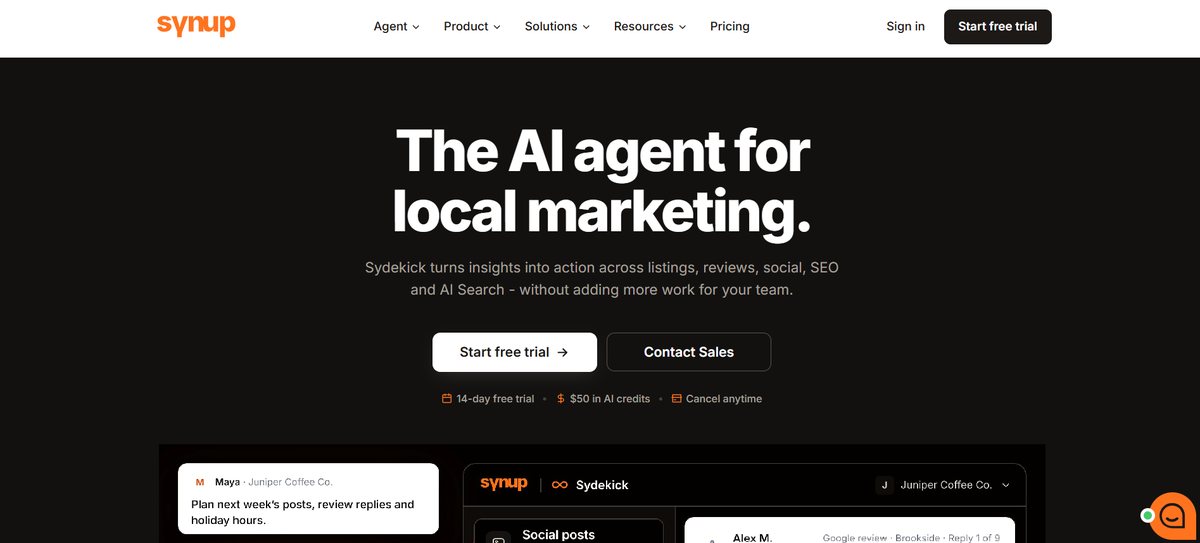
Synup combines local listings management, customer reviews, social publishing, local SEO monitoring, location pages, and AI-search visibility features.
Its offering also includes Sydekick, an AI agent designed to assist with and execute approved local marketing tasks.
Best suited for: Multi-location brands, marketing agencies, resellers, and organizations that want several local marketing functions managed through a shared platform.
Key capabilities
Synup provides business information distribution across its advertised network of more than 100 publishers, alongside review monitoring and responses, review generation, local rank tracking, and social publishing.
The platform also offers location landing pages and AI-search visibility analysis.
Agency-oriented capabilities include multi-client administration, white labeling, branded client experiences, permissions, and developer integrations.
Sydekick supports activities across listings, reviews, social publishing, SEO, and AI visibility. According to Synup's documentation, sensitive actions can be subject to approval controls.
Strengths
Synup's main differentiator is the combination of local marketing functionality and partner-oriented workflows.
For example, an agency managing 40 client locations may want to coordinate listings, review responses, local SEO reporting, and client access without maintaining a separate software application for every activity.
Its published subscription tiers also make early-stage budget planning easier than with enterprise-only quotation models.
Limitations
Large organizations should verify the platform's governance controls, integrations, location hierarchies, and support arrangements during a pilot.
Advertised publisher coverage does not establish that every business category or data field is supported across every destination.
AI activity is subject to credit allowances. Buyers should calculate expected usage instead of assuming unlimited automation.
White labeling is not included in the Solo plan.
Pricing
Synup's official pricing page lists the following monthly plans:
- Solo: Location allowance: 1. Monthly price: $49.
- Premium: Location allowance: Up to 10. Monthly price: $299.
- Pro: Location allowance: Up to 25. Monthly price: $499.
- Scale: Location allowance: Up to 50. Monthly price: $899.
- Enterprise: Location allowance: More than 50. Monthly price: Custom quote.
The plans include different credit allowances, parallel AI-agent capacities, and infrastructure arrangements.
Annual subscriptions may offer discounted pricing.
Assessment
Synup is worth evaluating when an organization wants integrated local marketing functionality, published entry-level pricing, and agency or partner workflows.
For larger deployments, the main questions concern governance, integrations, AI consumption, and operational performance at scale.
2. Yext

Overview
Yext provides enterprise software for organizing and distributing business information across search platforms, directories, websites, and other digital experiences.
Its Knowledge Graph serves as a structured foundation for managing business information and the relationships between different entities.
Best suited for: Enterprises with complex location data, multiple business units, and substantial information-governance requirements.
Key capabilities
Yext provides listings management, reviews, location pages, social publishing, analytics, and enterprise content management.
Its platform currently advertises more than 200 direct publisher integrations.
The Knowledge Graph supports structured information about locations, products, services, professionals, and other business entities.
Yext also offers APIs, data connectors, scheduled updates, and enterprise administration capabilities.
Strengths
Yext is particularly relevant when an organization manages more than basic business names, addresses, and phone numbers.
For example, a national healthcare organization may need to manage information about facilities, departments, physicians, specialties, and available services.
Those entities have relationships that a simple location spreadsheet may not represent effectively.
Yext's structured data model can help businesses manage those relationships and distribute information to connected experiences.
Limitations
Yext's broad product portfolio requires careful package selection.
Buyers should confirm which products, publisher connections, API capabilities, users, and integrations are included in the quotation.
Organizations requiring only basic listings maintenance may not need the platform's wider content and enterprise functionality.
The number of advertised integrations should also be assessed against the organization's actual channels and data requirements.
Pricing
Yext provides enterprise packages and reseller options.
Its official package comparison outlines available products and optional add-ons.
For a meaningful budget comparison, request an itemized quotation showing the required modules, locations, integrations, support, implementation, and renewal terms.
Assessment
Yext is a relevant choice when structured business information, centralized data governance, and integration with multiple digital experiences are major priorities.
Its value should be evaluated against the complexity of the organization's data and operating model.
3. Uberall
Overview
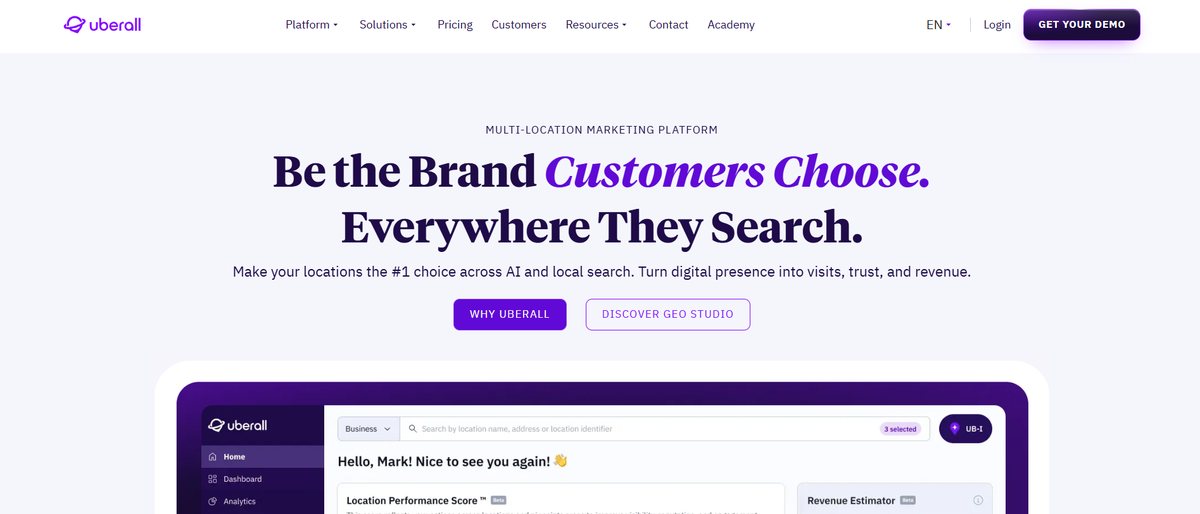
Uberall is a multi-location marketing platform that brings together business listings, customer reviews, local social media, location pages, and performance reporting.
Its offering emphasizes maintaining accurate business information and helping distributed organizations engage with local audiences.
Best suited for: Retail chains, restaurant groups, franchise networks, and other businesses with extensive physical location portfolios.
Key capabilities
Uberall provides centralized location-data management, listings distribution, duplicate suppression, review management, social publishing, and location-level analytics.
Its listings product advertises distribution across more than 200 directories and platforms, although available connections and supported functionality can vary.
Additional products include store locators, local landing pages, and GEO Studio for AI-search visibility analysis.
The platform also supports bulk location management and permission-related functionality.
Strengths
Uberall combines foundational location-data management with tools for local engagement.
For example, a retailer may need corporate administrators to maintain consistent business information while regional managers publish approved local promotions.
The platform can support coordination between centralized marketing requirements and location-specific execution.
Its packaged approach also gives buyers a way to select functionality according to their needs.
Limitations
Uberall's package boundaries require careful review.
Features such as enhanced analytics, collaboration controls, and location pages may involve additional subscriptions or add-ons.
For US businesses, publisher coverage should be verified against the directories and platforms customers actually use.
Organizations should also test what happens when location changes fail to synchronize or require further verification.
Pricing
Uberall's official pricing page lists three primary packages:
- Show Up: Core listings and location visibility.
- Stand Out: Listings and review management.
- Connect: Listings, reviews, and local social functionality.
Additional capabilities are available through add-ons.
Pricing is provided through a sales quotation.
Assessment
Uberall deserves consideration when location visibility, listings accuracy, local engagement, and scalable administration are important.
Buyers should request a complete package breakdown and test synchronization with their most important publishers.
4. SOCi
Overview
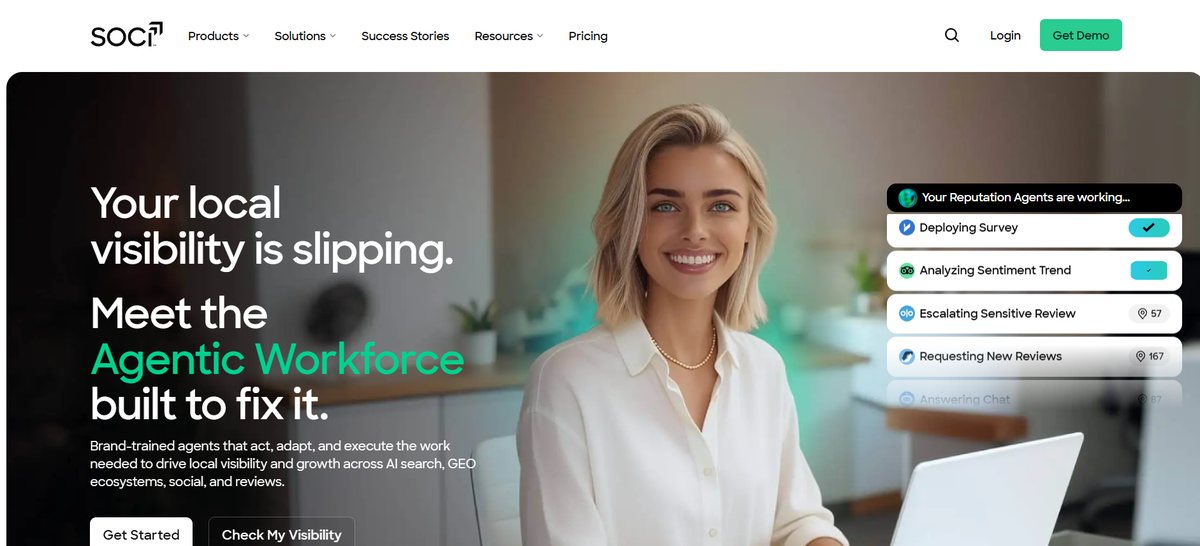
SOCi focuses on local marketing operations for enterprise and franchise organizations.
Its platform is organized around Genius Agents, which support work across local search, social marketing, and reputation management.
Best suited for: Enterprises managing hundreds or thousands of locations that want to automate recurring local marketing activities.
Key capabilities
SOCi offers listings management, local pages, social publishing, review management, customer feedback analysis, reporting, and automated workflows.
Its main agent categories include:
- Genius Local Search Agent: Listings management, local pages, local search optimization, and related visibility tasks.
- Genius Social Agent: Local content creation, publishing, and engagement.
- Genius Reputation Agent: Review management, customer sentiment, and feedback workflows.
Capabilities depend on the agents and skills included in the organization's deployment.
Strengths
SOCi is relevant to businesses where corporate teams establish marketing standards while regional managers, franchisees, or individual locations handle local execution.
Its automation-focused approach may reduce repetitive work associated with listings, review responses, and social publishing.
The vendor's pricing model also avoids separate charges for every user or business listing, according to its published pricing information.
Limitations
Automated workflows create additional requirements for governance and oversight.
Buyers should investigate who can approve AI-generated content, how exceptions are escalated, and whether potentially sensitive changes require human authorization.
A platform that can produce and publish content automatically still requires clear responsibility for accuracy.
Smaller organizations may find a large enterprise deployment more extensive than their needs justify.
Pricing
SOCi's official pricing page states that quotations are based on location count and selected Genius Agents and skills.
SOCi does not charge separately per user or per business profile under its stated model.
Some skills can have usage limits, and the company does not offer a standard free trial.
Assessment
SOCi is worth shortlisting when the main objective is coordinating and automating marketing work across a large distributed network.
Buyers should judge its value through demonstrated workflow improvements, approval controls, and measurable administrative efficiency.
5. Birdeye

Overview
Birdeye combines local business visibility, customer engagement, reputation management, and customer experience functionality.
Its product portfolio includes reviews, listings, social media, surveys, location pages, messaging, and AI-assisted workflows.
Best suited for: Businesses where customer reviews, communication, and experience management are central to local marketing.
Key capabilities
Birdeye provides review generation and management, listings optimization, social publishing, customer surveys, location pages, and reporting.
Its AI product portfolio also includes agents for review workflows, listings optimization, social marketing, customer communication, and feedback analysis.
For example, its Listings Optimization Agent can identify incomplete information and recommend changes for approval.
Strengths
Birdeye's customer engagement capabilities are useful for service businesses where feedback has a direct operational impact.
A dental group operating multiple practices may need to collect authentic patient feedback, monitor reviews, identify service-related complaints, and coordinate appropriate responses.
Connecting these activities with location-level marketing data can help teams understand issues that extend beyond search visibility.
Limitations
Organizations primarily seeking listings distribution should determine whether they need Birdeye's wider customer engagement products.
The available AI agents, workflow controls, integrations, and additional services depend on the commercial package.
Businesses operating in regulated industries should examine how customer information is stored, processed, and shared.
Buyers should also distinguish between AI recommendations requiring approval and workflows that can publish automatically.
Pricing
Birdeye uses customized pricing based on the selected products and deployment requirements.
Its official pricing page directs buyers to request a quotation rather than publishing a universal per-location subscription rate.
Assessment
Birdeye is a relevant candidate when local marketing needs to connect with reputation management, customer communication, and feedback analysis.
The purchasing decision should account for whether the wider customer experience functionality will be used sufficiently to justify its cost.
6. Reputation
Overview
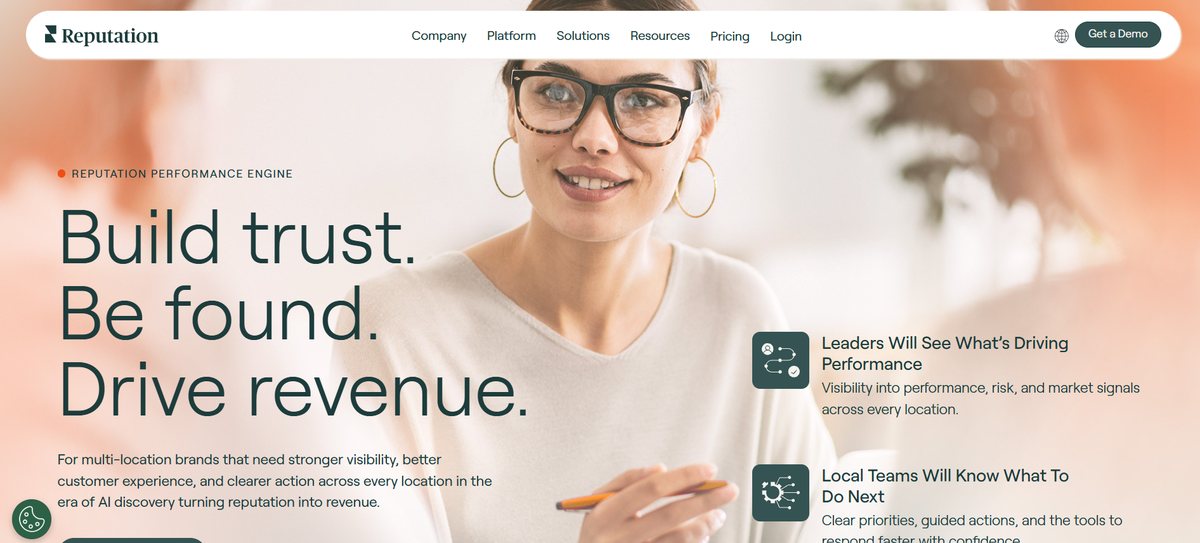
Reputation combines online reputation management, local discoverability, customer feedback, and analytics.
Its platform is designed for organizations that want to connect public customer feedback with broader operational and customer experience decisions.
Best suited for: Large service organizations, healthcare networks, automotive groups, and businesses with substantial customer feedback requirements.
Key capabilities
Reputation provides review collection and management, business listings, local SEO, surveys, customer experience analytics, and reporting.
Additional products and services include competitive insights, social media management, workflow ticketing, and specialized integrations.
Its platform supports analysis of feedback patterns across multiple locations.
Strengths
Reputation is relevant when customer feedback needs to inform departments beyond marketing.
For example, if reviews across several automotive dealerships repeatedly mention appointment delays, those comments may indicate an operational problem rather than merely a reputation issue.
A centralized feedback system can help identify such patterns and direct them to the appropriate teams.
Limitations
Businesses seeking straightforward listings maintenance may not need the wider analytics and feedback capabilities.
Features such as advanced insights, surveys, social management, and certain integrations depend on the selected subscription or additional purchases.
Enterprises should examine how the platform connects customer feedback with internal workflows and whether relevant teams can act on the information.
Pricing
Reputation publishes the following rates on its official pricing page:
- Rep Core: Published monthly price: $80 per location. Main focus: Reviews, listings, and local SEO.
- Rep Core + Pulse: Published monthly price: $115 per location. Main focus: Additional reputation insights and analytics.
- Rep Core + Surveys: Published monthly price: $150 per location. Main focus: Expanded surveys and customer experience insights.
- Enterprise: Published monthly price: Custom. Main focus: Organizations with 125+ locations.
Additional modules, integrations, and services may increase total cost.
Assessment
Reputation is worth evaluating when customer feedback, operational insights, and local marketing performance need to be managed together.
Buyers should establish which departments will use the platform and what actions will result from its reporting.
7. BrightLocal
Overview
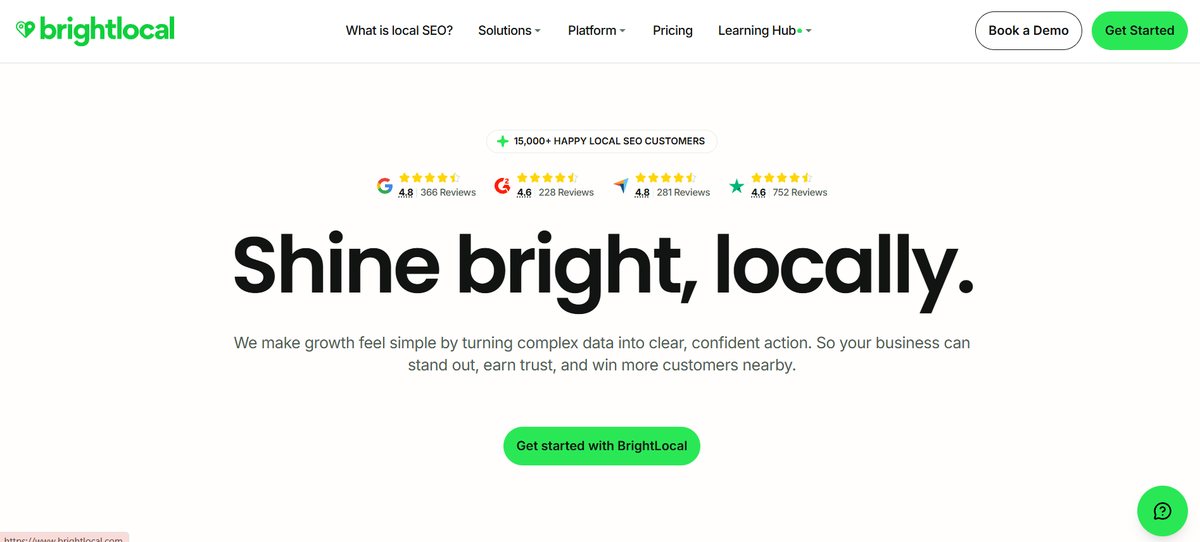
BrightLocal provides local SEO software and services for businesses, marketing agencies, and SEO teams.
Its offering focuses on local search visibility, citation management, listings accuracy, reputation monitoring, and performance reporting.
Best suited for: Local SEO specialists, agencies, and businesses that need focused search-management tools.
Key capabilities
BrightLocal offers local rank tracking, geo-grid reporting, Google Business Profile auditing, citation monitoring, listings management, and review management.
Its products also include Citation Builder services, agency reporting, and AI-search visibility tracking.
Strengths
BrightLocal's specialized local SEO functionality can be useful for teams that already have separate applications for social media, customer communications, and other marketing activities.
For example, an agency may use BrightLocal to audit location profiles, monitor local rankings, identify citation inconsistencies, and communicate optimization priorities to clients.
Published subscription tiers make the initial pricing comparison relatively straightforward.
Limitations
BrightLocal is more focused on local SEO operations than on managing every aspect of enterprise location marketing.
Organizations requiring extensive franchise governance, complex marketing automation, or sophisticated multi-department workflows should evaluate those requirements separately.
Buyers also need to distinguish between platform subscriptions, listings management, and one-off citation-building services.
Pricing
BrightLocal's official pricing page lists the following monthly rates for one managed location:
- Track: Monthly billing: $41. Main purpose: Local visibility tracking and auditing.
- Manage: Monthly billing: $54. Main purpose: Tracking plus listings management.
- Grow: Monthly billing: $65. Main purpose: Listings plus review management.
Annual billing provides discounted rates, and pricing changes with the number of locations managed.
Custom enterprise arrangements are also available.
Assessment
BrightLocal is an appropriate option when local SEO auditing, citation management, rank tracking, and reporting are the main requirements.
Larger organizations should compare its administration and workflow capabilities against the needs of their full location portfolio.
How These Local Marketing Platforms Were Evaluated
This guide uses publicly available vendor documentation, official pricing pages, and published product information reviewed on November 6, 2026.
The comparison assesses documented product capabilities and their relevance to multi-location marketing requirements.
This is a documentation-based editorial comparison, not an independent hands-on benchmark. No live enterprise accounts were tested, and the article does not claim to have measured software performance, synchronization speed, or customer outcomes.
Vendor descriptions of capabilities are treated as product claims rather than proof that the software will deliver a particular business result.
Evaluation Criteria
The following framework can help businesses shortlist vendors and structure a proof of concept.
The suggested weights are illustrative purchasing priorities, not vendor ratings.
- Listings accuracy and publisher coverage: Suggested weight: 25%. What buyers should verify: Supported sources, update behavior, duplicate handling, error reporting.
- Multi-location governance: Suggested weight: 20%. What buyers should verify: Bulk updates, roles, approvals, hierarchy, audit history.
- Marketing functionality: Suggested weight: 20%. What buyers should verify: Reviews, social, location pages, automation.
- Integrations and security: Suggested weight: 15%. What buyers should verify: APIs, SSO, exports, access controls, security documentation.
- Analytics and AI measurement: Suggested weight: 10%. What buyers should verify: Location reporting, attribution, AI methodology.
- Pricing and total cost: Suggested weight: 10%. What buyers should verify: Licenses, implementation, add-ons, support, contract terms.
Different organizations should adjust these weights.
For a healthcare network, privacy, customer feedback, and accurate provider information may deserve greater attention.
For a franchise system, franchisee permissions and approval workflows could be decisive.
For a marketing agency, white labeling, multi-client reporting, and reseller economics may carry more weight.
The evaluation criteria should be established before vendors are scored.
This reduces the risk of changing the framework simply to favor a preferred product.
How to Choose the Right Local Marketing Platform
The best purchasing process starts with the organization's actual workflows, not a vendor's feature list.
Before requesting demonstrations, document the number of locations, business profile ownership, key publishers, existing software, and teams responsible for local marketing.
1. Evaluate Listings Coverage and Data Accuracy
Listings management should support more than distributing names, addresses, and phone numbers.
For each location, determine whether the platform can manage the fields customers need, such as:
- Regular and holiday hours
- Business categories and services
- Website and appointment links
- Accessibility information
- Photos and location attributes
- Industry-specific information
Ask which publishers support direct synchronization, which require additional verification, and how failed updates are reported.
Apple's business management platform provides tools for businesses to manage how their locations appear on Apple Maps, including operating hours and other information.
A local marketing platform should complement native publisher tools without unnecessarily reducing the organization's ownership and control of its profiles.
Practical test: Select five representative locations and change their operating hours.
Inspect the software's update status, then independently check the information on the connected public platforms.
Record any delays, failures, or differences between the submitted data and published information.
2. Assess Governance, Permissions, and Integrations
A company with 500 locations requires more sophisticated administration than a business with five stores.
Corporate administrators may need to control business names, branding, and approved content while allowing regional managers to edit local operating information.
Franchise networks may require separate access for individual owners or operators.
Ask whether the platform supports restricted permissions, approval processes, bulk imports, audit histories, and relevant business integrations.
Enterprise buyers should also examine APIs, identity management, SSO options, data exports, and integration with existing master location records.
If approved location information already exists in a central database, the software should work with that source rather than creating another disconnected record that employees must maintain manually.
For franchise organizations, Hakken's guide to white-label local marketing platforms for franchisors explains how branded experiences and franchise-level governance can affect software selection.
3. Examine Reviews, Social Media, and Location Pages
Not every organization needs the same marketing functionality.
Some require little beyond listings management and local SEO analytics.
Others need centralized review responses, social publishing, location pages, customer messaging, and feedback reporting.
For reputation management, prioritize authentic review collection, appropriate customer responses, escalation rules, and the ability to identify repeated problems.
AI-generated replies can help with drafting, but complex or sensitive complaints should be reviewed carefully.
For a more detailed comparison, see Hakken's guide to AI review response software for multi-location brands.
For location pages, investigate whether the platform supports unique location information, useful page templates, crawlable links, appropriate metadata, and publishing controls.
Google's LocalBusiness structured data documentation explains how organizations can describe locations, hours, departments, and other details using structured information.
However, structured data does not guarantee indexing, rankings, or special search appearances.
Location pages should contain useful information about the actual business location rather than repeating the same content with only the city name changed.
If location pages are not appearing in search results, investigate technical eligibility before rewriting content.
Hakken's article on why location pages are not indexed provides a practical troubleshooting framework.
4. Compare AI Capabilities and Approval Controls
Local marketing vendors increasingly include AI capabilities, but the term covers different types of functionality.
One product may generate review response drafts. Another may recommend listing corrections, create social posts, analyze performance, or execute approved multi-step tasks.
Distinguish between three operating modes:
- AI recommendations: What it does: Identifies issues and suggests actions. Main evaluation question: Are recommendations accurate and explainable?
- AI-assisted workflows: What it does: Generates content or changes for approval. Main evaluation question: Can employees easily review and correct the output?
- Automated execution: What it does: Performs tasks under configured rules. Main evaluation question: What safeguards, limits, and audit records apply?
A suitable AI workflow should give administrators appropriate control over publishing, sensitive changes, and exception handling.
For example, an AI system should not independently announce that a location offers a service without verifying that the service is available there.
Likewise, an AI-generated response should not promise a refund, appointment, or operational resolution that has not been authorized.
During vendor demonstrations, test difficult scenarios rather than relying only on simple marketing tasks.
5. Examine AI-Search Visibility Reporting
AI-search visibility products may track brand mentions, cited URLs, responses to selected prompts, or competitive appearances.
These measurements can be useful, but they are not interchangeable.
Ask vendors to explain:
- Which AI systems are monitored
- How prompts or search queries are selected
- Whether results vary by location or language
- What counts as a brand mention or citation
- How frequently reports are refreshed
- Whether historical measurements can be exported
A brand appearing in a tracked AI response does not establish that the same result will appear for every user or query.
Microsoft's Bing Webmaster Tools AI Performance documentation describes reporting on citation activity, cited pages, and grounding queries across supported AI experiences.
Such data can help analyze trends, but citation counts are not equivalent to rankings, conversions, or verified sales outcomes.
Google also states that its established SEO best practices remain relevant to AI Overviews and AI Mode. There are no special technical requirements or additional schema types needed specifically for inclusion in those experiences.
For more context, see Hakken's guide to AI Overviews and local listings signals.
Local Marketing Platform Pricing: What Should Buyers Budget?
Local marketing software prices can be difficult to compare because vendors charge for different combinations of products and services.
Some use location-based subscriptions, while others offer bundled packages, separate modules, custom enterprise contracts, or usage-based AI allowances.
A useful comparison requires the same defined scope of work.
Calculate Total Annual Cost
A basic budgeting formula is:
Total annual cost = subscription fees + implementation + integrations + additional modules + support + expected usage charges.
For example, consider an organization managing 200 locations.
Suppose it receives a hypothetical proposal equivalent to $25 per location per month.
The base annual subscription would be:
200 locations × $25 × 12 months = $60,000
If implementation costs $10,000 and additional services cost $5,000 annually, the estimated first-year cost becomes:
$60,000 + $10,000 + $5,000 = $75,000
These are illustrative calculations, not quotations from a particular vendor.
Internal staffing, training, and other operational costs may increase the actual total.
Compare Contract Terms, Not Just Monthly Prices
Buyers should establish whether additional charges apply when:
- New locations are opened.
- Inactive or temporarily closed locations remain in the system.
- Premium publisher integrations are required.
- AI usage exceeds included credits.
- Additional modules or advanced reporting are enabled.
- More administrators or external users need access.
- Custom integrations or implementation services are necessary.
Contract exit conditions also matter.
Determine how location records, account permissions, historical reports, business profile connections, and hosted location pages will be handled if the organization changes software.
A lower subscription price may be less attractive if essential functionality requires expensive add-ons or creates substantial migration costs.
Local Marketing Platform Vendor Evaluation Matrix
A structured request for proposal helps turn vendor claims into comparable evidence.
For a US organization managing 100 or more locations, the following requirements provide a starting point.
- Listings synchronization: Evidence to request: Demonstrated updates to important US publishers. Priority: Critical.
- Google Business Profile management: Evidence to request: Bulk updates, ownership, verification, and permissions. Priority: Critical.
- Multi-location governance: Evidence to request: Regional roles, approvals, audit history. Priority: Critical.
- Duplicate management: Evidence to request: Detection and resolution workflow. Priority: High.
- Reputation management: Evidence to request: Review coverage, approvals, escalation procedures. Priority: High.
- Location pages: Evidence to request: Template controls, publishing process, SEO features. Priority: High.
- Integrations and APIs: Evidence to request: Documentation and tested data exchange. Priority: High.
- Reporting: Evidence to request: Location-level dashboards, exports, segmentation. Priority: High.
- AI automation: Evidence to request: Demonstrated execution, guardrails, and human oversight. Priority: Medium–High.
- White labeling: Evidence to request: Branded portals, reports, and account controls. Priority: Use-case dependent.
- Commercial terms: Evidence to request: Itemized pricing, usage limits, renewals, exit terms. Priority: Critical.
The evaluation should include marketing, operations, IT, procurement, and teams responsible for customer feedback.
Otherwise, a platform may be selected based on one department's priorities while leaving important organizational requirements unresolved.
Run a Representative Five-Location Pilot
A practical proof of concept does not need to begin with the entire location portfolio.
Select five locations that represent different operational situations:
- A typical established location with complete business information.
- A recently opened location requiring new listings.
- A location with unusual holiday or service hours.
- A franchise or regional location with restricted user permissions.
- A location with a known listings discrepancy or unresolved review issue.
Ask each shortlisted vendor to complete the same tasks.
Compare accuracy, workflow steps, approval controls, reporting, errors, and required employee intervention.
For example, test whether a corporate holiday-hours change can be applied to the appropriate locations without overwriting valid local exceptions.
A controlled pilot provides more meaningful evidence than comparing sales demonstrations conducted under different conditions.
Questions to Ask During a Vendor Demo
A demonstration should show how the platform behaves under realistic business conditions.
Use the following questions to guide the discussion:
- How does the platform handle updates across 500 locations, including regional differences in hours and services?
- Which US publishers support direct synchronization, and how are unsuccessful changes reported?
- Can corporate administrators require approval before local managers publish changes?
- How does the platform identify, prioritize, and resolve duplicate listings?
- What happens if an AI-generated response contains inaccurate or inappropriate information?
- Can reports be segmented by region, franchise owner, business category, and location?
- Which integrations are native, and which require custom development or additional fees?
- What business information and historical records can we export when leaving the platform?
- Who owns the connected business profiles, and what happens to those connections after contract termination?
- What is the complete cost of the required functionality over three years?
Review Policy Compliance Before Automating Feedback
Businesses must ensure that automated review collection and response processes comply with applicable rules.
The US Federal Trade Commission's consumer reviews and testimonials rule addresses practices including fake reviews, certain undisclosed insider testimonials, review suppression, and incentives conditioned on positive or negative sentiment.
Software automation does not remove a company's responsibility for its marketing practices.
Organizations should also consider the review policies of the platforms on which they collect and respond to feedback.
For healthcare and other sensitive industries, customer privacy requires particular attention.
Which Local Marketing Platform Fits Your Business?
Instead of selecting one vendor for every situation, consider a shortlist based on the organization's most important requirements.
- Marketing agencies and resellers: Platforms worth evaluating: Synup, BrightLocal, Yext. Main selection factors: Client management, branding, reporting, partner economics.
- Large retail chains: Platforms worth evaluating: Uberall, Yext, SOCi. Main selection factors: Listings accuracy, bulk administration, governance.
- Franchise networks: Platforms worth evaluating: SOCi, Synup, Uberall. Main selection factors: Corporate permissions, franchisee access, repeatable workflows.
- Reputation-intensive service businesses: Platforms worth evaluating: Birdeye, Reputation, Synup. Main selection factors: Reviews, customer feedback, reporting.
- Enterprise data management: Platforms worth evaluating: Yext, Uberall, Synup. Main selection factors: Structured information, integrations, synchronization.
- Local SEO teams: Platforms worth evaluating: BrightLocal, Synup, Yext. Main selection factors: Auditing, rank tracking, listings.
- Enterprise marketing automation: Platforms worth evaluating: SOCi, Birdeye, Synup. Main selection factors: AI execution, approvals, operational workflows.
- Healthcare and multi-site clinics: Platforms worth evaluating: Reputation, Birdeye, Yext. Main selection factors: Provider information, privacy, feedback management.
These are suggested shortlists based on documented functionality, not independent certifications or guarantees of suitability for particular industries.
Why Industry Requirements Matter
A pharmacy network may need different operating hours, services, and appointment information for each location.
A healthcare system may need to manage separate information about facilities, departments, and medical professionals.
A franchise network may require strict separation between corporate and franchisee permissions.
A restaurant group may prioritize local social publishing, customer reviews, menus, and changing opening hours.
Consequently, two organizations managing the same number of locations may need very different products.
How to Measure the ROI of Local Marketing Software
Return on investment should be evaluated using operational improvements and meaningful business outcomes.
The organization should establish a baseline before implementation so that later changes can be compared with documented starting conditions.
Measure Operational Efficiency
Potential efficiency improvements include:
- Less time spent updating business profiles
- Faster resolution of listings errors
- Reduced manual reporting
- Fewer disconnected software applications
- More consistent review and social workflows
For example, suppose 200 locations each recover one hour of administrative work per month.
At an assumed internal labor cost of $40 per hour:
200 locations × 1 hour × $40 × 12 months = $96,000 in annual staff capacity
If software costs $60,000 annually, the difference is $36,000 before implementation, training, and other expenses.
However, recovered staff capacity is not automatically equivalent to cash savings.
The business must establish whether those hours are genuinely saved and how the time is subsequently used.
Measure Business Outcomes Separately
Commercial performance may be assessed through:
- Qualified calls and appointment inquiries
- Website conversions and bookings
- Actions reported by supported business profiles
- Customer feedback trends
- Location-specific lead or sales outcomes, where measurable
Marketing attribution requires caution.
Advertising, seasonal demand, business openings, local competition, and other factors may influence results independently of the software.
An increase in direction requests or profile interactions should not automatically be treated as an equivalent increase in customer visits or revenue.
A stronger reporting approach separates four categories:
- Operational efficiency: Example metric: Administrative hours recovered. Important limitation: Time saved may not become direct cost savings.
- Information quality: Example metric: Percentage of accurate location records. Important limitation: Accuracy does not guarantee better rankings.
- Customer engagement: Example metric: Review response time or qualified inquiries. Important limitation: Engagement is not always a sale.
- Commercial outcomes: Example metric: Measurable bookings or conversions. Important limitation: Other marketing and market factors influence results.
This separation makes it easier to identify where the platform is delivering value and where further evidence is required.
Common Mistakes When Selecting a Local Marketing Platform
Several purchasing mistakes can reduce the value of otherwise capable software.
Choosing Based on Publisher Count Alone
A large directory network may appear attractive, but not every publisher is relevant to every business.
Prioritize the channels customers use and test synchronization quality before treating network size as a deciding factor.
Confusing Available Features With Included Features
A platform may advertise advanced analytics, social publishing, or AI automation without including those capabilities in every plan.
Request a written feature breakdown for the exact proposed package.
Evaluating Only the Corporate Dashboard
A platform may work well for head-office administrators but create difficulties for franchisees or regional teams.
Test access permissions, common tasks, and usability with representative users.
Automating Before Fixing Data Quality
Automation can distribute incorrect information just as efficiently as accurate information.
Establish reliable location records, review procedures, and data ownership before enabling large-scale publishing.
Buying Without a Proof of Concept
A polished demonstration cannot establish how software will perform with the organization's actual location data.
A representative pilot can reveal workflow problems, integration limitations, and hidden administrative requirements before a long-term contract is signed.
Frequently Asked Questions
What Is the Best Local Marketing Platform for Multi-Location Brands?
There is no single best platform for every organization.
Synup is worth evaluating for integrated local marketing and agency workflows. Yext is relevant for structured enterprise business data, Uberall for multi-location visibility, and SOCi for enterprise marketing automation.
Birdeye and Reputation are suitable shortlist candidates when customer engagement and feedback management are priorities. BrightLocal is relevant for focused local SEO operations.
The final choice should be based on documented requirements and a controlled vendor evaluation.
How Much Does a Local Marketing Platform Cost?
Pricing depends on the number of locations, selected features, contract terms, and usage.
Synup publishes plans starting at $49 per month for one location. BrightLocal lists monthly plans starting at $41 for one location, while Reputation publishes Rep Core at $80 per location per month.
Other vendors use customized enterprise quotations.
These subscriptions include different capabilities and should not be compared as directly equivalent products.
Can One Platform Manage Hundreds or Thousands of Locations?
Enterprise local marketing platforms are designed to manage large location portfolios.
However, practical scalability depends on integrations, data quality, permissions, bulk operations, and reporting requirements.
Buyers should test location updates, approval workflows, performance reporting, and exception handling before committing to a full deployment.
Importing thousands of records is not the same as managing them efficiently.
Can Local Marketing Software Improve Google and AI Search Visibility?
Local marketing software can support search visibility by maintaining accurate location information, helping teams manage useful location pages, and identifying optimization opportunities.
However, no vendor can guarantee higher rankings in Google Search or citations in ChatGPT, Copilot, Gemini, Perplexity, or other AI systems.
Visibility depends on multiple factors, including relevance, geography, content quality, competition, and the systems used by each search provider.
AI visibility analytics should be treated as measurement tools, not guaranteed performance outcomes.
Is an All-in-One Platform Better Than Using Separate Tools?
An all-in-one platform can reduce administrative effort when multiple marketing activities share the same location information.
Separate tools may be preferable when an organization has specialized requirements or already uses well-integrated applications.
The decision should consider functionality, integrations, internal workflows, contract flexibility, and total cost.
Software consolidation is beneficial only when the combined platform meets the organization's actual needs.
Final Recommendation
The right local marketing platform is the one that fits the organization's operating model, not necessarily the one with the longest feature list.
Synup is a practical starting point for organizations looking to combine listings, reviews, local SEO, social publishing, location pages, and agency workflows in one platform.
Yext deserves particular consideration when structured enterprise information and connected digital experiences are priorities.
Uberall is relevant for organizations managing location visibility and local engagement across large physical networks.
SOCi is worth evaluating when enterprise marketing automation and distributed workflows are central requirements.
Birdeye is particularly relevant for customer engagement and reputation management, while Reputation connects feedback analysis with broader customer experience and operational insights.
BrightLocal provides a more focused option for local SEO auditing, citation management, and reporting.
For a business managing 100, 500, or 1,000 locations, the final decision should follow a structured evaluation rather than a sales presentation alone.
Shortlist three platforms that closely match your requirements. Ask each vendor to demonstrate the same listings update, review workflow, location-level report, and integration scenario.
Compare their results, administrative effort, governance controls, and total three-year cost.
A well-chosen platform should make individual locations easier to manage while providing the central team with reliable information, appropriate control, and better visibility into everyday marketing operations.