Employee Experience vs. Employee Engagement: What’s the Difference?
A new employee can have a laptop waiting on day one, receive a clear onboarding plan, get paid correctly, find company policies without asking three people, and still feel completely disconnected from the job six months later. Another employee might put up with an outdated HR portal, a few awkward processes, and an office printer that appears to have developed personal grievances, yet still feel deeply committed to the work.
Sandeep Kumar
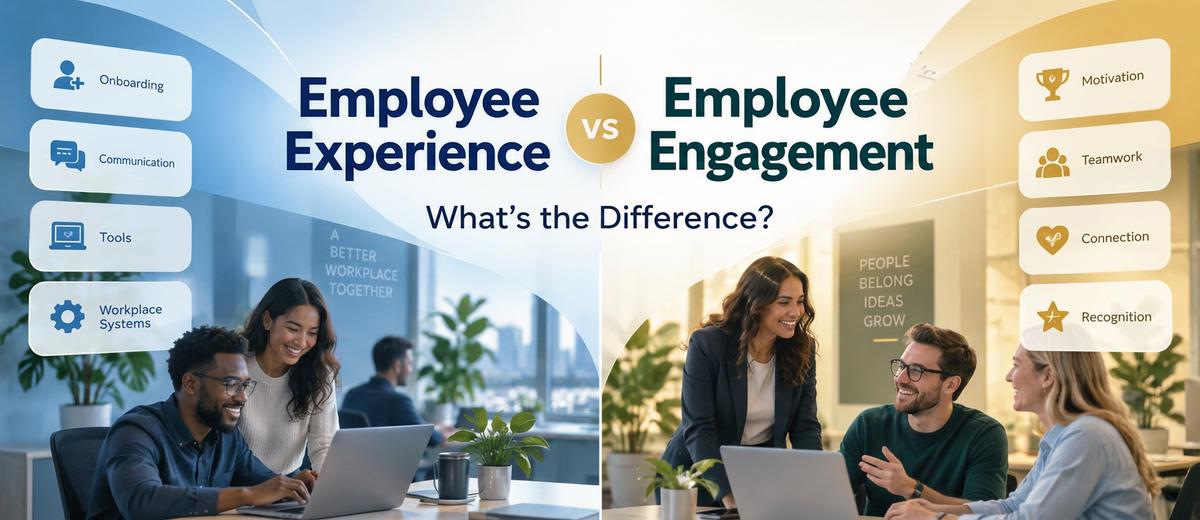
A new employee can have a laptop waiting on day one, receive a clear onboarding plan, get paid correctly, find company policies without asking three people, and still feel completely disconnected from the job six months later.
Another employee might put up with an outdated HR portal, a few awkward processes, and an office printer that appears to have developed personal grievances, yet still feel deeply committed to the work.
That difference gets to the heart of employee experience vs. employee engagement.
Employee experience describes what people encounter while working for an organization. Employee engagement describes how invested, interested, and connected they feel toward their work.
The two influence each other, but they are not interchangeable.
That distinction becomes useful when an organization is trying to fix something. If employees cannot find policies, the problem may be experience. If they understand their jobs perfectly well but see no purpose or future in them, the issue may be engagement. If both are weak, another pulse survey is unlikely to solve much.
Platforms such as Staffbase, HubEngage, Workvivo, Simpplr, and LumApps can support communication, employee access, recognition, feedback, and workplace information. They can improve some of the conditions surrounding work. They cannot manufacture commitment by themselves.
That part is still stubbornly human.
Employee Experience vs. Employee Engagement: The Short Answer
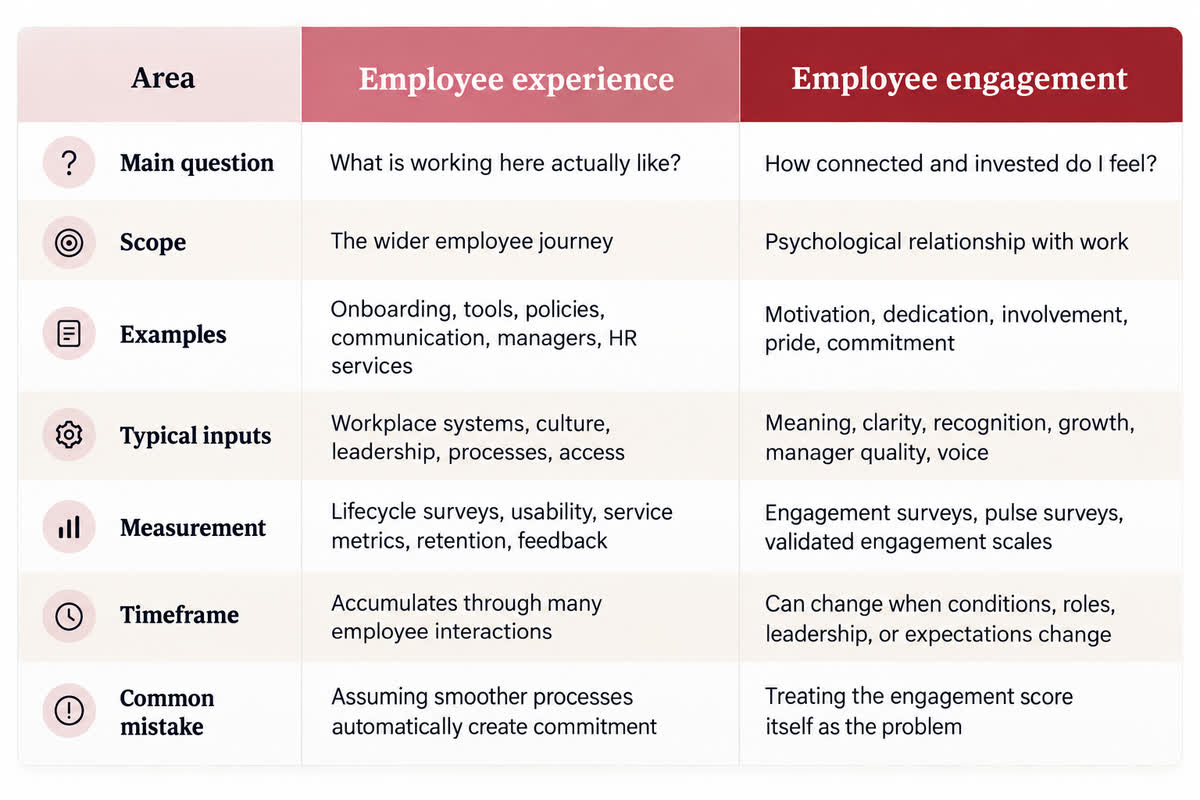
Employee experience is the overall reality of working for an organization. Employee engagement is the psychological connection an employee develops with their work and workplace.
SHRM describes employee experience in terms of the complete employee journey and the interactions people have with the organization, including culture, leadership, technology, development, and daily work.
Gallup defines employee engagement as employees' involvement and enthusiasm in their work and workplace.
CIPD's evidence review adds an important layer. Academic research commonly treats work engagement as a psychological state involving vigor, dedication, and absorption.CIPD employee engagement evidence review
Put simply: The overlap is real. The difference is still worth preserving.
What Is Employee Experience?
Employee experience is the combined practical, cultural, emotional, and digital reality employees encounter while working for an organization.
It begins earlier than many companies realize.
The candidate who waits three weeks for interview feedback is already forming an opinion. So is the person trying to complete six onboarding systems before lunch on their first day.
Employee experience can include:
- Recruitment and hiring
- Preboarding
- Onboarding
- Workplace technology
- Manager interactions
- Internal communication
- Payroll and benefits
- Scheduling
- HR support
- Performance discussions
- Recognition
- Training
- Career development
- Internal mobility
- Flexible working
- Workplace policies
- Team relationships
- Organizational changes
- Offboarding
This is one reason employee experience can be difficult to manage. No single department controls all of it.
HR may design onboarding. IT supplies the laptop. Payroll handles salary. Internal communications explains organizational changes. A line manager determines whether expectations make sense. Senior leadership makes decisions that may affect all of those functions.
The employee experiences the result as one organization.
Employee Experience Is Often About Ordinary Friction
Some of the most important experience problems are surprisingly mundane.
Consider a frontline employee who has no company email account.
A safety update is distributed through email. A benefits reminder appears on the corporate intranet. A survey link goes to the same inbox. An invitation to a recognition program arrives there too.
The company may believe it communicates frequently.
The employee experiences silence.
That is initially an access problem. If it happens repeatedly, it may eventually affect trust, belonging, and engagement.
Technology becomes relevant here, which is why organizations increasingly evaluate employee apps and intranet platforms. Hakken's guide to modern intranet software in 2026 compares platforms including HubEngage, Staffbase, Simpplr, LumApps, and Unily, particularly around employee access, communication, search, and frontline support.
What Is Employee Engagement?
Employee engagement concerns the employee's psychological relationship with work.
Gallup describes engaged employees in terms of involvement and enthusiasm. CIPD points to research around vigor, dedication, and absorption.
Neither definition says anything about being cheerful every morning.
That is important.
An engaged employee can disagree with leadership. They can dislike a new policy. They can have a difficult week. They can even be actively looking for a better solution to a workplace problem.
Engagement is closer to questions such as:
- Do I understand what is expected of me?
- Does my work feel worthwhile?
- Do I have the resources to perform?
- Does anybody notice good work?
- Can I contribute ideas?
- Do I trust my manager?
- Am I developing?
- Can I see how my work connects with something useful?
Common engagement drivers include:
- Role clarity
- Meaningful work
- Manager quality
- Recognition
- Employee voice
- Career development
- Trust
- Resources
- Team relationships
- Fairness
- Opportunities to use strengths
Definitions still vary between researchers and consulting firms. CIPD specifically warns that organizations can create confusing engagement measures when they combine several different concepts into one score.
That raises an uncomfortable question.
When an engagement dashboard says 68, what exactly does 68 mean?
Without a clear definition, remarkably little.
Employee Engagement in 2026
Gallup reported in July 2026 that 31% of U.S. employees were engaged during the first half of 2026, unchanged from 2025. Another 18% were classified as actively disengaged.Gallup's July 2026 U.S. engagement update
The number is interesting partly because organizations have spent heavily on collaboration software, employee apps, flexible-work systems, AI tools, workplace programs, and surveys.
Better technology may make work easier.
Ease is not the same thing as engagement.
Gallup's 2026 findings around AI make this especially clear. Merely giving employees access to AI did not determine whether engagement improved. Clear expectations, manager support, and an understandable plan for how AI should fit into work were important conditions.
The tool is part of the experience.
What people understand about the tool, how managers introduce it, and whether it actually helps them work can affect engagement.
What Is the Main Difference Between Employee Experience and Employee Engagement?
The simplest distinction is:
Experience describes conditions and interactions. Engagement describes a psychological response influenced by those conditions.
Imagine two employees.
Employee A
Employee A receives:
- Excellent onboarding
- Modern software
- Flexible work
- Reliable HR support
- Clear company communication
- Competitive benefits
Those are positive experience factors.
But the employee's manager rarely discusses development. The work feels repetitive. Promotion criteria are unclear. The employee cannot see where the role is heading.
The experience can look good on paper while engagement remains weak.
Employee B
Employee B deals with:
- An old HR system
- Manual expense forms
- Occasional information gaps
- A few inconvenient internal processes
Yet the employee has a strong manager, meaningful work, trusted colleagues, real responsibility, and a visible development path.
Engagement may remain strong despite imperfect employee experience.
This is why removing workplace friction is useful, but it should not be mistaken for creating commitment.
Is Employee Engagement Part of Employee Experience?
In many practical HR frameworks, yes.
Employee experience is usually treated as the broader concept.
It covers what employees encounter through areas such as:
- Systems
- Managers
- Culture
- Communication
- Leadership
- Physical environments
- Policies
- Development
- Relationships
Engagement describes one possible response to those conditions.
A useful structure is:
Workplace conditions → employee perceptions → engagement and other employee outcomes → behavior and organizational results
Reality is messier than the diagram.
Two people can experience the same manager differently. A policy one person values may frustrate someone else. Career stage, role, expectations, team relationships, outside circumstances, and personal priorities all affect how employees interpret work.
Employee experience therefore influences engagement without controlling it completely.
Employee Experience vs. Engagement vs. Satisfaction
Satisfaction creates another layer of confusion.
The three concepts answer different questions.
At a glance (sync-safe):
- Concept: Employee experience | What it describes: The broader reality of working in the organization | Useful question: How easy is it to get the information, tools, and support you need?
- Concept: Employee engagement | What it describes: Psychological connection with work | Useful question: How motivated and involved do you feel in your work?
- Concept: Employee satisfaction | What it describes: Contentment with particular job conditions | Useful question: How satisfied are you with your pay, schedule, benefits, or workplace?
A person can be satisfied without being engaged.
A predictable job near home with decent pay may suit somebody perfectly. They may have no desire to invest more energy or build a long-term career there.
An engaged employee can also be dissatisfied.
They may care deeply about the organization and still think the promotion system is unfair.
Collapsing every sentiment measure into one score removes precisely the information leaders need.
How Employee Experience Can Affect Engagement
Employee experience gives employees repeated evidence about how the organization works.
Sometimes that evidence is positive.
Sometimes it is an expense reimbursement that disappears into an approval queue for 37 days.
Employees notice both.
Communication
Suppose an organization announces major changes late, provides different answers across departments, and gives employees nowhere to ask questions.
The immediate issue is communication experience.
Repeated often enough, it can influence trust in leadership.
Management
Managers affect several parts of daily work:
- Expectations
- Feedback
- Recognition
- Workload
- Development
- Team communication
- Priorities
- Problem resolution
A polished employee portal cannot resolve consistently poor management.
Digital Experience
Employees now interact with dozens of workplace systems.
An employee who spends ten minutes finding a leave policy once will probably survive.
An employee who spends ten minutes searching for basic information several times every week experiences something different.
Repeated friction becomes part of how the organization feels to work for.
Frontline Access
Communication becomes even more basic for employees in factories, hospitals, retail locations, hotels, warehouses, and field roles.
If frontline staff cannot access the same information as office employees, organizations can accidentally create two workplace experiences inside the same company.
That is why channel strategy deserves attention. Hakken's comparison of internal newsletter software in 2026 examines how products such as HubEngage, Staffbase, ContactMonkey, Workshop, Poppulo, and Cerkl Broadcast approach email, mobile communication, targeting, and frontline reach.
Which Comes First: Employee Experience or Engagement?
There is little value in turning this into a sequence.
Measure engagement while fixing obvious experience problems.
If new hires routinely wait a week for laptops, fix it.
If employees cannot find their schedules, fix it.
If managers are not holding basic conversations with their teams, address it.
If frontline workers do not receive important communication, solve the access problem.
You do not need another engagement survey to confirm that missing payroll annoys people.
Engagement data becomes useful when the underlying issue is less obvious.
Perhaps one business unit has unusually weak engagement.
Is it role clarity?
Recognition?
Manager behavior?
Development?
Communication?
Workload?
That is where engagement research can direct attention toward questions worth investigating.
How to Measure Employee Experience
Employee experience is easier to understand when you measure important moments rather than relying on one annual questionnaire.
Qualtrics' employee lifecycle approach, for example, includes collecting feedback around onboarding, promotions, transitions, and employee departure.Qualtrics employee lifecycle guidance
Useful measures may include:
- Candidate feedback
- New-hire onboarding feedback
- 30-, 60-, and 90-day check-ins
- Time to productivity
- HR service response times
- Internal search success
- Technology usability
- Communication reach
- Manager support
- Training participation
- Development opportunities
- Internal mobility
- Recognition participation
- Absence
- Retention
- Exit interview themes
- Qualitative employee comments
Do Not Ask One Number to Explain Everything
eNPS can be useful as one signal.
It cannot explain an employee experience by itself.
Suppose eNPS falls by 12 points.
Was the cause:
- Compensation?
- A restructuring?
- A poor manager?
- New scheduling rules?
- A broken payroll migration?
- Return-to-office requirements?
- Career concerns?
- Workload?
The score identifies movement.
The investigation explains it.
Segment the Data Carefully
Company averages can hide local problems.
Look at differences by:
- Location
- Department
- Role
- Shift
- Tenure
- Business unit
- Manager group
- Frontline and desk-based population
A global score of 78 can look reassuring while a critical 600-person operating unit sits at 49.
The average is correct.
It is also incomplete.
How to Measure Employee Engagement
Engagement measurement works best when outcomes and possible drivers are separated.
Engagement Outcomes
These might assess:
- Enthusiasm
- Dedication
- Psychological connection
- Motivation
- Involvement
- Energy
Possible Engagement Drivers
These might examine:
- Role clarity
- Manager support
- Recognition
- Development
- Employee voice
- Team relationships
- Leadership trust
- Communication
- Resources
- Meaning
This difference is important.
If the engagement outcome falls, you know something is wrong.
Driver analysis gives you places to investigate.
Useful measurements can include:
- Engagement index
- Validated engagement scale
- Favorable response percentages
- Driver scores
- Pulse survey movement
- Department or location variation
- Open-text themes
- Changes after specific workplace actions
Turnover, productivity, absenteeism, customer experience, and safety data can add useful context.
They should not automatically be treated as engagement measures.
Many things affect them.
Employee Experience Survey vs. Employee Engagement Survey
The surveys should ask different questions because they serve different purposes.
Employee Experience Survey Questions
Examples include:
- Was your laptop ready when you started?
- Did your onboarding prepare you for your role?
- Can you easily find company policies?
- Is it easy to access HR support?
- Do workplace systems help you complete your work efficiently?
- Did you receive clear information during your role transition?
Employee Engagement Survey Questions
These explore the employee's connection with work:
- Do you understand what is expected of you?
- Do you feel enthusiastic about your work?
- Do you receive useful recognition?
- Can you see how your work contributes?
- Do you have opportunities to develop?
- Do you believe your opinions are taken seriously?
Used together, these surveys give HR a more useful picture.
Experience data tells you where people encounter problems.
Engagement data tells you something about their relationship with the work taking place inside those conditions.
How to Improve Employee Experience and Employee Engagement Together
1. Start With Repeated Employee Friction
You do not need to redesign the entire employee lifecycle.
Find two or three problems employees repeatedly mention.
For example:
- Slow onboarding
- Difficult scheduling
- Poor internal search
- Confusing benefits information
- Inconsistent performance reviews
Define what should happen instead.
Then measure whether it actually happens.
2. Give Managers Specific Responsibilities
"Improve engagement" is not a useful manager instruction.
Ask managers to do concrete things:
- Hold monthly development conversations
- Give useful feedback every two weeks
- Explain changing priorities
- Recognize strong contributions
- Review workload
- Clarify responsibilities
Managers need actions they can perform, not another dashboard.
3. Design Communication Around the Workforce
Look at where employees genuinely receive information.
Office staff may use:
- Outlook
- Gmail
- Teams
- Slack
- Intranet
Frontline employees may depend more on:
- Mobile apps
- SMS
- Digital signage
- Shared devices
- Manager briefings
Measure whether messages reached employees before worrying about reactions and comments.
Nobody can engage with information they never received.
4. Respond to Employee Feedback
Repeated surveys without visible response teach employees something.
They teach them that surveys do not matter.
After collecting feedback, communicate:
- What employees said
- What leaders understood
- What will change
- What cannot change
- Who owns the action
- When another update will come
Even an unpopular answer can be clearer than silence.
5. Compare Employee Data With Operational Data
Suppose engagement falls sharply at one location.
Look at:
- Manager turnover
- Overtime
- Scheduling
- Absence
- Employee turnover
- Safety incidents
- Customer complaints
- Internal promotions
- Workload
Do not assume correlation proves cause.
Use the pattern to decide what to investigate next.
6. Measure After Employees Have Experienced the Change
If you change onboarding this month, do not wait eleven months for the annual engagement survey.
Ask employees at:
- 30 days
- 60 days
- 90 days
You will learn far more about onboarding while people can still remember being onboarded.
Employee Experience and Engagement Platforms in 2026
Software can support several parts of employee experience: communication, information access, feedback, recognition, search, community, and employee services.
Software cannot determine whether employees trust their managers, believe a policy is fair, or find meaning in their work.
The five platforms below approach the problem differently. They are not ranked.
1. Staffbase
Best fit: Larger organizations that need structured employee communication across office, remote, and frontline populations.
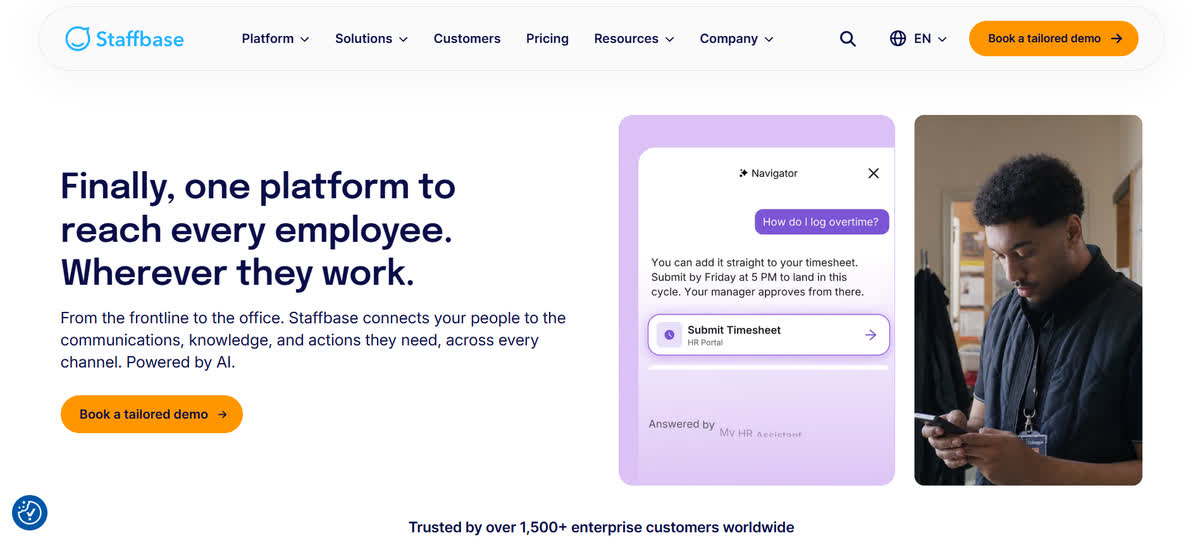
Staffbase has developed into a broad employee experience and communications platform covering employee communication, intranet functions, employee apps, knowledge access, campaigns, and cross-channel publishing.
Its central strength is communication at enterprise scale.
Teams can manage information across several employee channels rather than treating the intranet, employee app, Microsoft Teams, and other communication surfaces as completely separate programs. Staffbase also provides targeting and personalization so communications can vary by factors such as employee role or location.
That becomes useful in organizations where central communications, HR, regional teams, and individual business units all need publishing access without losing basic governance.
Staffbase also supports integrations with workplace systems and employee data sources, which can help companies expose information such as schedules or absence details in the employee environment.
Its Journeys capability addresses lifecycle communication, allowing organizations to structure messages around employee moments such as onboarding.
Where Staffbase makes sense:
- Large distributed organizations
- Enterprise internal communications teams
- Companies combining intranet and employee communication
- Workforces containing office and frontline employees
- Organizations needing structured publishing governance
- Teams managing communication across several locations or regions
Questions to ask during evaluation:
- Which channels are included in your proposed package?
- How much ongoing administration will the platform require?
- How will existing SharePoint or Microsoft 365 content fit?
- Which employee-data integrations are native?
- How granular are communication analytics?
- Who will own content governance after launch?
Staffbase deserves close consideration when communication itself is the main operational problem. Organizations primarily looking for a specialist engagement survey system may need to compare it with more listening-focused products.
2. HubEngage
Best fit: Organizations with mixed, distributed, frontline, and deskless workforces that want communication, surveys, recognition, and employee participation in one system.
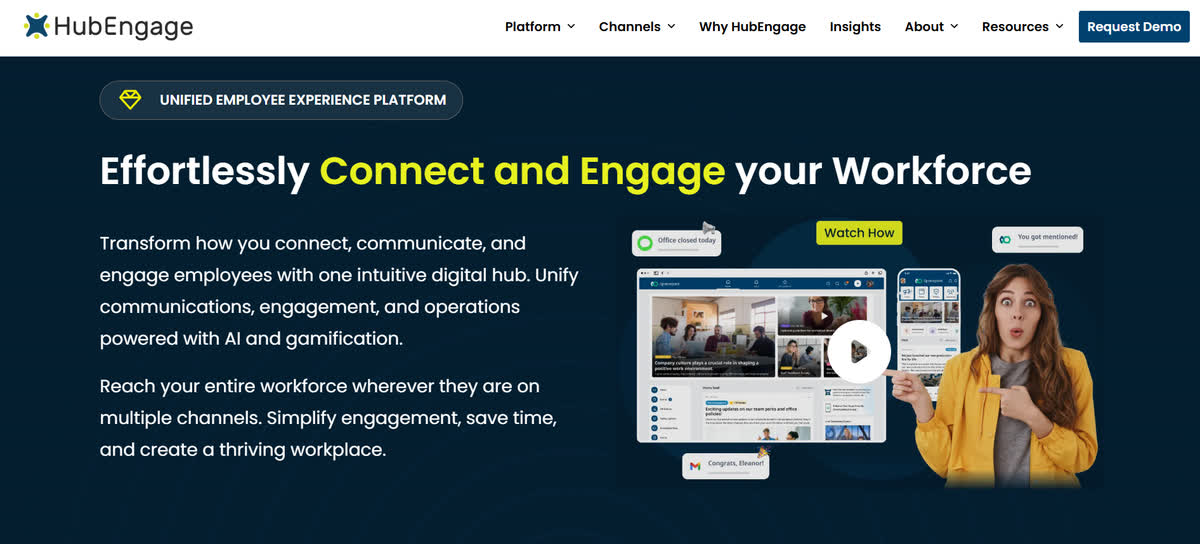
HubEngage brings several employee-facing functions together: internal communication, an employee intranet, recognition, surveys and forms, social features, messaging, digital signage, and mobile access.
The platform is especially interesting when employee access varies considerably.
A head-office employee might live in email and Teams. A factory employee might rarely open either. A field employee may depend on a phone. HubEngage supports communication through mobile apps, web, email, SMS, digital displays, Teams, and Slack, giving organizations several ways to reach those groups
Recognition is another significant part of the product. Organizations can run peer, manager, and company recognition, automate milestone celebrations, and use points, badges, leaderboards, and rewards.
Its survey and forms tools allow HR teams to collect pulse feedback while distributing requests across different employee channels.
The social component provides a more informal layer where employees can share updates and interact, while the intranet side gives organizations somewhere to store policies, resources, announcements, and workplace information.
Where HubEngage makes sense:
- Manufacturing
- Healthcare
- Hospitality
- Retail
- Field workforces
- Distributed organizations
- Companies wanting communication and recognition together
- Employers with employees who do not regularly use corporate email
Questions to ask during evaluation:
- Which channels will employees realistically use?
- How does employee data stay synchronized?
- How are surveys segmented?
- Which reward options are available?
- Can separate business locations manage their own content?
- What analytics can be viewed by role, department, or location?
- Which capabilities require separate modules?
HubEngage has a wider functional footprint than a simple employee communication tool, which can be useful when several workplace programs need to sit together. Organizations needing only a traditional intranet or a dedicated scientific engagement-survey platform should compare whether they need that breadth.
3. Workvivo
Best fit: Organizations that place employee communication, workplace community, participation, and culture near the center of their employee platform.
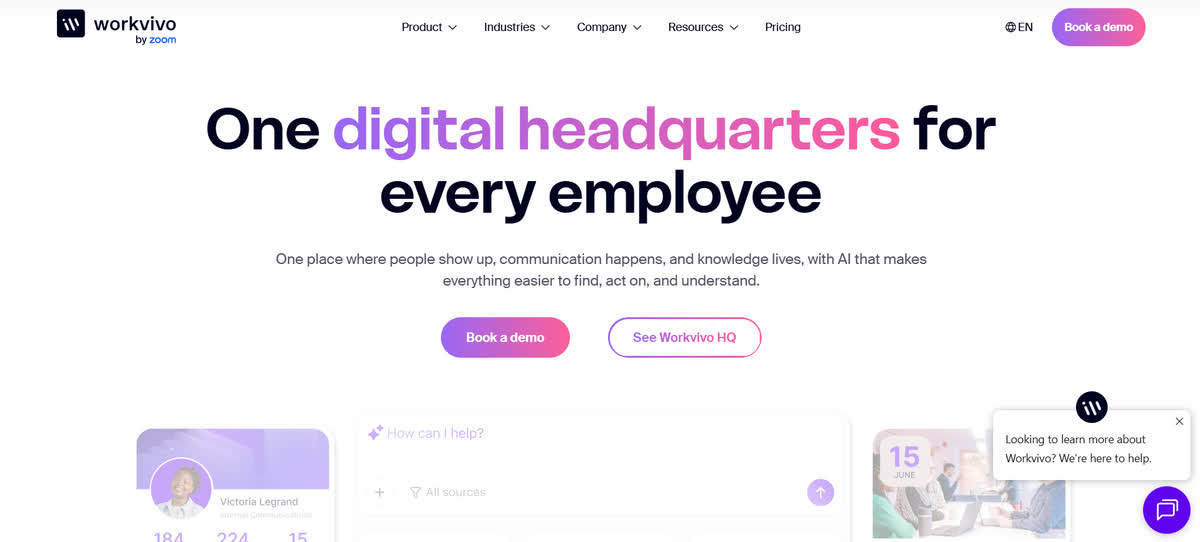
Workvivo describes its current product around a digital headquarters where employees can find information, receive communication, participate in workplace conversations, and access organizational knowledge
Its approach has traditionally been more socially oriented than a conventional corporate intranet.
Employees can interact with posts, participate in spaces and communities, recognize colleagues, access company information, and engage with workplace content through desktop and mobile experiences.
That can make Workvivo useful where the organization wants employees to participate rather than simply consume top-down communication.
The platform also addresses knowledge access and search. This becomes more important as workplace information spreads across intranets, documents, business systems, and communication tools.
Mobile support is particularly relevant for organizations where employees move between locations or spend little time behind a computer.
Where Workvivo makes sense:
- Companies prioritizing workplace community
- Distributed teams
- Global organizations
- Companies wanting a social layer around communication
- Organizations replacing older intranets
- Workforces needing mobile access
- Teams where recognition and employee participation are priorities
Questions to ask during evaluation:
- How much employee participation does your culture realistically support?
- Will social features overlap with Teams, Slack, or existing communities?
- How should important official information be separated from social content?
- How will knowledge governance work?
- What HR and identity integrations are required?
- How much content moderation will internal teams need?
Workvivo can be attractive when employee connection is an explicit objective. Companies with heavily regulated publishing requirements should spend time testing governance and information-management workflows alongside the social experience.
4. Simpplr
Best fit: Organizations seeking a modern employee hub that combines intranet content, workplace information, search, communication, and employee services.
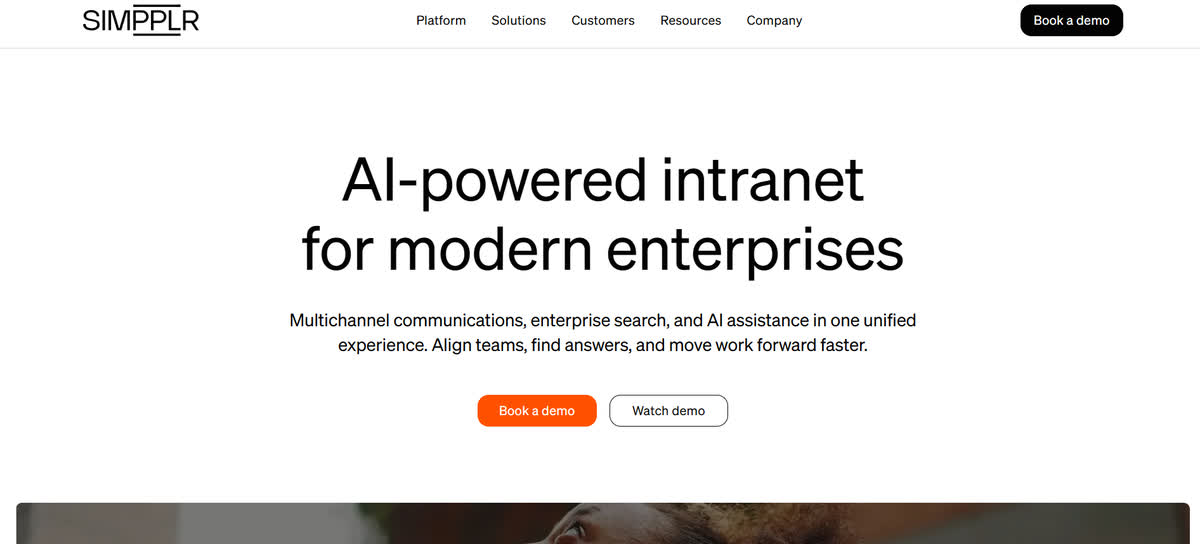
Simpplr positions its platform around reducing friction in daily work, especially the effort involved in finding trusted information and completing common workplace tasks
This makes Simpplr particularly relevant when the intranet has become less of a communication problem and more of a findability problem.
Employees may technically have access to everything they need while still spending far too long finding it.
Simpplr combines intranet capabilities with enterprise search, employee communication, directories, mobile access, personalization, recognition, surveys, and integrations.
The product is useful to consider when companies want the employee hub to become a consistent starting point for work rather than a website employees visit mainly for announcements.
Where Simpplr makes sense:
- Knowledge-heavy organizations
- Companies replacing legacy intranets
- Organizations prioritizing workplace search
- Distributed corporate workforces
- Teams combining communication and knowledge management
- Companies seeking stronger personalization of employee information
Questions to ask during evaluation:
- Which connected systems can search access?
- How does the system determine which information is trusted?
- Who owns outdated content?
- How much configuration is required for personalization?
- How do surveys compare with dedicated listening platforms?
- How should recognition fit with any existing rewards system?
Simpplr makes the most sense when communication and knowledge access are part of the same problem. If employees already find information easily and the main requirement is frontline communication through several external channels, another platform may fit the problem more closely.
5. LumApps
Best fit: Larger organizations seeking a connected employee hub with strong ties to Microsoft 365 or Google Workspace.
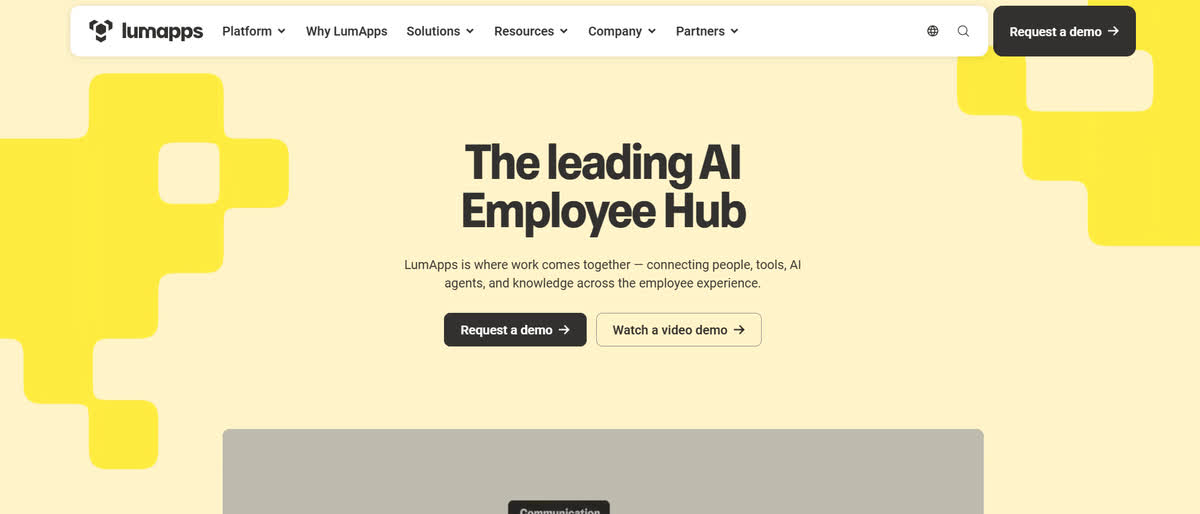
LumApps combines internal communication, knowledge, workplace search, employee community, onboarding, recognition, feedback, learning, and connections to business applications.
Its approach centers on giving employees a more unified destination for information and workplace tools
Its Microsoft and Google connections are particularly relevant.
Many employee experience projects fail because they accidentally create another destination employees need to remember to visit.
For organizations already built around Microsoft 365 or Google Workspace, integration with existing work patterns can matter as much as the standalone feature list.
LumApps also supports targeted and translated communication, employee communities, feedback, recognition, and structured onboarding experiences.
Where LumApps makes sense:
- Global organizations
- Microsoft 365 environments
- Google Workspace environments
- Companies replacing traditional intranets
- Organizations with multilingual workforces
- Teams bringing communication and knowledge access together
- Companies wanting more structured employee journeys
Questions to ask during evaluation:
- How deeply does it connect with your existing productivity suite?
- Which workflows require employees to leave the platform?
- How does information governance work?
- What search sources can be indexed?
- How does frontline access differ from desk-worker access?
- Will specialist survey or recognition tools still be required?
LumApps is worth considering when workplace information is spread through multiple systems and the organization wants a common employee destination. Companies should still test whether its communication, feedback, and recognition capabilities are deep enough for their specific requirements.
Staffbase vs. HubEngage vs. Workvivo vs. Simpplr vs. LumApps
The products overlap considerably, so the useful question is rarely "Which platform has employee communication?"
They all address it in some form.
The more useful question is what problem sits at the center of your project.
At a glance (sync-safe):
- Platform: Staffbase | Strong area to investigate: Enterprise communication and multichannel governance | Particularly relevant for: Large distributed organizations
- Platform: HubEngage | Strong area to investigate: Frontline reach, communication, recognition, surveys | Particularly relevant for: Mixed desk and frontline populations
- Platform: Workvivo | Strong area to investigate: Workplace community and employee participation | Particularly relevant for: Organizations emphasizing connection and culture
- Platform: Simpplr | Strong area to investigate: Modern intranet, search, and information access | Particularly relevant for: Knowledge-heavy workplaces
- Platform: LumApps | Strong area to investigate: Employee hub with Microsoft/Google connections | Particularly relevant for: Large organizations already built around those suites
This is not a ranking.
A company with 8,000 factory employees has a different communications problem from a software company with 1,200 remote knowledge workers.
Choose around the workforce you actually have.
Common Mistakes Around Employee Experience and Engagement
Assuming a Good Experience Guarantees Engagement
It does not.
Efficient systems and fair processes improve conditions. Employees still care about meaning, development, trust, managers, relationships, and the nature of the work itself.
Treating Engagement as Happiness
Engaged employees are not permanently cheerful.
They may challenge decisions precisely because they care what happens.
Treating the Annual Survey as the Strategy
The survey is measurement.
The useful work comes afterward:
- Understand the results.
- Investigate possible drivers.
- Choose actions.
- Assign ownership.
- Tell employees what will happen.
- Measure again.
Treating App Activity as Employee Engagement
Views, clicks, likes, comments, logins, and survey responses measure digital behavior.
They can tell you whether a communication platform is being used.
They cannot prove that someone feels motivated by their job.
Making HR Solely Responsible
Employee experience crosses organizational boundaries.
HR matters.
So do:
- Managers
- Internal communications
- IT
- Payroll
- Operations
- Workplace teams
- Senior leadership
An employee does not particularly care which department technically owns the problem.
They experience the result.
Frequently Asked Questions
What is the difference between employee experience and employee engagement?
Employee experience describes the conditions, interactions, systems, and perceptions employees encounter throughout their relationship with an organization.
Employee engagement describes their psychological connection, enthusiasm, involvement, and investment in work.
Experience is broader. Engagement is a distinct outcome influenced by parts of that experience.
Is employee engagement part of employee experience?
In many HR frameworks, yes.
Employee experience covers the wider employee journey, while engagement describes one dimension of how employees respond to work and the workplace.
They should still be measured separately.
Can employees have a good experience and low engagement?
Yes.
An employee can have good tools, excellent benefits, flexible work, and supportive HR processes while finding the actual job uninteresting or seeing no opportunity to develop.
Can someone be engaged despite a poor employee experience?
Yes.
People sometimes remain deeply committed to work despite inefficient systems or frustrating processes because they value the mission, team, manager, profession, or customers.
There is probably a limit to how long repeated friction can be ignored.
Is employee satisfaction the same as employee engagement?
No.
Satisfaction concerns contentment with particular parts of the job.
Engagement concerns a stronger psychological connection with work.
Someone can be satisfied with salary and hours without feeling especially involved in the work itself.
How should employee experience be measured?
Use several sources across the employee lifecycle.
Useful examples include onboarding surveys, HR service metrics, technology usability, communication reach, development data, manager feedback, internal mobility, retention, exit interviews, and qualitative research.
How should employee engagement be measured?
Start with a clear definition.
Use engagement outcome questions or validated scales, then measure possible drivers separately. These may include recognition, manager support, role clarity, employee voice, development, resources, communication, and leadership trust.
What should an organization improve first?
Fix visible experience failures while measuring engagement in parallel.
If employees cannot access essential systems, receive correct pay, understand their schedules, or get information required to do their jobs, those problems do not need to wait for a broader engagement program.
Conclusion
The distinction between employee experience and employee engagement sounds like HR terminology until you try to solve a real workplace problem.
Then it becomes surprisingly practical.
Employee experience asks what people encounter.
Employee engagement asks what kind of relationship they develop with their work inside those conditions.
Employee satisfaction asks whether they are content with specific parts of the arrangement.
Keeping those ideas separate gives leaders better questions.
Is the system difficult?
Is communication failing?
Is the manager unclear?
Does the employee see a future here?
Does the work itself feel worthwhile?
Those questions lead to very different actions.
Technology from Staffbase, HubEngage, Workvivo, Simpplr, LumApps, and similar platforms can remove friction, improve communication, increase access to workplace information, gather feedback, and make recognition more consistent.
That can create better conditions.
What happens psychologically after those conditions improve remains more complicated.
And perhaps that is the useful thing to remember about employee engagement. Organizations can design environments, improve systems, train managers, listen carefully, and remove unnecessary frustration.
They still cannot reduce a person's relationship with work to a dashboard score.