How to Build an Internal Communications Plan for Desk and Frontline Staff in 2026
A step-by-step guide to building an internal communications plan that reaches both desk-based and frontline employees, with templates, channel comparisons, KPIs, and platform options.
Sandeep Kumar
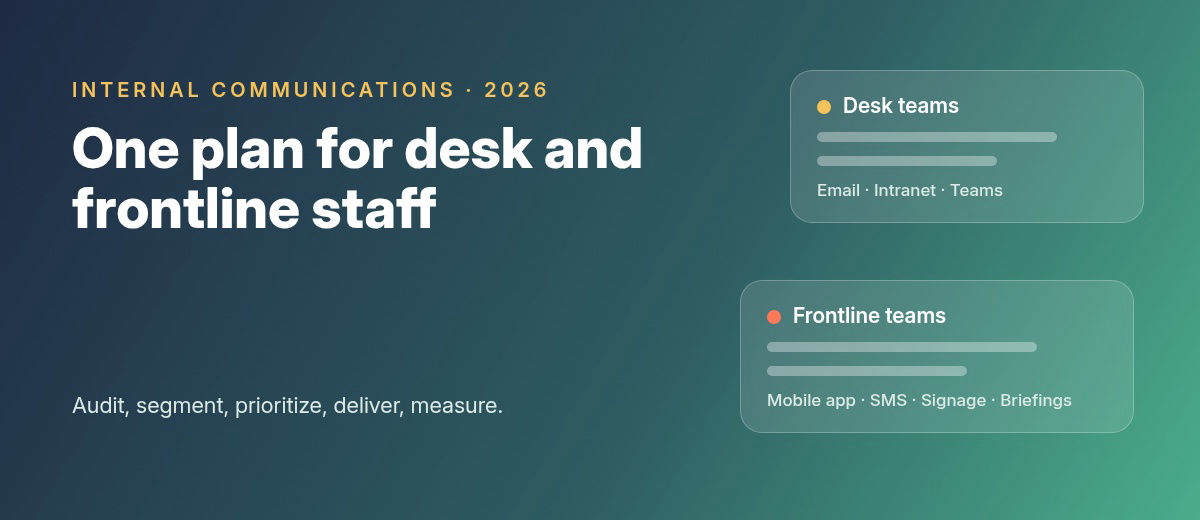
An effective internal communications plan for desk and frontline staff defines what employees need to know, how information reaches them, who is responsible for communicating it, and how results are measured. Start by auditing existing channels, segmenting employees by role and access, setting measurable objectives, assigning communication owners, and establishing two-way feedback.
Use email and intranets for desk-based employees alongside mobile apps, SMS, digital signage, and manager briefings for frontline teams.
Platforms such as Staffbase, HubEngage, Beekeeper, Blink, Workvivo, and Connecteam can support different parts of this strategy. However, the communication plan should come before the software. Employees must be able to receive, understand, and act on the information relevant to their jobs.
This guide explains how to build an internal communications plan in 2026, with a reusable template, channel comparison, software evaluation, implementation checklist, and performance metrics.
What Is an Internal Communications Plan?
An internal communications plan is a documented framework for delivering relevant information to employees across an organization.
It establishes communication objectives, target audiences, messaging priorities, channels, publishing schedules, responsibilities, feedback processes, and measurement methods.
For organizations with both desk-based and frontline employees, the plan must account for different working conditions.
For example:
- Corporate employees may use Microsoft Teams, email, and the company intranet throughout the day.
- Retail associates may only have a few minutes to check updates between customers.
- Manufacturing employees may need shift briefings, digital signage, and accessible mobile announcements.
- Healthcare employees may require concise operational updates delivered around patient-care responsibilities.
- Field workers may depend on mobile notifications, approved messaging channels, or supervisor contact rather than a company computer.
The goal is not to send identical messages through every available channel. It is to make essential information accessible to every affected employee in a format appropriate for their role.
Internal Communications Plan vs. Internal Communications Strategy
Although the terms are related, they serve different purposes.
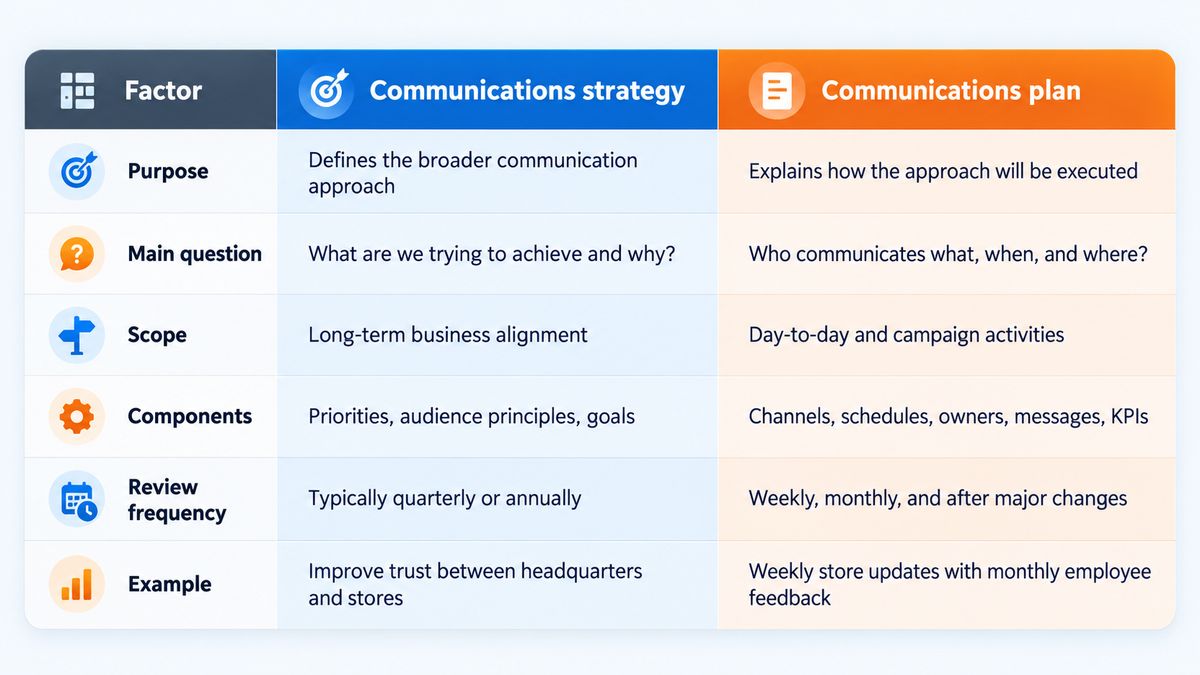
A communication strategy provides direction, while an internal communications plan turns that direction into repeatable activities.
Both should support organizational priorities without overlooking employees' actual working conditions.
Why Internal Communications Matter for Desk and Frontline Employees
Organizations can publish frequent updates while still leaving parts of their workforce uninformed.
A newsletter might reach corporate employees but miss warehouse workers. A manager might discuss a new procedure during the morning shift without informing the evening team. A policy might exist on the intranet but remain inaccessible to employees without corporate accounts.
These communication gaps can contribute to inconsistent procedures, duplicated work, employee frustration, and confusion during organizational changes.
According to Gallup's State of the Global Workplace 2026, 20% of employees worldwide were engaged at work in 2025. Engagement among employees working on-site in roles that could not be performed remotely was 17%.
The report was published in April 2026 using data collected during 2025.
These figures do not demonstrate that communication alone causes differences in employee engagement. Engagement depends on multiple factors, including management, working conditions, expectations, and organizational culture.
However, the findings reinforce the importance of understanding employees' circumstances rather than assuming one communication approach will work for everyone.
Mobile access also deserves attention.
Pew Research Center's January 2026 analysis, based on its 2025 U.S. survey, found that 16% of U.S. adults were smartphone-dependent for internet access. This means they owned a smartphone but did not subscribe to home broadband.
This is a measure of internet access among U.S. adults, not a measure specifically of frontline employees.
Mobile-first communication can improve accessibility, but employers should not assume that every worker has a suitable personal device, reliable connectivity, or permission to use that device for work.
Organizations also need to consider shared devices, workplace access points, language requirements, shift schedules, and employees who cannot access digital updates during working hours.
A practical communication strategy therefore combines digital tools with reliable workplace alternatives.
How to Build an Internal Communications Plan: 10 Steps
Step 1: Audit Your Current Internal Communications
Before introducing another communication channel, identify where existing information flows are working and where they fail.
Review communication tools, publishing processes, employee access, and feedback mechanisms.
Start with five questions:
- Which channels currently reach desk-based employees?
- Which channels can frontline employees actually access?
- How do different shifts receive time-sensitive information?
- Who owns company-wide and location-specific announcements?
- How can employees ask questions or report confusing instructions?
Interview representatives from headquarters, operations, HR, and frontline locations.
Include employees working different shifts and those who rarely use corporate communication systems. Otherwise, the audit may overrepresent the experiences of employees who are already well connected.
Examine available communication data, including newsletter readership, app activation, survey participation, acknowledgment records, and delivery failures.
Look beyond company-wide averages.
An organization may report strong overall readership while one location or shift consistently misses important announcements.
The CIPD's employee communication guidance covers planning, tailoring communications, management responsibilities, and multidirectional dialogue.
Practical output: A communications audit identifying existing channels, audience coverage, access barriers, ownership gaps, and baseline performance.
Step 2: Segment Employees by Role, Location, and Communication Access
Audience segmentation is essential when building an internal communications plan for a mixed workforce.
Employees need information relevant to their responsibilities without searching through unrelated announcements.
Build audience segments using factors such as department, location, shift, job function, language, employment type, and access to approved communication tools.
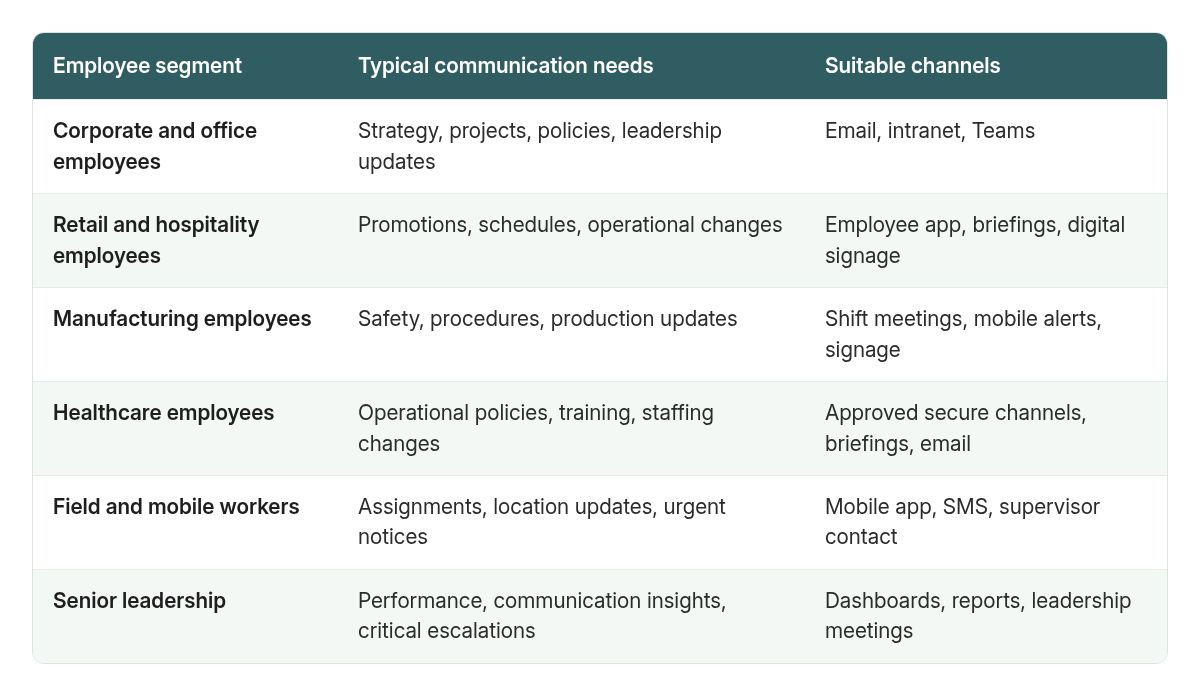
Segment employees carefully rather than creating an excessive number of overlapping groups.
For example, a safety update may need to reach everyone at a manufacturing facility, regardless of department.
A payroll announcement may require broad distribution but different instructions for hourly and salaried employees.
Each segment should have a defined primary channel and a backup method for essential information.
For employees without personal smartphones or corporate email accounts, consider shared workplace devices, scheduled briefings, approved noticeboards, or other accessible methods.
Maintain employee audience lists through approved HR systems and assign responsibility for keeping them current.
Practical output: An audience map connecting each employee group with its communication needs, preferred channels, backup methods, and language requirements.
Step 3: Set Clear, Measurable Communication Objectives
Communication goals should describe outcomes rather than simply publishing activity.
"Send more newsletters" is an activity.
"Increase the percentage of frontline employees who receive and understand schedule changes" is an outcome.
Choose objectives connected to organizational priorities, such as reducing missed operational updates, improving policy acknowledgment, strengthening employee feedback, and supporting change management.
Example objectives include:
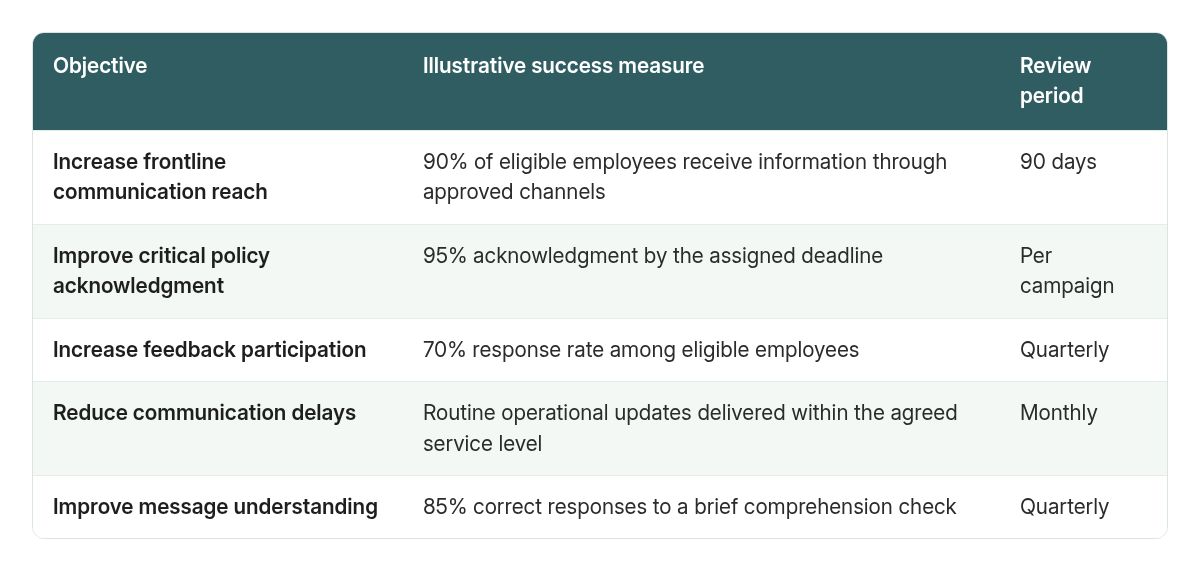
These figures are illustrative internal planning targets, not published industry benchmarks.
Organizations should establish their own targets based on baseline performance, workforce needs, the importance of each message, and available resources.
For high-priority communications, distinguish between:
- Delivery: Did the message successfully reach an approved destination?
- Readership: Did the employee open or access the information?
- Understanding: Did the employee understand the message?
- Action: Did the employee complete the required next step?
These are separate outcomes and should not be treated as interchangeable.
A policy acknowledgment, for instance, may indicate that an employee confirmed receipt without proving they understood the procedure.
Practical output: Three to five communication objectives with defined metrics, owners, baselines, and deadlines.
Step 4: Create a Message Priority Framework
Not every internal announcement requires the same urgency or distribution method.
A company anniversary message should not compete with an urgent safety instruction.
Classify communications into practical categories.
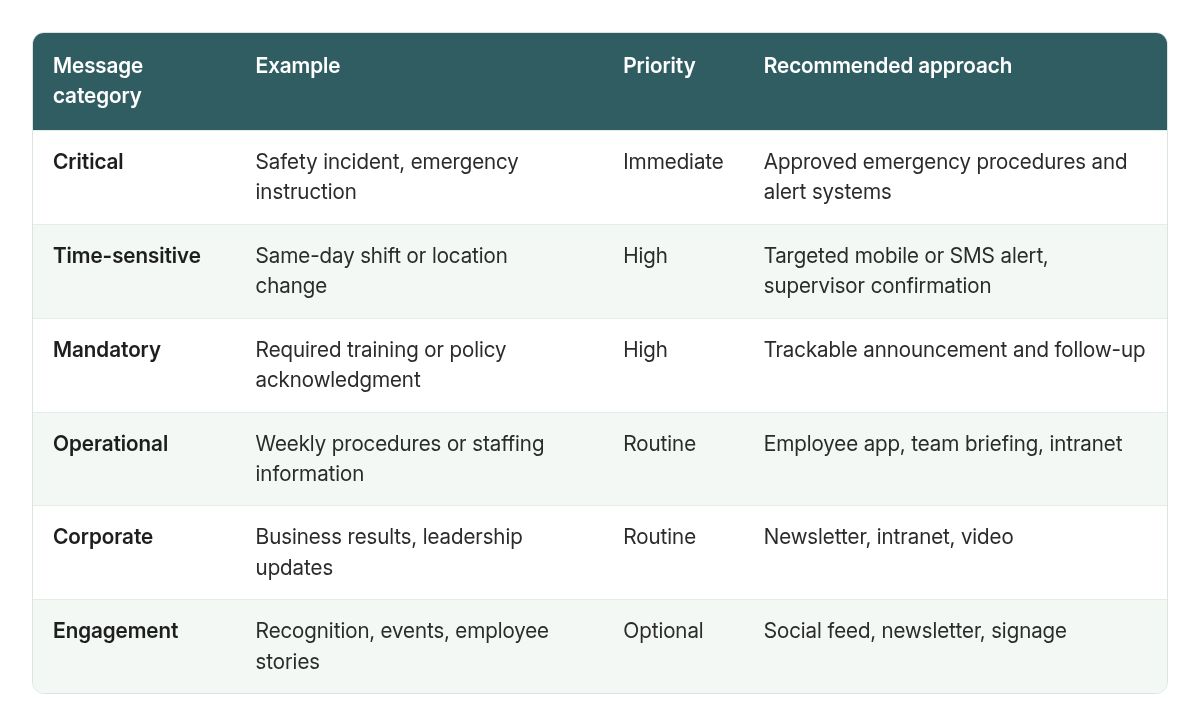
A communication priority framework helps prevent notification fatigue.
Reserve interruptive alerts for information that genuinely requires immediate attention. Schedule routine announcements at predictable intervals whenever possible.
For high-priority messages, define what happens when the primary channel fails.
For example, if a manufacturing employee cannot receive a mobile alert during a shift, the escalation procedure might require the supervisor to deliver the message in person and record completion when appropriate.
Emergency communications require additional safeguards.
Organizations must follow applicable workplace safety requirements rather than relying solely on a commercial employee communication app.
OSHA's guidance on employee alarm systems explains requirements for workplace alarm systems, including employees' ability to perceive and understand emergency warnings where the standard applies.
Practical output: An approved communication priority policy covering message categories, delivery methods, escalation paths, and emergency exceptions.
Step 5: Select the Right Internal Communication Channels
No single communication channel is ideal for every employee or message.
Use a multichannel approach in which each platform has a defined purpose.
Internal Communications Channel Comparison
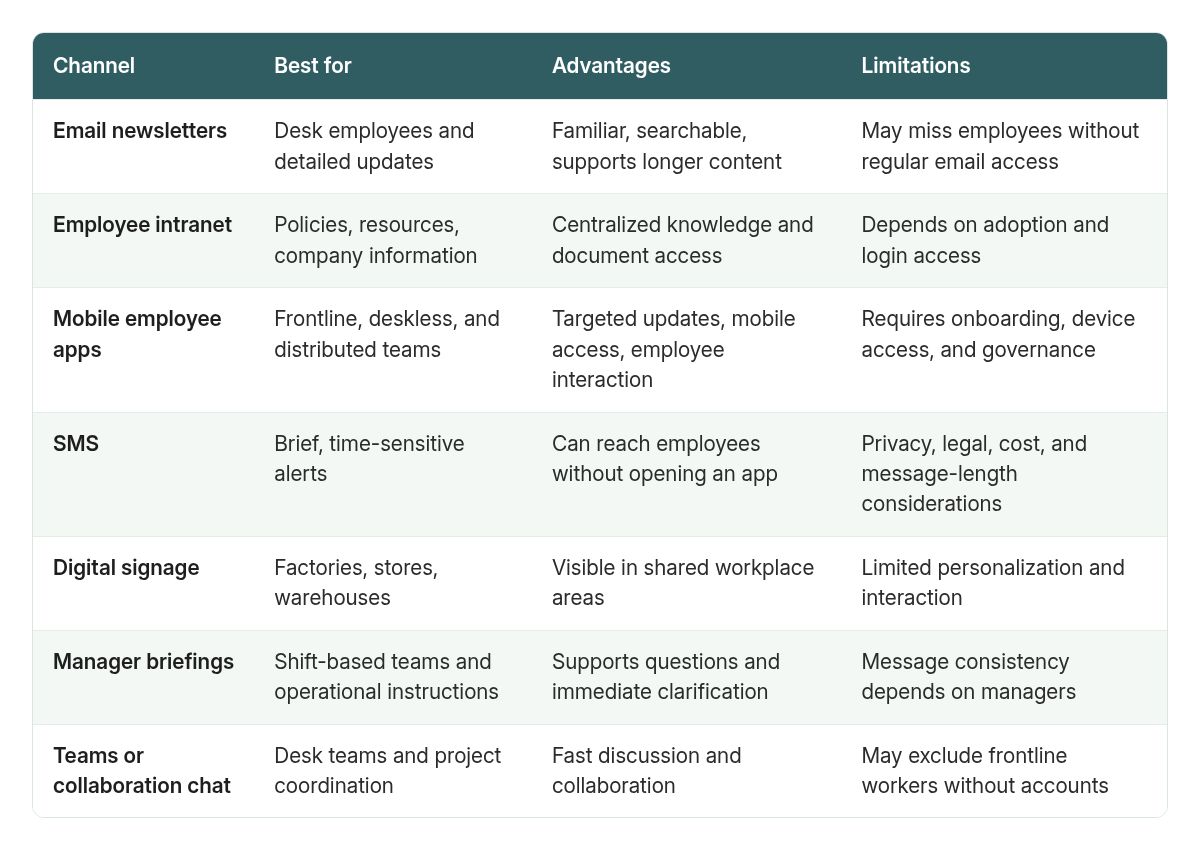
Select a primary channel for each employee segment and supporting channels for important communications.
For example, headquarters might distribute a policy through the intranet and email, while retail staff receive a mobile summary followed by a manager briefing.
The underlying policy should have one approved source of truth, even when it is distributed through several formats.
Avoid making employees read multiple identical announcements unless repetition serves a specific communication purpose.
Organizations evaluating their employee information systems can also use this modern intranet software comparison to understand different employee hub and workplace communication options.
Step 6: Assign Communication Ownership and Governance
Even a well-designed communication system can fail when nobody knows who is responsible for publishing, approving, or correcting information.
Define ownership before launching the plan.
A practical governance structure could include:
- Internal communications: Owns the overall plan, editorial calendar, and company-wide announcements.
- HR: Owns people policies, benefits communication, and employee surveys.
- Operations: Validates frontline procedures, shift information, and location-specific updates.
- Local managers: Reinforce essential messages and report employee questions.
- IT and security: Manage platform access, integrations, privacy, and technical support.
- Leadership: Communicates company direction and sponsors major changes.
Approval requirements should reflect the potential impact of a message.
Routine announcements might need one approval. Communications involving employee safety, legal obligations, security incidents, or employment policies may require specialist review.
Maintain one approved version of critical documents and record when each version was published.
For important campaigns, keep an approval record showing who prepared the content, who validated the information, who authorized distribution, and who is responsible for corrections.
Organizations operating in regulated industries should establish appropriate rules for confidential information, employee data, access permissions, and message retention.
Governance should also cover communication through personal devices, including employee choice, working-time considerations, and applicable workplace policies.
Practical output: A communication ownership matrix with publishing permissions, approval procedures, escalation responsibilities, and document controls.
Step 7: Build a Consistent Internal Communications Calendar
A communication calendar gives employees predictable opportunities to receive information.
It also prevents HR, IT, operations, and leadership from sending overlapping campaigns without coordination.
A practical schedule might include:
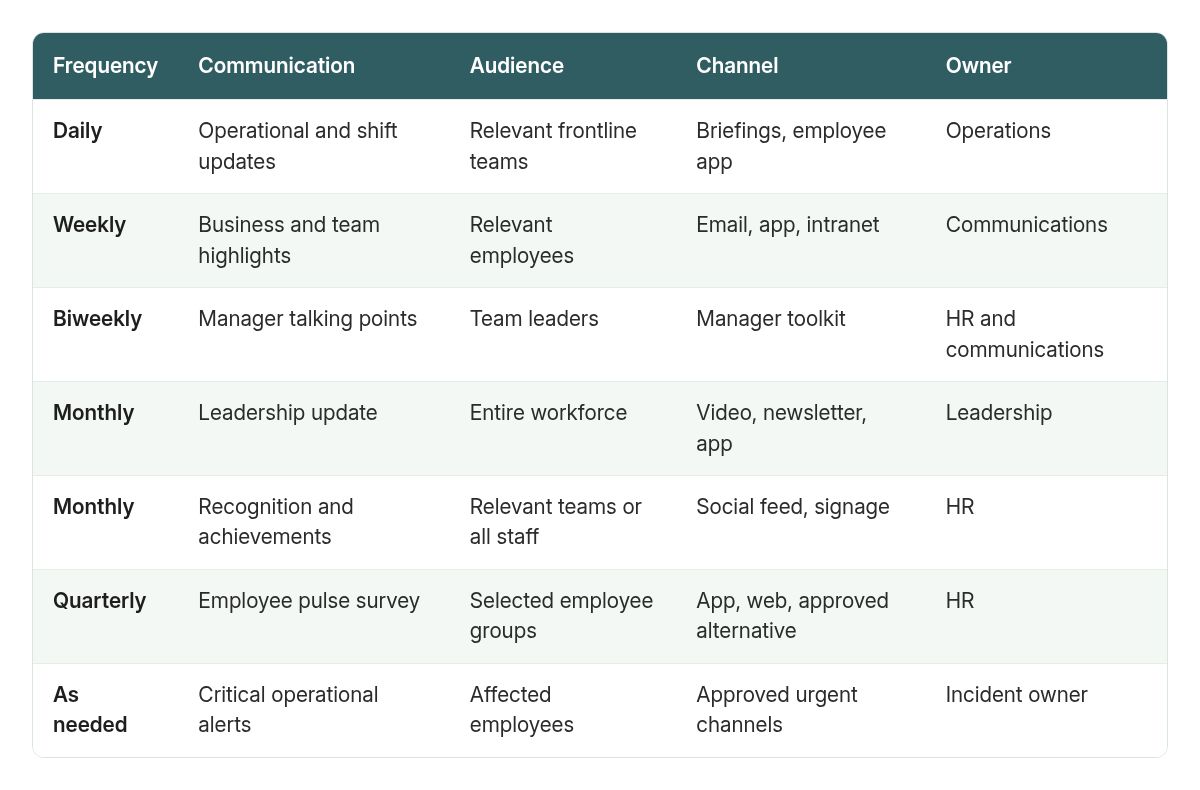
The calendar should record the planned publishing date, target audience, communication owner, approval status, required action, and measurement method.
Avoid scheduling communications based only on headquarters working hours.
Consider shifts, weekends, time zones, and employees who are not expected to monitor work-related messages outside their scheduled working time.
Where communications require action, specify a realistic deadline that allows employees across shifts to respond.
For organizations using email as part of their communication strategy, this guide to internal newsletter software tools provides additional options.
Step 8: Introduce Two-Way Employee Communication
Employees should be able to communicate with leadership, not simply receive corporate announcements.
Two-way communication helps organizations identify problems, clarify confusing instructions, and understand how policies affect daily work.
Useful mechanisms include pulse surveys, anonymous suggestion forms where supported, manager feedback sessions, moderated employee discussions, and regular leadership Q&A sessions.
The CIPD's 2026 employee voice factsheet explains that employee voice involves communicating views and having opportunities to influence workplace matters.
Collecting feedback is only the beginning.
Organizations need a clear process for reviewing concerns, assigning responsibility, taking action, and communicating outcomes.
For example, employees may report that schedule updates arrive after their shifts have ended.
The communications team could respond by changing notification timing, introducing shift-targeted messages, and checking whether the revised process reduces missed updates.
A practical feedback cycle is:
Ask → Listen → Categorize → Assign → Act → Communicate the outcome.
Where appropriate, feedback systems should also give employees a safe way to raise sensitive concerns outside their direct management chain.
Protect confidentiality and avoid promising anonymity unless the chosen process genuinely supports it.
Employees should also know when they can expect a response and where unresolved concerns can be escalated.
Practical output: A recurring employee feedback process with assigned owners, response expectations, and a way to report outcomes.
Step 9: Make Every Message Clear, Accessible, and Actionable
Internal communications should be easy to understand during a busy working day.
Start with the most important information rather than a lengthy introduction.
Use a consistent message structure:
- What is changing?
- Who is affected?
- When does the change take effect?
- What action is required?
- Where can employees get help?
Consider the following example.
Weak announcement:
"We are pleased to share that an operational scheduling transformation initiative will be implemented next week."
Improved announcement:
"Starting Monday, October 19, all store employees must check their updated shifts in the scheduling app before their next scheduled workday. Contact your store manager if you cannot access your schedule."
The second version identifies the change, effective date, required action, and support contact.
The CDC's plain-language resources recommend putting important information first, using familiar words, and organizing content around audience needs.
Digital communication should also account for accessibility.
Use readable formatting, meaningful headings, sufficient color contrast, captions for video, accessible documents, and appropriate language alternatives.
The W3C Web Content Accessibility Guidelines 2.2 provide a technical reference for accessible digital content.
When important information is translated, arrange suitable review before publication, particularly for safety instructions, legal notices, and sensitive employment communications.
Practical output: A standard message template supported by plain-language, accessibility, translation, and approval checks.
Step 10: Launch a Pilot, Measure Results, and Improve
Avoid introducing a company-wide communication system without first testing it with employees who represent different working conditions.
Select a pilot group that reflects the workforce.
For example, a retailer might test the plan with one corporate department, three stores, and employees from different shifts.
Evaluate whether employees can access messages, understand instructions, and complete required actions.
Collect feedback from managers and employees.
Review technical problems such as login failures, notification permissions, inaccessible documents, and outdated audience lists.
Identify whether the proposed backup communication channels work when the primary channel is unavailable.
Then adjust the plan before expanding the rollout.
A 90-day implementation sequence could look like this:
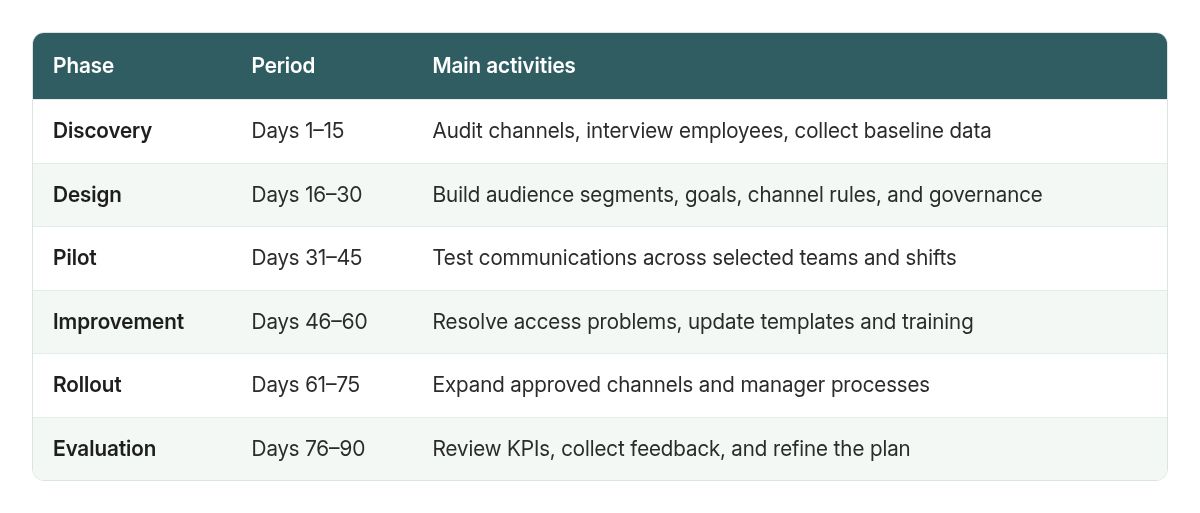
This is an illustrative implementation schedule rather than a universal deployment timeline. Larger organizations, particularly those with complex security, HR, or procurement requirements, may need more time.
Practical output: A tested internal communications plan supported by documented rollout responsibilities and performance baselines.
Internal Communications Plan Template for Desk and Frontline Staff
The following template can be adapted for a retail chain, healthcare provider, manufacturing company, hospitality business, or another organization with a mixed workforce.
Example: Organization With 1,000 Employees
Assume an illustrative organization has 300 office employees and 700 frontline employees across several locations.
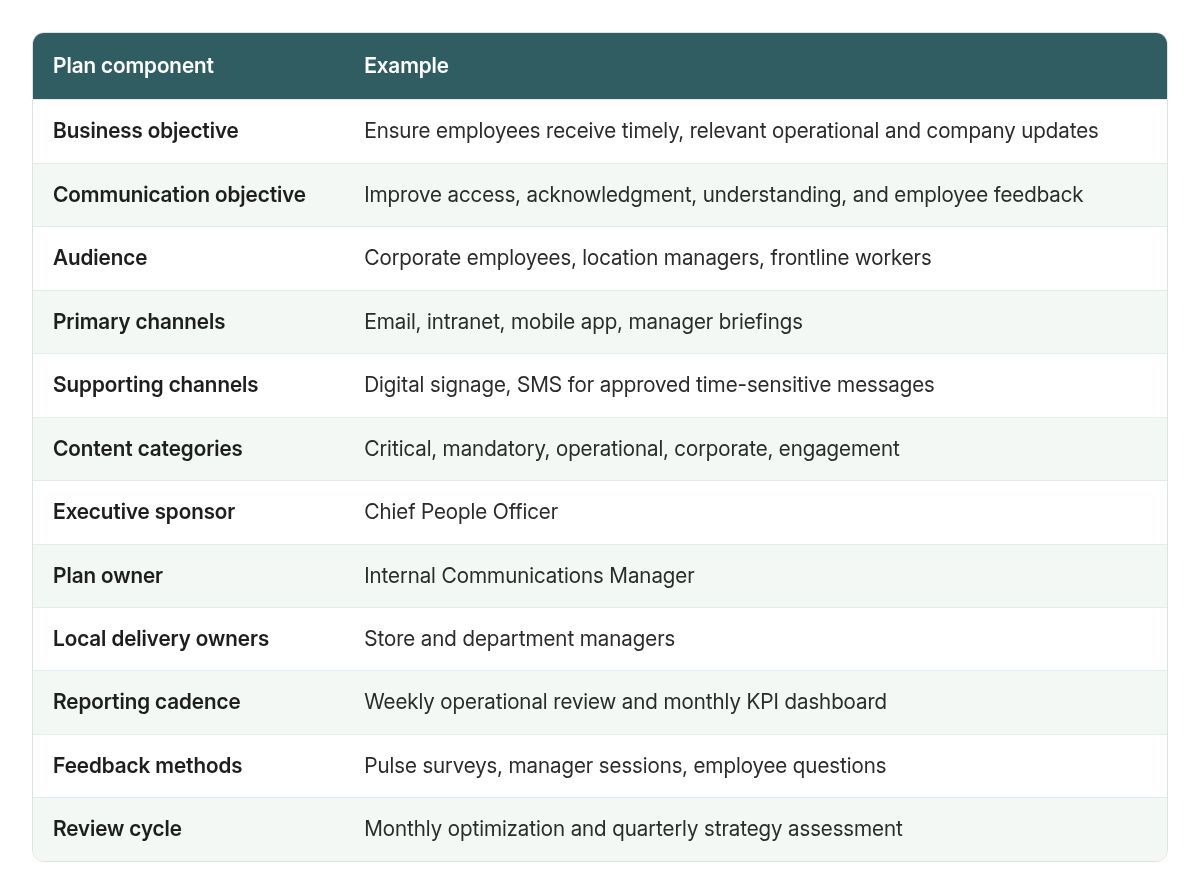
Sample Communication Campaign
Campaign: New employee safety procedure
Objective: Ensure all affected employees understand and follow the revised procedure before its effective date.
Audience: Operations teams, shift supervisors, and relevant corporate staff.
Message: Explain what is changing, why the change matters, when it takes effect, and what employees must do.
Distribution: Employee app, supervisor briefings, updated document library, and approved workplace signage.
Action required: Complete the assigned training or acknowledgment, depending on the procedure.
Measurement: Eligible audience coverage, confirmed delivery where measurable, acknowledgments, comprehension checks, and overdue follow-ups.
Ownership: Operations approves the content, internal communications distributes it, and managers verify required completion.
Fallback procedure: Employees who cannot access the digital announcement receive the approved information through a supervisor-led briefing or another authorized method.
This structure turns an announcement into a measurable operational process.
For safety-related changes, the communications campaign should support—not replace—required training, supervision, and workplace safety procedures.
Reusable Message Planning Template
For each important communication, record the following details before publication.
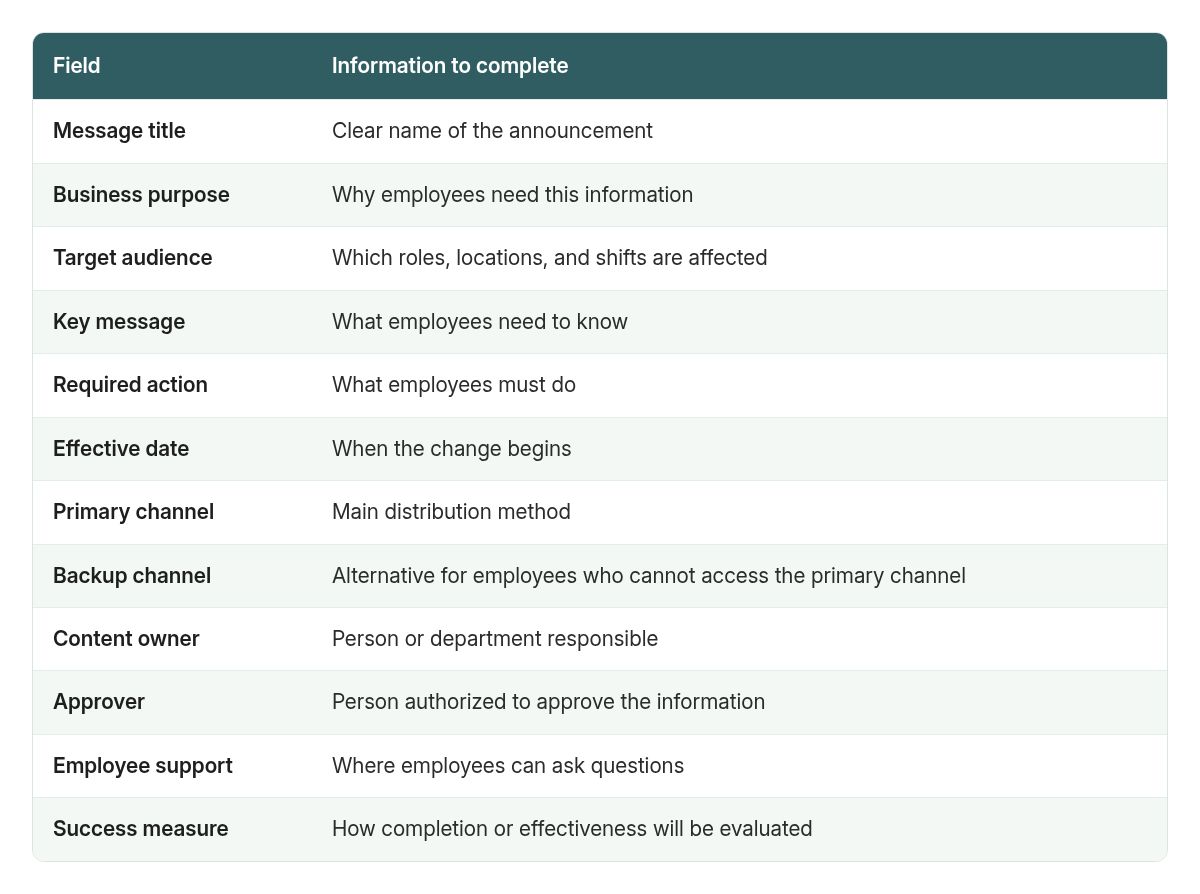
Maintaining these fields in a shared calendar or project management system makes it easier to coordinate announcements across departments.
How to Measure Internal Communications Effectiveness
Internal communication measurement should move beyond counting emails, posts, and notifications.
A high publishing volume does not demonstrate that employees received, understood, or acted on important information.
Use a balanced KPI dashboard.
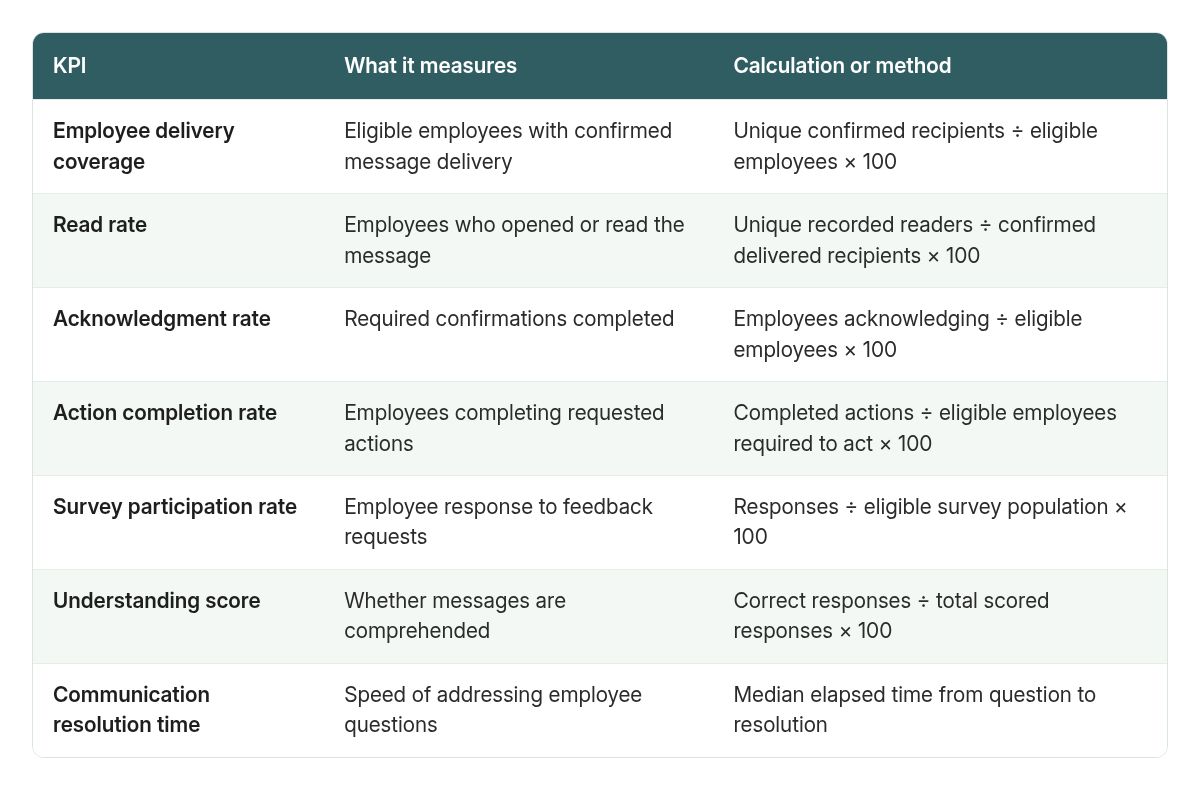
These measurements need consistent definitions.
For example, a delivered notification does not prove an employee read the message.
A read receipt does not prove understanding.
An acknowledgment does not necessarily prove compliance with a procedure.
The distinction matters when communicating mandatory training, safety changes, or sensitive employment policies.
Measuring Channels Without Individual Read Receipts
Not every communication channel provides person-level analytics.
Digital signage, printed notices, and in-person briefings may not automatically generate delivery or readership data.
Organizations can use appropriate alternatives, including:
- Supervisor confirmation that a briefing took place.
- Voluntary employee comprehension checks.
- Short surveys about whether employees received important information.
- Attendance or training records where collection is appropriate.
- Sampling across shifts and locations to identify communication gaps.
These methods provide different levels of evidence and should not be presented as equivalent to verified individual delivery records.
Compare results across locations, roles, and shifts while respecting privacy and avoiding unnecessary individual surveillance.
Example KPI Dashboard
Assume an internal policy update was distributed to 1,000 eligible employees.
- 900 employees had confirmed message delivery.
- 810 were recorded as having read the announcement.
- 760 acknowledged the policy.
- 680 completed the required learning activity.
The corresponding results are:
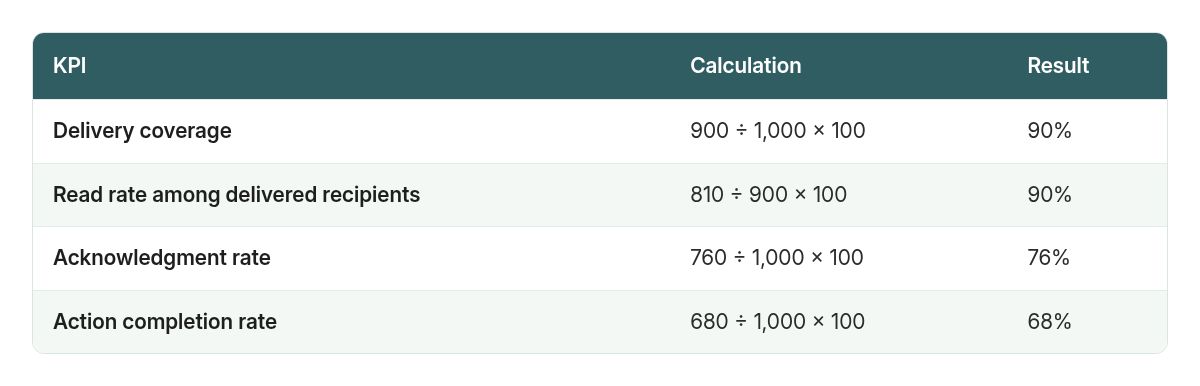
This illustrative example reveals an important distinction: successful distribution did not translate into universal action.
The next step would be to investigate why eligible employees did not complete the activity.
Possible reasons include access problems, unclear instructions, scheduling conflicts, insufficient training time, or a lack of manager follow-up.
Sending more notifications may not resolve those underlying problems.
Internal Communication Platforms to Consider in 2026
Software should support the communication plan rather than determine it.
The following six platforms are relevant to organizations communicating with desk-based, frontline, and distributed employees.
They are compared by intended use case rather than ranked by overall superiority.
The evaluation considers communication channels, frontline accessibility, employee feedback, administration, integrations, and deployment trade-offs.
Quick Platform Comparison
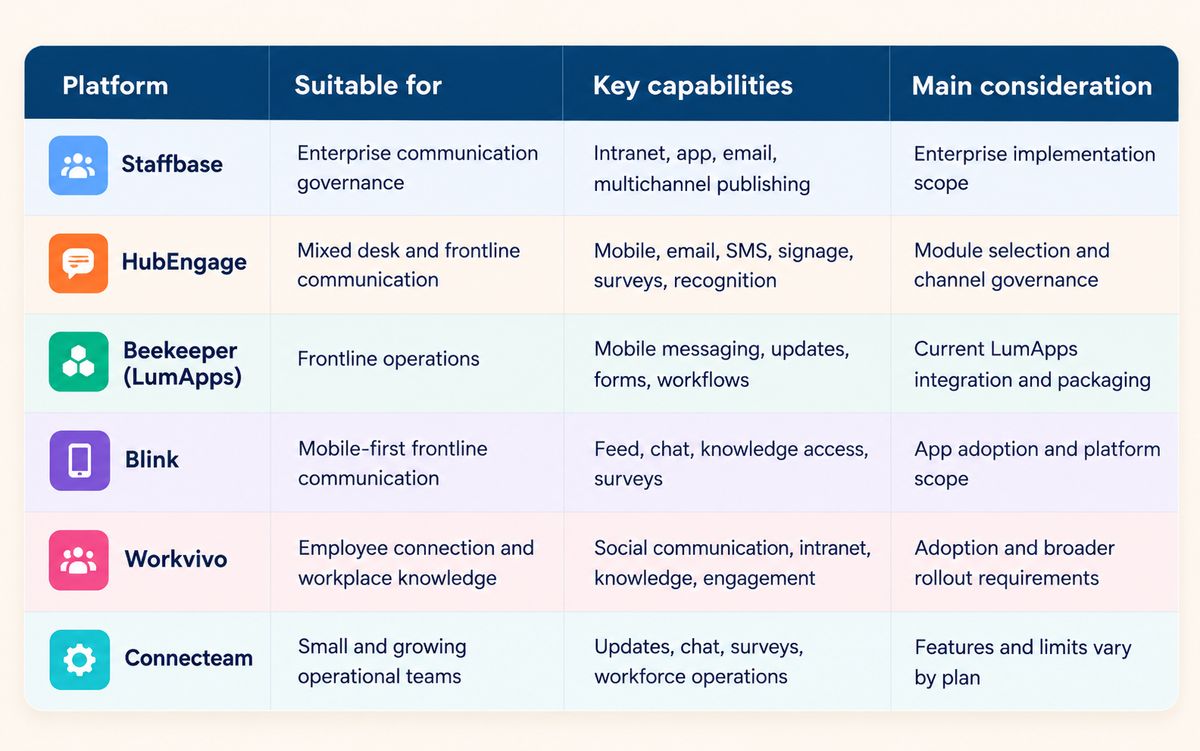
1. Staffbase
Best for: Large organizations needing centralized communication governance across corporate and frontline teams.
Key capabilities: Staffbase offers an employee intranet, branded mobile app, internal email, SMS, digital signage, and communication analytics. Its platform supports coordinated publishing and communication across different employee channels.
Strengths: Staffbase is worth considering when multiple departments need consistent publishing standards and centralized oversight. Its intranet and communication tools can support organizations with distributed audiences and complex information-management requirements.
Limitations: Buyers should assess implementation effort, content migration, ongoing administration, employee training, and whether all proposed modules are necessary. Organizations seeking a basic messaging tool may not require the full breadth of the platform.
Pricing: Request a current quote and confirm licensing, required channels, implementation services, and support costs.
Choose Staffbase if: Enterprise-wide communication coordination, governance, and integrated employee information access are major priorities.
2. HubEngage
Best for: Organizations combining office-based, frontline, shift-based, and distributed employees.
Key capabilities: HubEngage supports employee communication through mobile apps, web, email, SMS, and digital signage. Its broader platform includes surveys, recognition, social features, messaging, document access, and communication analytics.
Strengths: HubEngage is relevant when employees depend on different communication channels, and teams want to distribute targeted information from a centralized system. Its multichannel publishing and feedback capabilities can support both operational announcements and broader employee engagement initiatives.
Limitations: Organizations should confirm which communication and engagement modules are included in a proposed package. Audience-data management, access permissions, location-level publishing, and channel governance still require planning. Buyers should also validate how the platform integrates with their existing employee systems.
Pricing: Request vendor-provided pricing based on employee count, selected capabilities, contract terms, and implementation requirements.
Choose HubEngage if: Multichannel reach, employee feedback, and consistent communication across desk and frontline populations are central requirements.
3. Beekeeper (Part of LumApps)
Best for: Frontline-heavy organizations connecting employee communication with daily operational work.
Key capabilities: Beekeeper, now part of LumApps, provides mobile-first communication, targeted updates, messaging, digital forms, checklists, workflow support, and access to frontline knowledge and operational resources.
Strengths: Its frontline orientation makes it relevant to workplaces where employees need operational information without relying on corporate email. Communication can connect with activities such as accessing procedures, completing forms, managing tasks, and coordinating everyday work.
Limitations: As Beekeeper operates within the broader LumApps offering, buyers should verify current integrations, product packaging, contract terms, and the availability of relevant capabilities. Existing customers and new buyers may have different deployment considerations.
Pricing: Obtain a current proposal and confirm licensing, workflow functionality, integrations, and implementation costs.
Choose Beekeeper if: Frontline accessibility, operational workflows, and employee communication need to work together.
4. Blink
Best for: Organizations prioritizing a mobile-first communication experience for frontline employees.
Key capabilities: Blink combines employee updates, messaging, knowledge access, surveys, and engagement tools. Its mobile-focused approach helps organizations communicate with employees who do not regularly work at a desk or use corporate email.
Strengths: Blink brings announcements, useful documents, and employee interaction into a centralized experience. Its communication, knowledge, and engagement capabilities may be useful when an organization wants frontline employees to access information through one primary workplace app.
Limitations: Deployment still requires employee onboarding, device-access planning, notification governance, and integration testing. Buyers should evaluate how its communication and operational capabilities fit existing HR, IT, and workforce systems.
Pricing: Blink publishes subscription pricing for certain plans, while larger deployments should confirm current commercial terms, implementation costs, and feature availability.
Choose Blink if: Mobile-first frontline communication and a consistent employee app experience are high priorities.
5. Workvivo
Best for: Organizations emphasizing workplace culture, employee participation, and shared company knowledge.
Key capabilities: Workvivo offers employee communications, intranet capabilities, social engagement, messaging, recognition-oriented features, livestreaming, and knowledge access. Workvivo HQ, announced in June 2026, brings AI-assisted information access and workplace capabilities into the wider platform offering.
Strengths: Workvivo is relevant when organizations want employees to participate in workplace conversations instead of only receiving announcements. Its community-oriented features can support connections among corporate employees, distributed teams, and frontline staff.
Limitations: Buyers should assess how essential operational updates, permissions, access controls, integrations, and frontline communication workflows fit the platform. A successful rollout may require content governance and employee adoption support across multiple teams.
Pricing: Contact Workvivo to confirm current licensing, required capabilities, implementation services, and support terms.
Choose Workvivo if: Employee connection, workplace community, and accessible organizational knowledge are major priorities.
6. Connecteam
Best for: Small and growing organizations looking to combine employee communication with workforce operations.
Key capabilities: Connecteam provides employee announcements, chat, surveys, and targeted communication. Its wider platform includes scheduling, time tracking, and other workforce-management and HR-related tools.
Strengths: Connecteam may suit operations-led businesses that want communication functionality alongside scheduling and everyday workforce coordination. Its mobile approach is relevant to retail, hospitality, field services, and other distributed teams.
Limitations: Buyers should review plan-level restrictions, employee counts, administrative requirements, integrations, and feature packaging. The communication tools may be most useful for organizations that also need related workforce-management functions.
Pricing: Connecteam offers a free Small Business Plan for up to 10 users, subject to eligibility and configuration conditions. Larger teams should confirm the applicable paid plans and additional-user costs.
Choose Connecteam if: Practical team communication and workforce-management functionality are needed within one operational platform.
How Should You Choose Between These Platforms?
Start with the communication problem rather than the number of features.
An enterprise coordinating multiple communication departments may prioritize Staffbase.
A mixed workforce requiring mobile, email, SMS, digital signage, and employee feedback may shortlist HubEngage.
For operational frontline workflows, Beekeeper or Connecteam may be relevant.
Blink deserves consideration when mobile-first communication and knowledge access are central requirements, while Workvivo may suit organizations emphasizing employee participation and workplace culture.
These are starting points for evaluation, not conclusions about which product will perform best in every organization.
During vendor demonstrations, require each provider to complete the same practical scenario:
Deliver a policy update to 300 office employees and 700 frontline employees working across two shifts.
Ask the vendor to demonstrate how the platform:
- Selects the correct employee audiences.
- Distributes the update through appropriate channels.
- Supports employees without corporate email access.
- Collects acknowledgment where required.
- Identifies delivery failures or incomplete actions.
- Provides managers with appropriate follow-up information.
- Reports results by location and employee group.
The demonstration should use realistic workflow requirements rather than only polished sample dashboards.
Compare implementation effort, accessibility, security, HR-system integrations, ongoing administration, support, and total cost.
A smaller feature set that meets the organization's actual needs may be more useful than a broader platform that introduces unnecessary complexity.
How Can AI Improve Internal Communications in 2026?
AI can support internal communications teams by reducing routine administrative work and helping employees find relevant information.
Potential applications include:
- Content drafting: Creating initial versions of newsletters, employee announcements, and manager talking points.
- Translation: Preparing multilingual versions of approved messages, subject to appropriate review.
- Content targeting: Helping communication teams organize information for relevant employee groups.
- Knowledge assistance: Helping employees find approved policies and resources when the underlying content is accessible and reliable.
- Survey analysis: Summarizing recurring themes in employee feedback.
- Measurement: Identifying communication trends, delivery gaps, and recurring questions.
These capabilities depend on the specific AI system, its configuration, available integrations, and permissions.
AI-generated content may also contain errors, omit context, or present outdated information.
For that reason, organizations should not allow AI to independently approve sensitive employment policies, safety instructions, confidential disclosures, or legally consequential communications.
Human reviewers should validate important facts, instructions, and translations before distribution.
Employee data also requires appropriate safeguards. Organizations should consider access controls, information retention, vendor data practices, and the handling of confidential feedback.
The NIST AI Risk Management Framework provides a useful foundation for evaluating AI-related risks and governance.
AI can support faster communication workflows, but it does not replace accountability, accurate source information, or employee trust.
Internal Communications Implementation Checklist
Use this checklist before launching or refreshing an internal communications plan.
Strategy and Governance
- Define measurable communication objectives.
- Identify the executive sponsor and plan owner.
- Complete an audit of existing communication channels.
- Assign publishing, approval, and escalation responsibilities.
- Establish rules for critical and routine announcements.
Employee Accessibility
- Segment employees by role, location, shift, and access needs.
- Confirm communication options for employees without corporate email.
- Provide suitable alternatives for employees without smartphone access.
- Review language, accessibility, privacy, and device requirements.
- Train managers to reinforce important updates.
Execution and Measurement
- Create a shared communications calendar.
- Establish standard announcement templates.
- Introduce two-way employee feedback.
- Set baseline KPIs and realistic improvement targets.
- Test the system with representative employee groups.
- Review communication results monthly.
- Update the plan after major operational or workforce changes.
A useful plan makes these responsibilities visible and repeatable rather than leaving them dependent on informal conversations.
Common Internal Communications Mistakes to Avoid
Relying entirely on email: This can exclude frontline employees who lack regular inbox access. Provide approved alternatives that work during their scheduled shifts.
Sending every message to everyone: Excessive notifications reduce relevance. Use appropriate audience targeting and communication priorities.
Assuming delivery means understanding: A sent notification is not evidence of comprehension or action. Measure the outcomes that matter for each message.
Excluding local managers: Managers help clarify operational information, reinforce instructions, and identify communication barriers. Provide approved talking points and escalation procedures.
Collecting feedback without acting: Employees need to see how feedback influences decisions or understand why a requested change cannot be made.
Ignoring privacy and working time: Personal-device policies, off-hours messages, information retention, and timekeeping requirements need appropriate review, particularly where employees are not expected to monitor communications outside paid working hours.
Buying software before defining the process: Technology cannot resolve unclear ownership, inaccurate employee lists, inaccessible content, or poorly written messages by itself.
Frequently Asked Questions
1. What Should an Internal Communications Plan Include?
An internal communications plan should include communication objectives, employee audience segments, messaging priorities, delivery channels, publishing schedules, assigned owners, approval procedures, feedback mechanisms, and performance indicators.
For mixed workforces, it should also explain how employees without corporate email or reliable mobile access will receive essential information.
The plan should identify where approved policies are stored and how employees can raise questions.
2. How Do You Communicate Effectively With Frontline Workers?
Use communication channels that fit employees' working conditions.
Mobile employee apps, SMS for appropriate alerts, manager briefings, shared workplace displays, and accessible knowledge resources can all play a role.
Messages should be concise, relevant, and available at appropriate times across shifts.
For critical changes, provide clear instructions and a way to confirm receipt or understanding when necessary.
Avoid assuming every employee can use a personal phone for work.
3. What Is the Best Communication Channel for Desk and Frontline Employees?
There is no single best channel for every organization.
Email and intranets are often practical for desk-based staff. Mobile apps, manager briefings, and workplace displays may be more suitable for frontline employees.
The appropriate approach is to establish primary and supporting channels based on employee access, message urgency, and communication purpose.
4. How Often Should Organizations Update Their Internal Communications Plans?
Review operational communication performance monthly and reassess the broader plan at least quarterly.
An annual strategic review can help align communication goals with organizational changes.
Update the plan sooner after mergers, major policy changes, new locations, technology deployments, or significant workforce changes.
5. How Do You Measure Internal Communications Effectiveness?
Measure delivery coverage, readership, acknowledgment, action completion, feedback participation, and message understanding.
Analyze results by relevant employee groups to identify unequal access, poor timing, or communication barriers.
Avoid relying entirely on email open rates, notification deliveries, or the number of announcements published.
6. What Role Do Managers Play in Frontline Communication?
Frontline managers help translate organization-wide announcements into practical operational instructions, clarify questions, and identify employees who need additional support.
They can also report recurring concerns to HR and communication teams.
Organizations should provide managers with approved talking points, clearly defined responsibilities, and reliable escalation paths rather than expecting them to interpret complex policies independently.
7. Can a Small Business Create an Internal Communications Plan Without Expensive Software?
Yes.
Smaller businesses can begin with a shared communication calendar, approved email or messaging tools, team meetings, accessible documents, and a simple employee feedback process.
As employee numbers, locations, and communication requirements grow, dedicated software may help automate audience targeting, delivery, acknowledgments, and reporting.
The central requirements remain the same regardless of organization size: clarity, accessibility, ownership, and measurement.
Final Thoughts
Building an internal communications plan for desk and frontline staff in 2026 requires more than choosing an employee communication app or publishing regular company announcements.
An effective plan begins with employees' actual working conditions. It establishes communication responsibilities, identifies accessible channels, creates opportunities for feedback, and measures whether important information leads to understanding and action.
Platforms such as Staffbase, HubEngage, Beekeeper, Blink, Workvivo, and Connecteam offer different ways to support those goals. Their value depends on how well their capabilities fit an organization's communication requirements, workforce structure, and available resources.
The goal is not to send the most messages. It is to make sure employees can reliably access and act on the information they need to do their jobs.