Best White-Label Local Marketing Platforms for Franchisors Compared
Compare 7 white-label local marketing platforms for franchisors: Synup, Vendasta, Uberall, SOCi, Yext, Birdeye, and BrightLocal, with pricing.
Sandeep Kumar
The best white-label local marketing platforms for franchisors to compare include Synup, Vendasta, Uberall, SOCi, Yext, Birdeye, and BrightLocal. Each serves a different requirement, from branded franchisee dashboards and marketing service delivery to enterprise listings management, reputation monitoring, and local SEO reporting.
Synup is worth considering for branded local marketing dashboards, Vendasta for reselling marketing services, and Uberall for managing location information across large networks. SOCi specializes in enterprise marketing automation, Yext emphasizes structured business data, Birdeye focuses on reputation and customer experience, and BrightLocal offers branded local SEO reporting.
However, not every franchise marketing platform provides the same level of white labeling.
Some vendors allow businesses to customize the customer-facing software experience with their own branding. Others provide branded reports, reseller integrations, or partner-specific configurations.
A franchisor managing 30 locations may need affordable listings management and a straightforward franchisee dashboard. A national franchise system with 500 locations may prioritize hierarchical permissions, corporate approvals, integrations, and location-level reporting.
This guide compares seven platforms based on their documented capabilities, white-label options, pricing models, limitations, and suitability for different franchise organizations.
Which White-Label Franchise Marketing Platform Should You Choose?
The right platform depends on whether your priority is branding, local marketing operations, enterprise administration, or reselling services to franchisees.
- Synup: Best for: Branded local marketing dashboards. Main advantage: Combines listings, reviews, social publishing, local SEO tools, and white-label client access.
- Vendasta: Best for: Franchisors reselling marketing services. Main advantage: Branded client portal, service marketplace, billing, and marketing automation.
- Uberall: Best for: Large multi-location franchise networks. Main advantage: Centralized location information, publisher distribution, and white-label partner integrations.
- SOCi: Best for: Enterprise franchise marketing automation. Main advantage: Corporate-to-local workflows, search, social, reputation management, and AI-assisted execution.
- Yext: Best for: Enterprise listings and structured location data. Main advantage: Centralized business information, publisher integrations, and reseller branding.
- Birdeye: Best for: Reputation and customer experience. Main advantage: Review management, customer engagement, listings, and partner white-label options.
- BrightLocal: Best for: Franchise agencies and local SEO reporting. Main advantage: Branded reports, local rankings, citation management, and client dashboards.
What Is a White-Label Local Marketing Platform for Franchisors?
A white-label local marketing platform allows a franchisor, franchise marketing organization, or agency to deliver marketing software and services through an experience presented under its own branding.
Depending on the vendor and contract, white labeling may include custom logos, brand colors, a branded domain, customized email notifications, client-facing dashboards, and marketing reports.
Franchisors typically use these platforms to coordinate local marketing activities across multiple locations without developing every software component internally.
Common capabilities include:
- Business listing management across multiple locations
- Google Business Profile management and local SEO monitoring
- Online review monitoring, response workflows, and reputation management
- Local social media publishing and campaign approvals
- Franchisee dashboards and location-specific reporting
- Corporate administration and marketing automation
- CRM, analytics, API, and other business integrations
For example, a franchisor operating 150 locations might provide franchisees with a branded marketing dashboard.
Corporate administrators could manage approved business information and national campaigns, while individual franchisees could monitor reviews, update permitted location details, and evaluate their local marketing performance.
The software provider supplies the underlying technology while the franchise organization controls the permitted customer-facing experience.
Why Does White Labeling Matter for Franchise Businesses?
Franchisors need to coordinate marketing across independently operated locations while maintaining a consistent brand identity.
White-label software can create a familiar environment where franchisees access marketing information, performance reports, and approved tools.
It may also simplify service delivery when headquarters sells or distributes marketing packages to franchisees.
However, white labeling and franchise marketing functionality are not the same thing.
A branded login does not automatically provide enterprise permissions, bulk updates, approval workflows, or data governance.
For franchise systems, those operational capabilities can be more important than removing a software provider's logo.
Three Levels of White-Label Functionality
The term white label can describe different types of software customization.
- Branded reporting: What it generally includes: Custom logos, colors, reports, and reporting portals. Suitable use case: Agencies providing franchise SEO reports.
- Branded client platform: What it generally includes: Customized login, domain, dashboard, and notifications. Suitable use case: Franchisors providing marketing software to franchisees.
- Reseller or API-based solution: What it generally includes: Contractual resale rights, deeper branding, and possible custom integrations. Suitable use case: Franchise marketing organizations creating a branded service offering.
These categories are not mutually exclusive.
A vendor may support several models under different subscriptions or partnership agreements.
Franchisors should therefore ask exactly which interfaces can be rebranded and whether those rights apply to their intended operating model.
How We Evaluated These Platforms
This comparison is based on publicly documented product capabilities and their relevance to franchise marketing requirements.
The evaluation considers seven factors:
- White-label functionality: Branding options, custom domains, dashboards, notifications, and contractual resale rights.
- Franchise management: Corporate administration, location-specific permissions, delegated access, and reporting.
- Local marketing capabilities: Listings, local SEO, reviews, social publishing, and automation.
- Scalability: Suitability for growing networks and enterprise franchise operations.
- Pricing transparency: Published rates, location limits, product minimums, and quotation requirements.
- Integrations: APIs, publisher connections, and supported business workflows.
- Limitations: Features, contractual restrictions, and implementation questions that buyers should examine.
Product information and pricing were reviewed against available official vendor documentation on October 30, 2026.
Editorial disclosure: This is a documentation-based comparison. No independent hands-on testing, proprietary performance benchmarking, or customer survey was conducted for this article.
The platform order reflects relevance to branded local marketing and franchise operations rather than a measured performance ranking. Vendor claims are not treated as independently verified outcomes.
Best White-Label Local Marketing Platforms for Franchisors
1. Synup: Best for Branded Local Marketing Dashboards
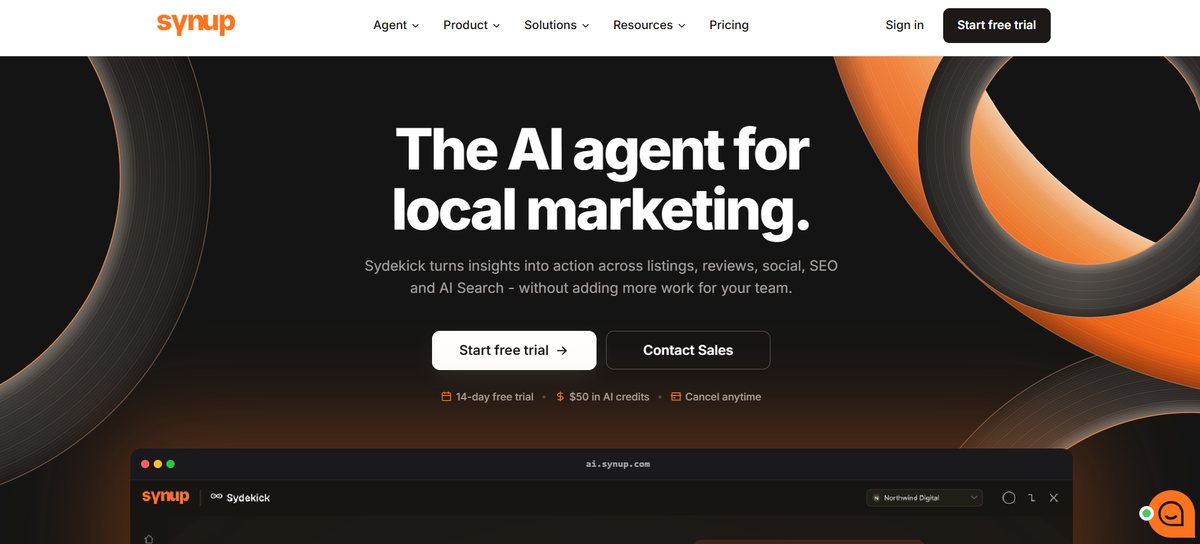
Best for: Franchisors and marketing agencies looking to manage listings, reviews, social publishing, and local visibility through a branded client-facing platform.
Synup is a local marketing platform serving agencies, multi-location businesses, and organizations managing marketing activities across multiple customer locations.
It combines listings management, review monitoring, social publishing, local SEO analysis, and AI-assisted marketing workflows.
For franchisors, its appeal is the ability to organize several recurring local marketing activities within a platform that supports branded client access.
Key Capabilities
Synup offers centralized location information management, listings distribution, review monitoring, social publishing, local ranking analysis, reporting, and marketing automation.
Its platform also includes AI-assisted workflows and location-level visibility features.
These capabilities make it relevant to franchise networks that want to reduce the number of disconnected marketing tools used by corporate teams and local operators.
White-Label Functionality
Synup documents white-label configuration for its client dashboard.
Supported customization includes logos, branding elements, and custom-domain configuration, allowing eligible organizations to present the client experience under their own identity.
Its documentation explains how partners can configure branded client dashboards and domains.
Strengths and Limitations
Synup's main advantage is the combination of local marketing capabilities and client-facing branding.
A franchisor can evaluate listings, reviews, social publishing, local SEO monitoring, and reporting without necessarily procuring a separate platform for every function.
The principal limitations involve subscription eligibility, usage allowances, and enterprise administration.
White labeling is not available on every tier. The platform also uses credits for certain agent-driven activities, with allowances and concurrent agent capacity varying by plan.
Large franchise networks should verify regional permissions, bulk workflows, data integrations, and automation consumption before deployment.
Pricing
Synup publishes the following monthly plans:
- Solo: Published monthly price: $49. Included locations: 1.
- Premium: Published monthly price: $299. Included locations: Up to 10.
- Pro: Published monthly price: $499. Included locations: Up to 25.
- Scale: Published monthly price: $899. Included locations: Up to 50.
- Enterprise: Published monthly price: Custom quote. Included locations: More than 50.
White labeling is available from Premium upward. Plan differences also include automation credits and agent capacity.
Published rates may change, and buyers should confirm the applicable billing terms and any additional usage charges.
Choose Synup if: Your franchise organization needs a branded local marketing dashboard covering multiple operational functions and prefers published pricing bands for smaller and mid-sized deployments.
2. Vendasta: Best for Reselling Marketing Services Under a Franchise Brand
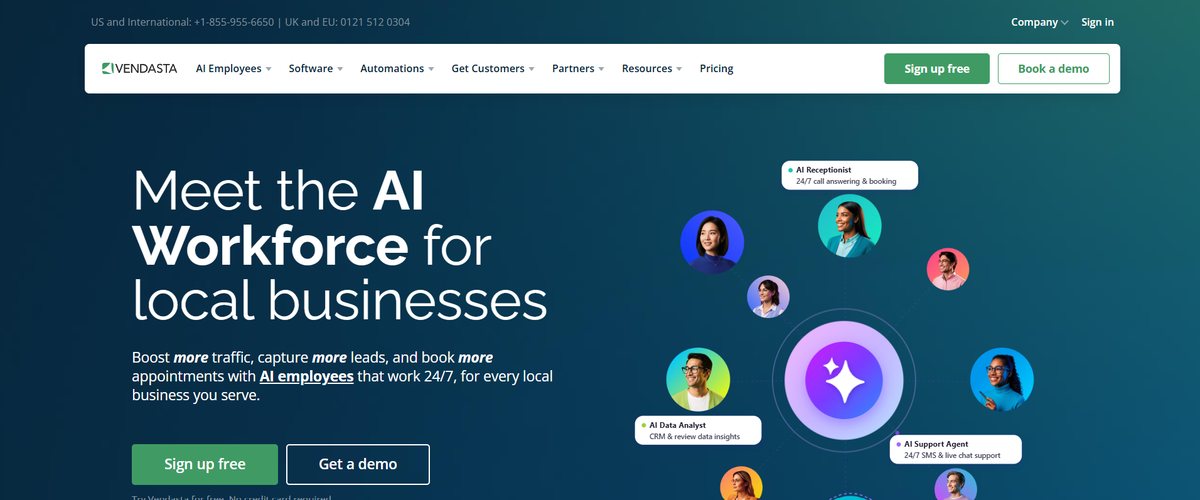
Best for: Franchisors, marketing organizations, and agencies that want to package and distribute digital marketing services through their own branded platform.
Vendasta provides software for organizations delivering marketing products and services to business customers.
Its platform combines client management, marketing applications, reporting, automation, and access to a marketplace of digital products and services.
Vendasta is particularly relevant when a franchisor wants to create a structured marketing program in which franchisees purchase or receive approved service packages.
Key Capabilities
Vendasta includes a client-facing Business App, product marketplace, client account management, marketing reporting, automation, billing capabilities, and access to services covering listings, reputation, and other digital marketing activities.
Its marketplace model allows organizations to assemble service packages instead of relying exclusively on one fixed software bundle.
This can suit franchise systems that provide different marketing services according to location requirements or franchisee participation.
White-Label Functionality
Vendasta supports branding for eligible partners.
Its documented customization options include company names, logos, colors, application naming, client communications, and custom domains where supported.
The platform can present its Business App under a partner's brand.
Some advanced branding capabilities, including custom-domain options, depend on subscription eligibility.
Strengths and Limitations
Vendasta's main advantage is its reseller-oriented operating model.
A franchisor could use it to distribute branded marketing services while managing product subscriptions and customer relationships.
The trade-off is purchasing complexity.
Software access, wholesale products, service subscriptions, contractual minimums, and individual product charges need to be considered together.
A buyer should not assume that every marketplace product is included in the platform commitment.
Pricing
Vendasta publishes the following qualifying monthly product-spend requirements:
- Starter: Monthly product-spend requirement: $99. Relevant features: Entry-level access and co-branding.
- Professional: Monthly product-spend requirement: $499. Relevant features: White-label client portal.
- Premium: Monthly product-spend requirement: $999. Relevant features: Multi-location client portal.
- Custom Enterprise: Monthly product-spend requirement: Negotiated. Relevant features: Enterprise pricing and requirements.
Under Vendasta's published structure, qualifying product spending can offset platform subscription fees according to the applicable terms.
Initial fees, product purchases, and contract requirements still need to be evaluated. Professional and Premium have published one-year contract terms.
These amounts should not be interpreted as fixed all-inclusive software prices.
Choose Vendasta if: Your franchise organization wants to create a branded marketplace or service delivery program through which franchisees access multiple marketing products.
3. Uberall: Best for Large Franchise Networks Managing Location Data
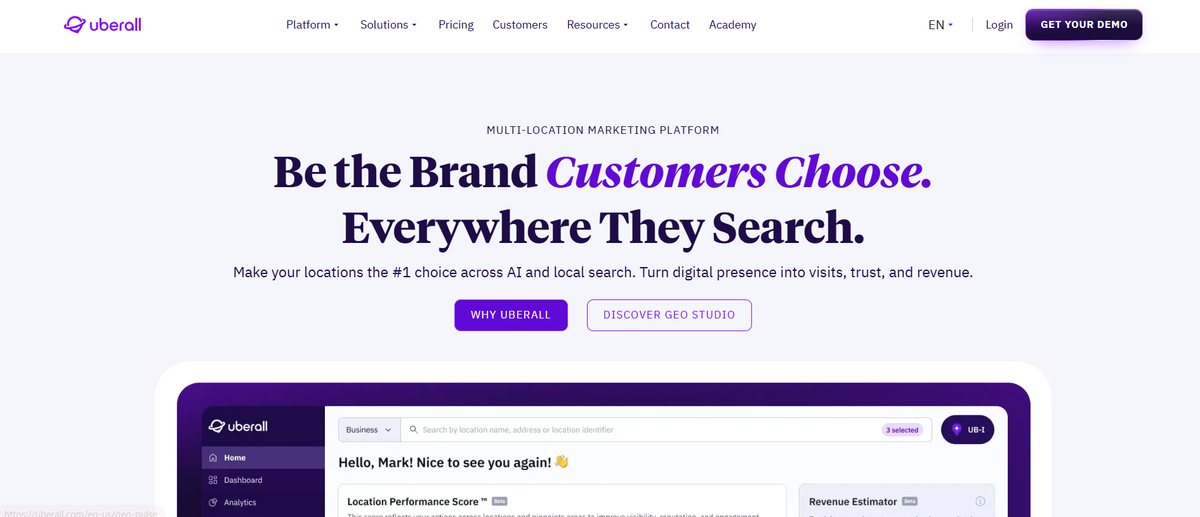
Best for: Enterprise franchisors prioritizing consistent business information, publisher distribution, and centralized location marketing operations.
Uberall is a multi-location marketing platform focused on helping businesses manage their presence across search engines, maps, directories, and other customer discovery channels.
Its products include listings management, reputation management, local social media capabilities, and location-level analytics.
Uberall is relevant to franchise systems where frequent store openings, relocations, holiday-hour changes, and other operational updates create substantial location-data management requirements.
Key Capabilities
Uberall supports centralized business information management, listings distribution, location updates, reputation monitoring, local social publishing, and reporting.
Its integration capabilities can also support organizations that need to connect location marketing with other internal systems.
For large franchise networks, location-data consistency and efficient updates are important evaluation areas.
White-Label Functionality
Uberall provides documented white-label application capabilities for partners.
Its partner integration documentation describes customization using brand logos, corporate colors, and company information.
It also explains custom-domain configuration through DNS records, branded email sender addresses, and single sign-on integration options.
White-label configuration involves coordination with Uberall's partner team.
Strengths and Limitations
Uberall's advantage is its emphasis on location information and multi-location marketing operations.
It deserves consideration when a franchise network must coordinate business information across many outlets and publisher systems.
The main limitation is implementation complexity.
White-label access, integration work, publisher coverage, and commercial terms may require a negotiated partnership arrangement.
Franchisors should also verify which directories are supported in each country and how updates are handled when publishers do not accept changes automatically.
Pricing
Uberall uses customized quotations for enterprise and partner requirements.
Pricing depends on the selected capabilities, number of locations, and agreement structure.
Buyers should request separate clarification of listings, reputation management, social capabilities, white-label access, implementation services, and integration costs.
Choose Uberall if: Your franchise network manages many physical locations and needs enterprise-oriented location marketing supported by documented white-label integration capabilities.
4. SOCi: Best for Enterprise Franchise Marketing Automation

Best for: Large franchise systems requiring centralized brand governance, coordinated local campaigns, and marketing automation.
SOCi provides local marketing software for multi-location businesses, including enterprise brands and franchise organizations.
Its Genius platform includes AI-assisted capabilities across local search, online reputation, and social marketing.
SOCi is relevant when corporate marketing teams need to maintain brand standards while allowing individual locations to participate in local marketing activities.
Key Capabilities
SOCi offers local search and listings management, online reputation monitoring, review response workflows, social publishing, marketing automation, and enterprise reporting.
Its Genius Agents support selected local marketing processes using AI-assisted execution.
For franchisors, the important evaluation questions concern how automated workflows follow brand policies, how exceptions are escalated, and how corporate teams retain oversight.
White-Label Functionality
SOCi's reseller program documents three delivery approaches:
- Co-branded platform: Joint branding involving SOCi and the reseller.
- White-label platform: A platform experience presented under the reseller's brand.
- API integration: A customized front-end experience using SOCi's APIs.
These are reseller program options and should not be assumed to be part of every standard enterprise contract.
Strengths and Limitations
SOCi's strength is its focus on large-scale local marketing coordination.
Franchise systems can evaluate its combination of centralized brand management, location marketing, automation, and enterprise reporting.
However, AI-assisted automation requires governance.
Franchisors should assess approval settings, factual accuracy, response policies, exception handling, and human oversight for sensitive customer interactions.
Buyers must also confirm whether their intended white-label implementation qualifies under SOCi's reseller arrangements.
Pricing
SOCi provides custom pricing based on location count and selected capabilities.
Its published pricing model emphasizes the number of locations and Genius Agents deployed rather than conventional per-user pricing.
Usage limits may also depend on the selected package.
Choose SOCi if: Your franchise organization needs enterprise-level marketing coordination and wants to evaluate automation across local search, social media, and reputation workflows.
5. Yext: Best for Enterprise Listings and Structured Location Data

Best for: Franchise networks and resellers that prioritize centralized business information, publisher connections, and structured location management.
Yext is a digital presence platform designed to manage business information across online publishers and customer discovery channels.
Its capabilities include listings, reviews, structured business data, and related digital presence management workflows.
For franchisors, Yext is relevant when business information must remain accurate and organized across a large network of locations.
Key Capabilities
Yext offers centralized location information management, listings distribution, publisher integrations, review-related capabilities, reporting, and APIs.
Its structured business information approach is useful for organizations maintaining detailed location attributes.
For example, a franchise system may need to manage store addresses, operating hours, website links, available services, and other location-specific attributes through a controlled source of information.
White-Label Functionality
Yext provides account branding functionality for eligible partners.
Its documentation describes customization of logos, colors, brand names, login experiences, email branding, and product names.
Yext also documents white-labeled URLs using a designated domain configuration.
Buyers should distinguish this arrangement from unrestricted use of an arbitrary custom domain.
Strengths and Limitations
Yext's advantage is its structured approach to business information and publisher integrations.
This is relevant to franchises with extensive location attributes or complex data management requirements.
However, reseller account branding and direct enterprise licensing are different commercial arrangements.
A franchisor purchasing Yext for internal operations should not assume that it automatically receives every reseller branding right.
Buyers should confirm account structure, data permissions, integration requirements, and the publisher connections included in their agreement.
Pricing
Yext's enterprise and reseller arrangements generally require customized quotations.
Pricing depends on location count, selected products, and contract structure.
Franchisors should request pricing for their actual network and required capabilities rather than extrapolating from smaller business packages.
Choose Yext if: Your franchise network places high priority on structured location data and publisher distribution, with partner branding where contractually available.
6. Birdeye: Best for Franchise Reputation and Customer Experience
Best for: Franchise organizations prioritizing customer reviews, reputation monitoring, customer communications, and location-level experience reporting.
Birdeye provides reputation management, customer experience, and local marketing software.
Its product ecosystem includes review management, business listings, social publishing, customer communications, and AI-assisted workflows.
Birdeye is especially relevant to franchises where local customer feedback, review responses, and service quality are central operating concerns.
Key Capabilities
Birdeye provides tools for monitoring and responding to reviews, generating review requests, managing listings, publishing social content, communicating with customers, and analyzing customer experience information.
Its reporting capabilities can help corporate teams evaluate patterns across locations.
For example, a service franchise could use review monitoring to identify recurring operational complaints and route them to the appropriate local or regional team.
White-Label Functionality
Birdeye's reseller program explicitly offers white-label and co-branded platform options.
Partners can evaluate a branded service offering using Birdeye's local marketing and customer experience capabilities.
The exact branding controls, supported modules, and resale permissions should be confirmed for the proposed agreement.
Strengths and Limitations
Birdeye's principal advantage is the connection between local reputation, customer engagement, and marketing operations.
It may be useful when a franchise needs more than listings management and wants a structured process for responding to customer feedback.
However, the product scope matters.
Listings, social publishing, messaging, analytics, and white-label capabilities should not be assumed to be included together in every subscription.
Franchisors should also verify how review requests and automated responses comply with the relevant platform's policies.
Pricing
Birdeye provides customized pricing based on selected products, location requirements, and commercial terms.
The company does not publish one universal monthly subscription price covering every franchise deployment.
Choose Birdeye if: Your franchise network needs reputation management and customer engagement workflows alongside local marketing capabilities, with white labeling through an appropriate partner arrangement.
7. BrightLocal: Best for White-Label Local SEO Reporting
Best for: Franchise marketing agencies and smaller multi-location teams focused on local SEO measurement, rankings, citation management, and branded reports.
BrightLocal is a local SEO software platform designed to help businesses and agencies measure and manage local search visibility.
Its tools include local ranking tracking, citation analysis, Google Business Profile auditing, listings management, and reputation-related reporting.
BrightLocal differs from enterprise franchise marketing suites because its primary emphasis is local SEO operations and measurement.
Key Capabilities
BrightLocal provides local rank tracking, geographic ranking analysis, citation auditing, business information management, Google Business Profile analysis, and review-related tools.
Its reports can help agencies explain changes in local visibility and identify areas requiring attention.
For franchise marketing teams, these capabilities can support location audits and consistent performance reporting.
White-Label Functionality
BrightLocal offers white-label local SEO reports and client dashboards.
Documented branding options include custom logos, colors, messaging, report scheduling, and custom-domain reporting experiences.
Agencies can also control which information is displayed in client-facing reports.
Strengths and Limitations
BrightLocal's strength is its focus on practical local SEO measurement and reporting.
It can suit franchise agencies that need branded reporting but do not require a complete enterprise marketing operating system.
Its limitation is the scope of franchise management.
Custom-branded reports do not automatically provide sophisticated regional permissions, corporate campaign approvals, or a marketplace for marketing services.
Large franchise networks should verify reporting scalability, location access, and additional service costs.
Pricing
BrightLocal publishes the following starting prices for one location:
- Track: Monthly equivalent with annual billing: Approximately $31. Annual charge: $369.
- Manage: Monthly equivalent with annual billing: Approximately $40. Annual charge: $485.
- Grow: Monthly equivalent with annual billing: Approximately $49. Annual charge: $584.
Prices increase according to location, volume and selected services.
Additional costs may apply to citation-building campaigns or other services. Buyers should also confirm which branding and reporting features are available under their intended subscription.
Choose BrightLocal if: Your primary requirement is branded local SEO reporting, citation analysis, and performance monitoring rather than complex franchise marketing administration.
White-Label vs. Traditional Enterprise Franchise Marketing Software
The main difference between white-label software and traditional enterprise franchise marketing software is the importance of branding rights and the intended operating model.
Both categories may offer local listings management, review monitoring, reporting, and marketing automation.
However, white-label platforms emphasize the ability to present software or services under another organization's brand.
Enterprise franchise marketing software may place greater emphasis on administration, security, integrations, and operational control.
- Branded client experience: White-label marketing platform: Common selling point. Enterprise franchise marketing platform: May be optional.
- Custom domain: White-label marketing platform: Vendor- and plan-dependent. Enterprise franchise marketing platform: Contract-dependent.
- Software resale rights: White-label marketing platform: Available through some agreements. Enterprise franchise marketing platform: Not necessarily included.
- Corporate marketing oversight: White-label marketing platform: Varies. Enterprise franchise marketing platform: Frequently emphasized.
- Franchisee permissions: White-label marketing platform: Must be evaluated. Enterprise franchise marketing platform: Common enterprise requirement.
- Listings and reviews: White-label marketing platform: Frequently supported. Enterprise franchise marketing platform: Frequently supported.
- Branded reporting: White-label marketing platform: Common. Enterprise franchise marketing platform: Often available.
- Enterprise integrations: White-label marketing platform: Varies. Enterprise franchise marketing platform: Frequently emphasized.
These categories overlap, and some vendors provide both kinds of functionality.
A national restaurant franchisor using software internally may prioritize centralized operating hours, location information, and review management over completely removing vendor branding.
By contrast, a franchisor selling marketing packages to franchisees may benefit from a branded client portal.
Before selecting a platform, determine whether it will function primarily as an internal marketing system, a franchisee-facing service, or a revenue-generating marketing offering.
What Features Should Franchisors Prioritize?
Branding is only one part of selecting local marketing software.
Franchisors should evaluate how the platform handles real operational requirements across independent locations.
1. Centralized Control With Local Permissions
Corporate headquarters should maintain control over brand-sensitive information while allowing franchisees to manage appropriate local details.
Look for permissions covering business names, listings, marketing templates, promotional content, customer responses, and reporting.
A simple administrator-versus-user distinction may be insufficient.
Test whether the platform can restrict actions by location, region, brand, and function.
For example, a regional manager may need access to 20 locations, while an individual franchisee should only manage their authorized outlets.
2. Consistent Business Listings Across Publishers
Local listings management should support accurate information about each franchise location.
Important details include the business name, address, phone number, website, categories, operating hours, and available services.
Google's guidelines for representing businesses require accurate real-world information and restrict misleading business names and duplicate profiles.
No third-party platform can override these policies.
Franchise systems should maintain an approved location information record and use it when reviewing public business profiles.
For broader vendor comparisons, see HAKKEN's guide to local listings management software.
3. Review Management and Response Governance
Review management software should help teams monitor customer feedback, assign responsibility, and respond consistently.
Not every review requires the same workflow.
Routine comments may be handled by local managers, while serious complaints involving safety, legal concerns, or sensitive customer information may require escalation.
AI-assisted responses should be checked for accuracy, tone, and compliance with applicable platform policies.
Franchisors should evaluate approval rules, response tracking, escalation procedures, and location-specific reporting.
4. Local Social Media Management
Franchise marketing requires consistency without making every location's content identical.
Look for approved campaign templates, scheduling tools, local customization, content permissions, and performance reporting.
Corporate teams can establish brand standards while giving franchisees appropriate flexibility to publish relevant local content.
Franchisors managing multiple Facebook Pages must also distinguish social publishing software from Meta's native account and asset permissions.
HAKKEN's guide to Facebook Pages for franchisees explains centralized, individual-location, and hybrid approaches.
5. Publisher Coverage and Integrations
A platform's ability to manage Google Business Profiles does not mean it controls every directory or mapping service.
Publisher coverage varies by vendor, contract, geographic market, and available integration.
Apple's business location documentation describes location management within Apple's business services.
Similarly, Microsoft's Bing business listing guidance explains how businesses can claim and update information in Bing Places.
Request a publisher-by-publisher coverage list for each country in which the franchise operates.
Also ask which changes are automatic, which require approval, and how the software reports unsuccessful updates.
6. Business Profile Ownership and Security
Franchisors should establish appropriate ownership and authorized access arrangements for their business assets.
Google's Business Profile third-party policies explain the rights of business owners and recommend that agencies generally receive manager access rather than taking ownership of a client's profile.
In franchise systems, ownership arrangements may also depend on franchise agreements and the relationship between headquarters and individual operators.
Before adopting a platform, define who controls the business profiles, connected social accounts, location data, and administrative credentials.
The franchise should also have a documented procedure for transferring access when an agency relationship ends or a location changes operators.
7. Data Portability and Exit Procedures
Software selection should include an exit plan.
Franchisors should ask whether they can export location information, reporting data, campaign assets, and historical records.
They should also understand what happens to listings, publisher connections, custom domains, and user access when the contract ends.
This is particularly important when a vendor's service maintains connections to external publisher accounts.
A platform should not become the only practical way for a franchise to access its core business information.
Which Platform Fits Different Franchise Sizes?
The appropriate platform depends on operational complexity, not simply location count.
The following ranges are practical buying scenarios rather than fixed vendor eligibility thresholds.
Growing Franchise Networks: 10–50 Locations
Smaller franchise systems often benefit from straightforward onboarding, predictable pricing, and manageable administration.
Synup and Vendasta are reasonable starting points when branded client access or service delivery is important.
BrightLocal may be suitable when the organization primarily needs local SEO audits, citation management, and reporting.
At this scale, prioritize user access, location-level visibility, data accuracy, support, and total cost.
Avoid purchasing enterprise complexity that the marketing team cannot realistically operate.
Established Franchise Networks: 50–100 Locations
As a franchise grows, manual administration can become increasingly difficult.
Synup's enterprise offering, Vendasta's multi-location options, Uberall, SOCi, and Yext are worth evaluating according to the required functions.
Important considerations include bulk updates, delegated access, reporting by region, location onboarding, and exception handling.
The goal is to prevent headquarters from becoming responsible for every minor location-level change.
Enterprise Networks: 100–500+ Locations
Large franchise organizations should examine enterprise-oriented platforms such as Uberall, SOCi, Yext, and Birdeye, alongside the enterprise offerings of Synup and Vendasta.
The choice depends on whether the network emphasizes location data, marketing automation, reputation management, or franchisee-facing services.
At this scale, do not rely solely on the number of locations a vendor claims to support.
Request demonstrations using realistic operational scenarios, including ownership transfers, store closures, holiday hours, regional permissions, and corporate approvals.
How Much Does White-Label Franchise Marketing Software Cost?
White-label franchise marketing platforms use different pricing models.
There is no single monthly price that accurately represents the entire category.
Costs may depend on location count, product selection, subscription level, marketing automation usage, reseller commitments, and implementation requirements.
Common models include location-based subscriptions, tiered plans, product-based pricing, wholesale purchasing commitments, and custom enterprise contracts.
Example: Calculating Franchise Software Costs
Consider a hypothetical platform priced at $25 per location per month.
For a franchise network with 100 active locations:
100 locations × $25 × 12 months = $30,000 annually
This is an illustrative calculation, not a price quote from any platform in this comparison.
Actual ownership costs may also include onboarding, technical integrations, support, training, additional modules, and usage-based charges.
Total Cost of Ownership
When comparing software, franchisors should consider:
- Base subscription: Questions to ask: Is pricing monthly, annual, or contract-based?
- Location charges: Questions to ask: Does each additional location increase cost?
- White labeling: Questions to ask: Is branding included or separately licensed?
- Automation usage: Questions to ask: Are there credits, limits, or overage charges?
- Additional products: Questions to ask: Are listings, reviews, social, and reporting separate modules?
- Implementation: Questions to ask: Are setup, integration, and data migration included?
- Support: Questions to ask: What level of technical assistance is provided?
- Contract termination: Questions to ask: What are the cancellation, export, and transition conditions?
Franchisors should also determine whether software costs are paid by corporate headquarters, individual franchisees, or a marketing or advertising fund.
In the United States, the FTC's Franchise Disclosure Document guidance discusses advertising obligations and the information addressed under Item 11.
The treatment of marketing software fees should be reviewed against applicable franchise agreements and disclosure requirements. Legal advice may be necessary when determining contractual obligations or allocating costs.
How Can Franchisors Evaluate White-Label Capabilities Before Buying?
A platform should be tested as an operational system rather than accepted based on a feature checklist.
A branded login is useful, but it does not demonstrate whether the platform can handle franchise marketing workflows securely and consistently.
Ask shortlisted vendors to demonstrate these requirements:
- Branded login: What the vendor should demonstrate: Approved franchise identity displayed in the client-facing experience.
- Custom domain: What the vendor should demonstrate: Portal accessible through the agreed branded URL.
- Email branding: What the vendor should demonstrate: Notifications using approved branding and sender configuration.
- Franchisee permissions: What the vendor should demonstrate: Users cannot edit unauthorized locations.
- Regional administration: What the vendor should demonstrate: Managers can access assigned regions without unrestricted network control.
- Corporate approvals: What the vendor should demonstrate: Sensitive changes can be reviewed before publication.
- Multi-location reporting: What the vendor should demonstrate: Headquarters can view network data while local users have restricted access.
- Review management: What the vendor should demonstrate: Complaints can be assigned and escalated.
- Bulk updates: What the vendor should demonstrate: Multiple location records can be updated efficiently.
- Publisher coverage: What the vendor should demonstrate: Supported integrations and update limitations are clearly demonstrated.
- Data export: What the vendor should demonstrate: Business information and relevant records can be retrieved.
- Exit procedures: What the vendor should demonstrate: Account access and publisher ownership can be managed after termination.
Run a Five-Location Pilot
A practical evaluation can use five representative franchise locations.
Select a mature location, a recently opened store, a branch with seasonal hours, a franchisee with restricted permissions, and a location with an unresolved listing issue.
Ask each vendor to demonstrate how its platform handles these cases.
For example, when headquarters changes a brand-wide holiday schedule, test whether the software can update the correct locations without overwriting legitimate exceptions.
Similarly, test what happens when a franchisee attempts to edit another operator's location.
The pilot should demonstrate real workflows, not just an attractive dashboard.
How Can Franchisors Measure ROI From Local Marketing Software?
Franchisors should evaluate software based on operational improvements and measurable business outcomes.
Important metrics include:
- Listing accuracy: What it measures: Percentage of audited fields matching approved business information.
- Update completion rate: What it measures: Percentage of required changes confirmed on relevant publishers.
- Review response coverage: What it measures: Percentage of eligible reviews receiving responses.
- Review response time: What it measures: Time required to address customer feedback.
- Local search visibility: What it measures: Visibility across relevant searches and geographic areas.
- Website conversions: What it measures: Measurable actions from location-specific website pages.
- Cost per location: What it measures: Total software and service cost divided by active locations.
- Marketing administration time: What it measures: Staff time required for recurring marketing work.
- Franchisee participation: What it measures: Adoption of approved marketing tools and workflows.
Measure Operational Improvements First
Some benefits are easier to attribute than others.
For example, if headquarters previously required several hours to coordinate location information changes, it may be possible to compare the staff time required before and after implementation.
Similarly, reporting can measure whether approved listing changes were completed successfully.
These metrics provide a more direct indication of software performance than broad claims about search visibility or revenue.
Evaluate Local Search Performance Carefully
Google explains that local results are primarily influenced by relevance, distance, and prominence.
Accurate business information can help customers and search systems understand a location, but no software purchase guarantees higher Google Maps rankings.
The same caution applies to AI-powered discovery.
Maintaining consistent business information may improve the quality of data available to search and AI systems, but it does not guarantee inclusion in AI-generated answers.
For additional context, HAKKEN explains how local listings relate to Google AI Overviews.
Avoid Overstating Marketing Attribution
Changes in website traffic, customer inquiries, and revenue can also reflect seasonality, advertising expenditure, location maturity, competitive activity, and changes in consumer demand.
A practical ROI evaluation should compare relevant periods and account for these factors wherever possible.
Franchisors should avoid attributing every improvement to their chosen software platform.
Frequently Asked Questions
Which White-Label Local Marketing Platform Is Best for a Growing Franchise?
Synup, Vendasta, and BrightLocal are reasonable starting points, depending on the required functionality.
Synup offers branded local marketing dashboards and published location-based tiers. Vendasta is more suitable when a franchise wants to package and distribute marketing services. BrightLocal is useful when local SEO reporting is the primary requirement.
The choice should depend on features, licensing, location count, permissions, and total cost.
Can Franchisors Manage Listings, Reviews, SEO, and Social Media in One Platform?
Yes. Several platforms in this comparison offer combinations of these capabilities.
However, feature availability varies by vendor, module, subscription, and enterprise agreement.
Buyers should confirm supported publishers, review management capabilities, reporting, social integrations, automation features, and franchisee access before purchasing.
Which Platforms Support Franchisee-Level Dashboards?
Synup and Vendasta provide branded client-facing dashboard capabilities.
Uberall, SOCi, Yext, and Birdeye also offer relevant enterprise or partner workflows involving location access and reporting. BrightLocal provides client-facing reporting capabilities.
Because permission structures differ, franchisors should request a demonstration of corporate, regional, and individual franchisee accounts.
Does White-Label Marketing Software Improve Google Maps Rankings?
White-label branding itself does not improve Google Maps rankings.
Local search performance depends on Google's ranking systems, including relevance, distance, and prominence.
Marketing software can help organizations maintain accurate information, manage appropriate review workflows, and monitor performance.
These are useful operational capabilities, not guaranteed ranking improvements.
What Is the Difference Between White-Label Marketing Software and Franchise Marketing Software?
White-label software emphasizes presenting a platform or service under another organization's brand.
Franchise marketing software emphasizes administering marketing activities across a network of locations.
Some products provide both.
A franchisor that operates software internally may not need complete white labeling. An organization offering marketing services to franchisees may consider branded client access essential.
How Can Franchisors Maintain Brand Consistency While Allowing Local Marketing?
Franchisors should separate centrally controlled brand elements from information that individual locations need to manage.
Corporate marketing teams can define brand standards, approved campaign templates, sensitive listing fields, and response policies.
Franchisees can manage authorized location details, approved promotions, and relevant local content.
The software should provide permissions, approval workflows, exceptions, and reporting to support this operating model.
Final Verdict
The right white-label local marketing platform for franchisors combines appropriate branding capabilities with the marketing tools, permissions, and operational controls a franchise network needs.
Synup is a useful starting point for organizations seeking branded local marketing dashboards that combine listings, reviews, social publishing, and visibility analysis.
Vendasta is particularly relevant for franchise systems distributing or reselling marketing services through a branded client experience.
Uberall and Yext deserve consideration when centralized location information and publisher integrations are major requirements.
SOCi is suitable for evaluating enterprise marketing automation, while Birdeye emphasizes reputation management and customer experience.
BrightLocal is a practical option when local SEO measurement, citation analysis, and branded reporting matter more than complex franchise administration.
For a large franchise network, shortlist several platforms and request demonstrations using the same location data, workflows, permissions, and cost assumptions.
The strongest choice is not necessarily the vendor with the longest feature list or the greatest number of branding options.
It is the platform that allows headquarters to maintain reliable brand standards while giving franchisees the tools and appropriate independence to manage local marketing effectively.