Reputation.com vs Birdeye vs Synup for Auto Dealers
Reputation.com vs Birdeye vs Synup for car dealerships: compare review management, automotive integrations, local SEO, limitations, and pricing.
Nancy Shrivastav
Synup, Reputation.com, and Birdeye are three reputation management platforms worth comparing for auto dealerships. Synup combines business listings, review management, and local marketing automation. Reputation.com, now branded primarily as Reputation, focuses on automotive customer experience intelligence and multi-rooftop reporting. Birdeye emphasizes automated review generation, customer engagement, and integrations with dealership systems.
The right choice depends on whether your dealership prioritizes local search visibility, collecting authentic customer reviews, understanding service department feedback, or managing reputation across multiple locations.
An independent dealership may need straightforward review requests and response management. A group operating 50 rooftops may require regional reporting, corporate permissions, CRM and DMS integrations, and consistent customer feedback processes.
This guide compares all three platforms using the same evaluation criteria, including their capabilities, strengths, limitations, pricing, and suitability for different dealership operations.
Reputation.com vs Birdeye vs Synup: Quick Comparison
- Synup: Best suited to: Dealerships prioritizing local visibility and marketing coordination. Main strengths: Listings, review management, social publishing, local SEO, and AI-assisted workflows. Key consideration: Confirm automotive CRM/DMS integrations.
- Reputation.com: Best suited to: Large dealer groups and OEM networks. Main strengths: Reputation analytics, customer experience intelligence, benchmarking, and multi-rooftop reporting. Key consideration: Dealer-specific packages, implementation, and total cost.
- Birdeye: Best suited to: Review generation and customer experience management. Main strengths: Automated review invitations, messaging, surveys, and automotive integrations. Key consideration: Custom pricing and integration requirements.
Which Platform Should Your Dealership Shortlist?
Synup is worth considering when your dealership wants to manage business listings, customer reviews, social media, and local marketing activities through a connected platform.
Reputation.com is particularly relevant when customer experience analytics, competitive benchmarking, and reporting across multiple dealerships are central requirements.
Birdeye is a strong candidate when the priority is collecting customer feedback through automated workflows and connecting review requests with sales and service transactions.
All three support multi-location organizations. Their differences become more important when evaluating permissions, automation, integrations, and contract terms.
These recommendations reflect documented capabilities and likely buyer fit rather than independently measured performance rankings.
Why Online Reputation Management Matters for Car Dealerships
Online reputation management helps automotive dealerships monitor customer feedback, respond to complaints, maintain accurate business information, and understand how customers perceive their sales and service operations.
Vehicle buyers often research dealerships before making contact.
They may read Google reviews, compare customer ratings, examine comments about salespeople, or investigate complaints about financing transparency.
Service customers may focus on different concerns, including appointment availability, repair estimates, communication, and warranty handling.
These experiences can influence whether someone chooses a particular dealership.
For a multi-location dealer group, reputation management becomes more complicated because customer experiences differ across branches and departments.
A dealership might receive positive feedback about its sales team while service customers report long waiting times.
Looking only at an overall star rating may conceal those differences.
Effective reputation management should help dealers:
- Monitor customer reviews across supported platforms.
- Request genuine feedback following completed transactions.
- Respond consistently without publishing generic or misleading replies.
- Identify recurring sales and service complaints.
- Maintain accurate dealership and department information.
- Compare reputation trends across multiple rooftops.
- Escalate sensitive issues to authorized employees.
The purpose is not simply to increase review counts. It is to understand customer experiences and use that information to improve operations.
How Reviews Affect Dealership Local SEO
According to Google's local ranking guidance, local results are primarily determined by relevance, distance, and prominence.
Complete and accurate business information helps Google understand a business and match it with relevant searches.
Google also explains that more reviews and positive ratings can contribute to local prominence.
However, purchasing reputation management software does not guarantee higher rankings, more website traffic, or increased vehicle sales.
A platform can support processes such as review monitoring, business listing accuracy, and customer communication. Search visibility remains subject to Google's systems and other factors.
For related information, Hakken's comparison of AI review response software for multi-location brands explains how businesses can use automation while maintaining appropriate response controls.
How We Evaluated Reputation.com, Birdeye, and Synup
This comparison uses publicly available product documentation, official vendor pricing information, automotive integration resources, and support materials reviewed in November 2026.
Seven criteria guide the evaluation:
- Review management: Monitoring, organizing, and responding to customer feedback.
- Review generation: Requesting authentic reviews through supported customer communication channels.
- Automotive integrations: Compatibility with dealership CRM, DMS, and transaction-based workflows.
- Multi-location governance: Corporate oversight, regional reporting, administrative permissions, and approval controls.
- Business listings: Managing dealership addresses, contact information, operating hours, categories, and other local data.
- AI and analytics: Automated review responses, sentiment analysis, competitive insights, and operational reporting.
- Pricing and implementation: Published subscriptions, automotive packages, onboarding, integrations, and potential additional expenses.
The recommendations distinguish documented product functionality from editorial assessments of likely suitability.
No independent hands-on testing, vendor interviews, customer surveys, or performance benchmarking is claimed.
The dealership scenarios are hypothetical examples intended to illustrate buying requirements, not descriptions of actual customer implementations.
Features and pricing may vary by subscription, region, integration, and commercial agreement. Buyers should confirm essential capabilities directly with each vendor.
Reputation.com vs Birdeye vs Synup: Feature Comparison
- Multi-location review monitoring: Synup: Supported. Reputation.com: Supported. Birdeye: Supported.
- Review invitations: Synup: Supported. Reputation.com: Supported. Birdeye: Supported.
- AI-assisted review responses: Synup: Available. Reputation.com: Available. Birdeye: Available.
- Business listings management: Synup: Supported. Reputation.com: Supported. Birdeye: Supported.
- Customer sentiment analysis: Synup: Available. Reputation.com: Available. Birdeye: Available.
- Local social management: Synup: Supported. Reputation.com: Available through relevant products. Birdeye: Supported.
- Competitor insights: Synup: Available. Reputation.com: Available. Birdeye: Available.
- Automotive-specific integrations: Synup: Verify individual systems. Reputation.com: Automotive-oriented workflows. Birdeye: Documented CRM/DMS integrations.
- Enterprise reporting: Synup: Multi-location reporting. Reputation.com: Automotive hierarchy and advanced analytics. Birdeye: Multi-location customer experience reporting.
- Pricing: Synup: Published location-based plans. Reputation.com: Published general and automotive rates. Birdeye: Custom quotations.
Availability does not mean that every feature is included in every subscription. The depth of integrations, automation, analytics, and administration may differ significantly.
1. Synup: For Integrated Local Marketing and Review Management
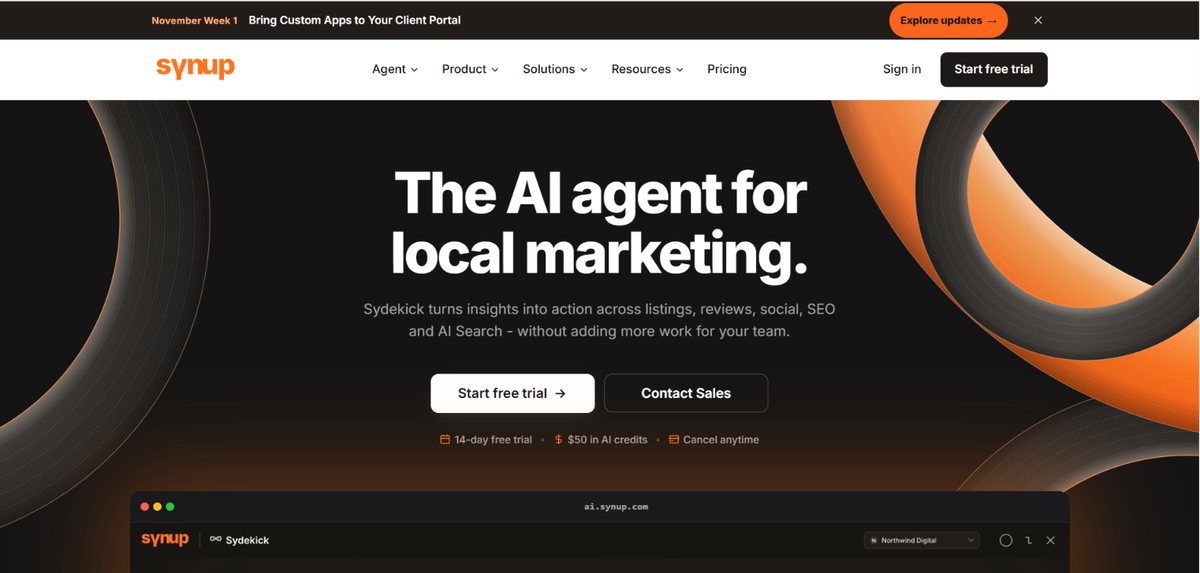
Best for: Independent auto dealers, used-car dealership groups, and marketing teams seeking business listings, review management, and local marketing capabilities in one platform.
Synup is a local marketing platform designed to help businesses manage their online presence across search engines, maps, directories, review websites, and social platforms.
Its products cover business listing management, review monitoring, review generation, social publishing, local SEO, and AI-assisted marketing workflows.
For automotive dealerships, this combination is useful when reputation management and local visibility are closely connected.
Before visiting a showroom, customers may search for its opening hours, location, customer ratings, and contact information.
Synup supports managing these activities in a shared environment rather than relying entirely on separate systems.
Key Features
Synup's documented capabilities include:
- Business listings: Managing dealership names, addresses, phone numbers, categories, hours, and related information.
- Unified review inbox: Organizing customer reviews from supported sources.
- AI-assisted responses: Drafting replies with opportunities for human review and editing.
- Review analytics: Monitoring feedback trends and comparing reputation performance across locations.
- Competitor tracking: Comparing Google review ratings, volume, and other reputation metrics with selected nearby competitors.
- Social publishing: Managing content across connected channels.
- Sydekick AI agent: Supporting recurring local marketing activities through configurable workflows.
Synup also provides location-level reporting and export functionality.
Its review management documentation describes review monitoring, response drafting, competitive comparisons, and multi-location reporting.
The company also documents a competitor scorecard that focuses on Google reviews and refreshes monthly rather than continuously.
This distinction matters when dealerships need current operational information.
Where Synup Works Well
Consider a hypothetical dealership group operating 15 used-car showrooms.
Each location has separate Google reviews, business hours, customer inquiries, and local competitors.
The corporate marketing team wants accurate location information while monitoring feedback across all showrooms.
Synup is a relevant option because it combines listings and reputation activities within one platform.
The group could use centralized reporting to identify locations receiving recurring complaints while maintaining consistent public information.
For agencies supporting multiple automotive clients, Synup's account management, reporting, and white-label functionality may also be useful.
Limitations
Synup is not a dedicated dealership CRM or DMS.
Dealerships requiring automated review invitations after vehicle purchases or completed service visits should verify compatibility with their existing systems.
A general API capability does not establish that a particular DMS transaction can automatically trigger a review request.
Organizations with complex manufacturer reporting obligations should also evaluate whether Synup's analytics, permission controls, and data exports meet their requirements.
Its AI workflows are subject to usage credits and agent capacity limits.
Buyers should estimate those requirements before assuming the published subscription will cover every planned automated task.
Pricing
Synup publishes the following US monthly prices:
- Solo: Monthly price: $49. Location capacity: 1 location.
- Premium: Monthly price: $299. Location capacity: Up to 10 locations.
- Pro: Monthly price: $499. Location capacity: Up to 25 locations.
- Scale: Monthly price: $899. Location capacity: Up to 50 locations.
- Enterprise: Monthly price: Custom quote. Location capacity: More than 50 locations.
The vendor advertises annual billing discounts.
Plans differ in location capacity, AI credits, parallel agent activity, and infrastructure arrangements.
White-label functionality is available in Premium and higher plans.
For larger dealership portfolios, enterprise pricing must be confirmed directly rather than extrapolated from smaller tiers.
Consider Synup when: Your dealership needs centralized business listings, reviews, and local marketing, with published pricing for smaller location portfolios.
2. Reputation.com: For Automotive Reputation Intelligence

Best for: Large automotive dealer groups, multi-brand networks, and OEM organizations requiring customer experience analysis, benchmarking, and centralized reporting.
Reputation.com, now primarily branded as Reputation, offers reputation management and customer experience software.
Its products include online review monitoring, review generation, surveys, business listings, social media functionality, and reputation analytics.
The company's automotive offering is designed around the relationships between manufacturers, dealer groups, regions, and individual dealerships.
This structure is relevant when reputation management involves more than responding to individual customer reviews.
Corporate leaders may want to identify recurring service issues, compare dealerships, and examine changes in customer satisfaction over time.
Reputation provides tools designed to support these activities.
Key Features
Reputation's automotive platform includes:
- Review management: Collecting, monitoring, and responding to customer feedback.
- Review generation: Requesting customer reviews through supported workflows.
- Business listings: Managing dealership information across connected platforms.
- Customer surveys: Collecting structured customer experience information.
- Reputation Score: A proprietary metric combining multiple reputation signals.
- Experience insights: Identifying recurring themes in customer feedback.
- Competitive benchmarking: Comparing reputation-related performance against relevant businesses.
- Multi-rooftop reporting: Organizing data across brands, regions, and locations.
- Reputation IQ: Exploring customer feedback through natural-language queries.
The company also provides managed services and additional enterprise capabilities.
Reputation Score and Reputation IQ
Reputation Score is intended to provide a consolidated view of online reputation using multiple inputs.
However, it is a vendor-defined metric.
A higher Reputation Score should not automatically be interpreted as a better Google ranking, a verified increase in customer satisfaction, or evidence of higher vehicle sales.
Dealers should understand which inputs contribute to the score and how changes are calculated.
Reputation IQ allows users to ask questions about available reputation and customer experience information.
For example, a regional manager might want to identify which service complaints have become more frequent or compare feedback themes across locations.
The usefulness of these insights depends on the completeness of the underlying data, classification accuracy, and the organization's ability to investigate reported problems.
Where Reputation.com Works Well
Consider a hypothetical automotive group operating 60 dealerships across several manufacturers.
Corporate management wants to compare customer satisfaction trends, identify recurring service complaints, and monitor reputation performance by region.
Reputation's automotive reporting framework is relevant to this requirement.
For example, regional managers could investigate whether complaints about financing transparency are concentrated in particular dealerships.
They could also compare service-related feedback across locations to identify patterns requiring training or operational changes.
Its enterprise structure is particularly relevant when responsibility for customer experience is distributed across corporate, regional, and dealership teams.
Limitations
Reputation's enterprise analytics and customer experience capabilities can require more implementation planning than basic review monitoring software.
An independent dealership primarily needing review invitations may not need the broader reporting environment.
Buyers should also clarify which capabilities require additional products or services.
For example, the platform's general pricing identifies competitive insights, ticketing, social management, integrations, and managed services as optional enhancements.
The automotive offering also includes separate self-service and managed-service packages.
Organizations should distinguish between software access and services performed by Reputation's team.
Pricing
Reputation publishes general platform pricing alongside automotive-specific packages.
General Platform Pricing
- Rep Core: Published price: $80/location/month.
- Rep Core + Pulse: Published price: $115/location/month.
- Rep Core + Surveys: Published price: $150/location/month.
- Enterprise: Published price: Custom quote.
Rep Core includes reviews and listings functionality. Higher plans introduce additional analytics, surveys, and AI-related features.
Automotive Dealer Packages
Reputation also publishes a separate automotive dealer rate card:
- Starter: Published monthly price: $210. Primary distinction: Self-service listings, reviews, and surveys.
- Core: Published monthly price: $495. Primary distinction: Adds managed review responses.
- Advanced: Published monthly price: $745. Primary distinction: Broader managed services and additional tools.
- Premium: Published monthly price: $945. Primary distinction: More comprehensive managed reputation services.
Specific OEM arrangements may have separate pricing and program conditions.
The general platform plans and automotive dealer packages should not be treated as equivalent offerings.
Before purchasing, confirm which pricing program applies, which features and managed services are included, whether integrations cost extra, and what contractual terms apply.
Consider Reputation.com when: Multi-dealership reporting, customer experience intelligence, competitive analysis, and corporate oversight are more important than a basic review-request solution.
3. Birdeye: For Automated Reviews and Customer Experience
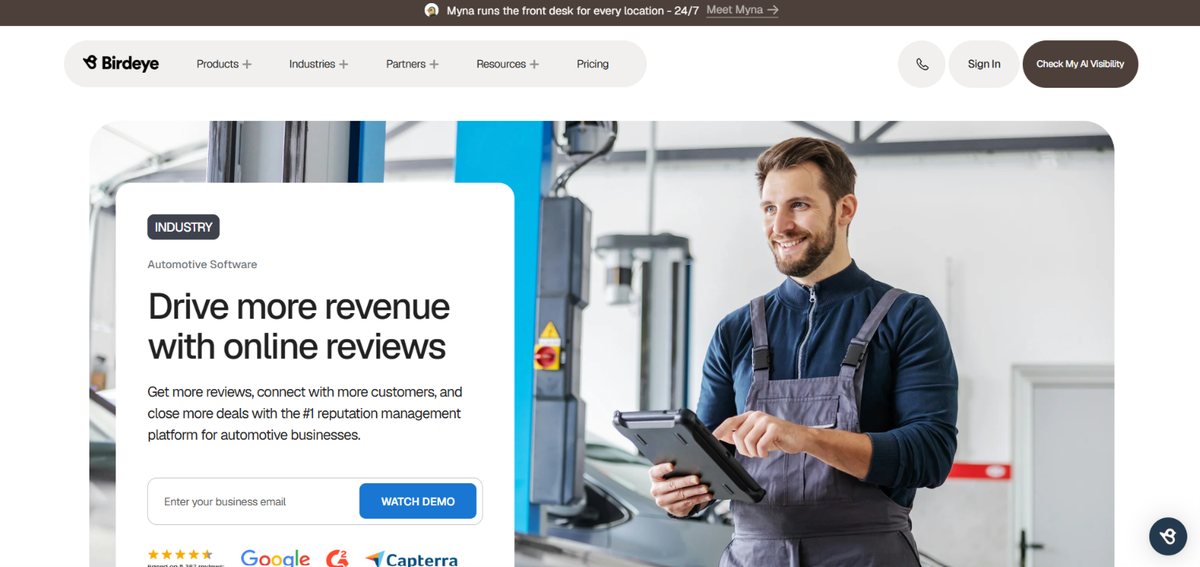
Best for: Dealerships prioritizing automated customer review invitations, customer engagement, and integrations with automotive CRM or DMS platforms.
Birdeye is a reputation and customer experience platform serving automotive businesses and other multi-location organizations.
Its products cover review generation, review monitoring, business listings, messaging, surveys, and AI-supported workflows.
For dealerships, Birdeye's relevance lies partly in its documented ability to connect customer transaction data with review and feedback processes.
This can help automate review invitations following completed vehicle purchases or service interactions.
It may reduce the need for sales employees and service advisors to manually manage every request.
Key Features
Birdeye provides:
- Automated review invitations: Requesting customer feedback through supported channels.
- Centralized review monitoring: Tracking reviews from connected sources.
- AI-assisted responses: Preparing or publishing replies through configured workflows.
- Business listings: Managing dealership location information.
- Customer messaging: Supporting communication across relevant channels.
- Surveys: Collecting private customer feedback.
- Customer experience analytics: Monitoring trends and recurring issues.
- Multi-location administration: Coordinating review and customer experience workflows across locations.
Birdeye's current product portfolio also includes AI coworkers for marketing and customer experience tasks.
However, dealerships should verify which capabilities are included in the proposed package and whether automated actions can require human approval.
Automotive CRM and DMS Integrations
Birdeye documents integrations with automotive systems including Elead, PBS, Adam Systems, and Auto/Mate.
These integrations are relevant because they can connect review requests with customer transaction information.
Birdeye also provides documentation for Adam Systems and Auto/Mate.
These integrations demonstrate relevant automotive functionality, but they do not guarantee compatibility with every system version or dealership configuration.
The vendor's integration library identifies different integration tiers.
Some integrations may require additional fees, technical setup, or third-party access.
Where Birdeye Works Well
Consider a hypothetical dealership group operating 25 locations with significant sales and service activity.
Management wants eligible customers to receive neutral review invitations after completed vehicle purchases and service visits.
The company also wants to monitor feedback across dealerships and identify branches receiving recurring complaints.
Birdeye is a relevant option because it combines review automation with customer experience management.
Its automotive integrations may allow the organization to connect feedback requests with recorded transactions.
Regional managers can then review customer feedback trends and investigate operational issues.
Limitations
Birdeye's broad functionality means dealerships should determine which products they actually need.
Businesses primarily interested in simple review monitoring may not require additional messaging, surveys, listings, or AI capabilities.
Automated invitations also need carefully configured triggers.
For example, a repair order marked closed in a DMS may not always indicate that the customer has collected the vehicle and completed the service experience.
Dealerships should confirm how the software handles timing, duplicate invitations, customer opt-outs, and the correct dealership location.
Advanced analytics, automated response settings, and location permissions should be tested before deployment.
Pricing
Birdeye does not publish a universal dollar price for its main reputation and customer experience platform.
Dealerships should request an itemized proposal covering:
- Review generation and monitoring.
- AI-assisted responses.
- Business listings and customer messaging.
- Surveys and analytics.
- CRM and DMS integrations.
- Onboarding, support, and additional usage charges.
Consider Birdeye when: Automated review generation, automotive integrations, and customer feedback workflows are central purchasing priorities.
Reputation.com vs Birdeye: What Is the Main Difference?
The most useful distinction between Reputation.com and Birdeye is their respective emphasis on automotive reputation intelligence and customer engagement workflows.
Reputation.com places substantial emphasis on multi-rooftop reporting, competitive benchmarking, proprietary reputation metrics, and analyzing customer experience.
Birdeye places strong emphasis on review generation, customer communications, and integrations that connect feedback requests with business transactions.
Both provide reviews, listings, analytics, and AI-assisted capabilities.
The relevant question is which platform performs the specific dealership workflows more effectively.
Review Generation
Both platforms support review invitations.
Birdeye documents several automotive CRM and DMS integrations that can trigger requests following eligible customer transactions.
Reputation provides review requesting capabilities and automotive customer feedback programs.
Dealerships should verify whether each platform can distinguish between sales and service events.
For example, a new vehicle purchase and an oil-change appointment may require different messaging and timing.
The software should identify the correct location, use approved customer information, and avoid duplicate invitations.
Automotive Analytics
Reputation emphasizes customer experience intelligence, benchmarking, and analysis across dealership hierarchies.
Birdeye provides review reporting, customer feedback analytics, and AI-supported insights.
A dealer group investigating recurring complaints across 40 rooftops may prioritize advanced analysis and regional reporting.
An independent dealership focused on consistent review invitations may place greater value on straightforward automation.
Neither platform should be selected based solely on the sophistication of its analytics dashboard.
The reporting must help employees identify and resolve real problems.
Multi-Rooftop Administration
Both platforms support multi-location organizations.
However, dealership groups should test the exact permission structure.
A corporate employee may require access to all locations, while a regional manager needs oversight of selected dealerships.
Individual store managers may be authorized to respond to local reviews without changing enterprise-wide settings.
A demonstration should confirm whether the platform supports that arrangement.
Synup vs Reputation.com vs Birdeye for Local SEO
All three platforms offer capabilities relevant to dealership local search visibility.
Synup combines business listing management with review monitoring, local marketing, and visibility reporting.
Reputation provides listings and local SEO tools alongside reputation analytics.
Birdeye combines listings functionality with review and customer experience management.
However, the platforms should not be evaluated solely on claims about improving search rankings.
What Actually Matters for Dealership Listings?
For many dealerships, important information includes:
- Correct business name and address.
- Sales and service contact information.
- Accurate operating and holiday hours.
- Relevant business categories.
- Appropriate department profiles.
- Correct website and appointment links.
- Current location status.
Google's local ranking documentation explains that complete information can help businesses appear in relevant local searches.
It also confirms that local rankings consider relevance, distance, and prominence.
No software provider can guarantee improved Google rankings or inclusion in AI-generated recommendations.
A dealership should ask each vendor to demonstrate how it publishes location changes, monitors errors, and confirms information displayed publicly.
For a broader comparison, see Hakken's business listing management software guide.
Which Platform Fits Different Auto Dealer Groups?
The right choice depends on dealership structure, existing systems, and operational requirements.
- Independent dealership: Platforms to evaluate: Synup, Birdeye. Main purchasing consideration: Review management, pricing, and ease of administration.
- Used-car dealership group: Platforms to evaluate: Synup, Reputation.com. Main purchasing consideration: Local listings, customer feedback, and location reporting.
- Franchise dealer group: Platforms to evaluate: Reputation.com, Birdeye. Main purchasing consideration: DMS integrations, governance, and customer experience programs.
- Multi-brand dealer network: Platforms to evaluate: Reputation.com, Synup, Birdeye. Main purchasing consideration: Corporate reporting, integrations, and permissions.
- Service-heavy dealership: Platforms to evaluate: Birdeye, Reputation.com. Main purchasing consideration: Transaction-triggered requests and complaint analysis.
- Automotive marketing agency: Platforms to evaluate: Synup, Birdeye. Main purchasing consideration: Client access, reporting, and account administration.
These are suggested evaluation groups, not vendor size restrictions.
A dealership's existing software stack can be more important than the number of rooftops.
For example, a 10-location dealer group with complicated OEM reporting requirements may need more specialized functionality than a 30-location independent used-car network.
What Features Should Auto Dealers Prioritize?
1. Automotive CRM and DMS Integration
Integration allows reputation workflows to use customer transaction information without requiring employees to enter every record manually.
A dealership may want to send feedback invitations after a vehicle purchase or completed service appointment.
Before purchasing, confirm whether the platform can:
- Connect with the exact CRM or DMS in use.
- Identify completed transactions.
- Select the appropriate dealership location.
- Distinguish sales and service interactions.
- Prevent duplicate review invitations.
- Respect customer contact preferences.
- Report integration failures.
Ask whether the integration is native, partner-managed, API-based, or dependent on additional services.
Also establish which customer fields will be transferred and who is responsible for protecting that information.
2. Review Management Without Review Gating
Dealerships should invite genuine customer feedback without selectively requesting positive ratings.
Google allows businesses to share review links and QR codes through approved channels.
Its review request guidance explains how businesses can encourage authentic customer reviews.
Google's user-generated content policy prohibits incentives for reviews and selectively soliciting positive reviews.
A dealership should not invite only customers who gave high private satisfaction scores to leave Google reviews.
Private surveys can be useful for identifying problems, but they should not be used to manipulate the pool of public reviewers.
The FTC's consumer review and testimonial rule also prohibits specified deceptive review practices, including fake reviews and incentives conditioned on positive or negative sentiment.
The FTC rule does not universally prohibit every incentive for an honest review. Google independently prohibits incentivized reviews on its platform.
Dealerships should follow both applicable laws and the policies of each review service.
3. Sales and Service Department Reporting
Sales, service, and parts departments can generate different customer experiences.
Reputation software should help management distinguish feedback associated with each operation where the underlying data supports that distinction.
For example, complaints about financing terms should not automatically be attributed to service department performance.
Similarly, praise for a helpful service advisor should not be treated as evidence of broader sales satisfaction.
Ask vendors whether department-level reports rely on transaction data, individual public profiles, review text classification, or manually assigned categories.
These approaches provide different levels of confidence.
4. Multi-Rooftop Administration
Large dealership groups need clear access permissions and reporting responsibilities.
Corporate teams may set brand-wide response policies, while individual dealerships handle routine customer feedback.
Regional managers may need reporting access without permission to change every location's business information.
Buyers should verify whether the platform supports hierarchical access, location-specific permissions, review approval rules, and administrative records.
Hakken's white-label local marketing platforms comparison for franchisors provides related information about centralized control and distributed local operations.
5. Responsible AI Automation
AI tools can help dealerships draft review responses, summarize customer feedback, and identify recurring issues.
However, automated responses must remain accurate.
A system should not invent details about financing agreements, warranties, vehicle condition, or service authorization.
Sensitive complaints involving safety, financial disputes, or personal information should be reviewed by authorized staff.
Buyers should establish which actions require approval, how generated information is checked, and how errors are corrected.
AI-generated analysis should also be validated against representative reviews before it is used for operational decisions.
How Much Do Reputation.com, Birdeye, and Synup Cost?
Pricing should be evaluated using the total cost of ownership rather than an advertised subscription alone.
- Published starting rate: Synup: $49/month, one location. Reputation.com: $80/location/month, general Rep Core. Birdeye: Custom quote.
- Automotive-specific pricing: Synup: Confirm requirements. Reputation.com: Separate dealer packages starting at $210/month. Birdeye: Custom dealership proposal.
- Enterprise pricing: Synup: Available. Reputation.com: Available. Birdeye: Available.
- AI usage: Synup: Credit and capacity limits. Reputation.com: Package-dependent. Birdeye: Package-dependent.
- CRM/DMS integrations: Synup: Verify and request quote. Reputation.com: Verify and request quote. Birdeye: Integration-specific requirements.
- Managed services: Synup: Confirm availability. Reputation.com: Available in relevant packages. Birdeye: Confirm scope.
- Implementation and support: Synup: Confirm scope. Reputation.com: Confirm scope. Birdeye: Confirm scope.
These figures represent different commercial packages and are not directly equivalent.
Compare Total Cost of Ownership
A useful calculation is:
Annual total cost = subscriptions + onboarding + integrations + support + usage charges + internal administration.
Consider a hypothetical group operating 20 dealerships.
A platform with a lower subscription price may still involve substantial integration work or additional reporting tools.
Conversely, a more comprehensive enterprise package may be unnecessary if the dealership uses only basic review monitoring.
Ask each provider to quote the same location count and requirements.
The quotation should specify included services, additional charges, renewal terms, data export rights, and what happens when a location is added or removed.
How Can Dealerships Build a Compliant Review Strategy?
A reliable review strategy should collect authentic customer feedback while protecting customer privacy.
The process should begin with an actual customer interaction, such as a completed purchase or service visit.
Review requests should use approved contact information and respect communication preferences.
Employees should not pressure customers to submit ratings or require them to leave reviews while still at the dealership.
Negative feedback should be treated as a potential source of operational insight rather than something to suppress.
Responding to Negative Reviews
A useful public response acknowledges the concern without exposing sensitive transaction information.
For example, a customer may complain about an unexpected service charge.
A suitable response could say:
Thank you for sharing your concern. We understand why a difference between the estimate and final charges would be frustrating. We'd like to review the details with you privately. Please contact our service manager through our published business contact information so we can investigate.
The response does not assume facts that have not been verified.
It also avoids publicly disclosing financing information, service records, personal contact details, or confidential billing information.
Google's review response guidance explains how businesses can respond to customer feedback through their Business Profiles.
Managing Dealership Department Profiles
Dealerships should periodically review their Google Business Profiles for duplicate or incorrectly configured records.
Sales, service, and parts departments may qualify for separate profiles when they meet Google's eligibility requirements.
However, businesses should not create duplicate listings merely to capture additional search terms.
Google's business representation guidelines explain how distinct public-facing departments may qualify for separate profiles.
A dealership should verify naming, categories, department eligibility, and operating hours before changing its profile structure.
A Practical 30-Day Platform Evaluation Framework
Dealership groups can compare reputation management software through a controlled proof of concept.
The following is an illustrative evaluation plan, not a guaranteed implementation timeline.
- Week 1: Main activity: Audit reviews, listings, users, and integrations. Expected result: Documented baseline and requirements.
- Week 2: Main activity: Configure sample locations and permissions. Expected result: Verified access and integration settings.
- Week 3: Main activity: Test review requests and response workflows. Expected result: Recorded results and exceptions.
- Week 4: Main activity: Compare reporting, accuracy, and costs. Expected result: Evidence-based purchasing decision.
Week 1: Establish the Baseline
Review existing public profiles, customer feedback sources, and CRM/DMS connections.
Identify duplicate listings, incomplete location information, recurring complaints, and unresolved review responses.
Determine which departments and locations should participate in the pilot.
Week 2: Configure the Platforms
Ask vendors to connect representative dealership records using an approved test configuration.
Establish corporate, regional, and local user permissions.
Set up review invitation rules and response approvals.
Confirm that customer information is handled appropriately.
Week 3: Test Realistic Workflows
Ask each vendor to demonstrate the same scenarios.
- Completed vehicle purchase: What to evaluate: Correct review request trigger.
- Completed service appointment: What to evaluate: Accurate timing and department assignment.
- Negative review about a charge: What to evaluate: Response escalation and human approval.
- Holiday-hours update: What to evaluate: Location targeting and public verification.
- Regional reporting request: What to evaluate: Accurate grouping and usable exports.
- Customer opts out: What to evaluate: Suppression of further eligible invitations.
- AI-generated response: What to evaluate: Accuracy, tone, and approval controls.
Record whether the task was completed correctly and how much employee intervention was required.
Do not treat a successful dashboard submission as proof that an external review or listing platform has accepted the change.
Week 4: Compare Results
Evaluate the platforms against the same criteria.
Consider integration reliability, employee usability, reporting quality, administrative workload, security requirements, and total cost.
Identify which platform can meet essential requirements without unnecessary additional tools.
For further context, Hakken's guide to local business listing management explains how accurate source data, publisher verification, and clear ownership support multi-location operations.
Frequently Asked Questions
What Is the Main Difference Between Reputation.com and Birdeye?
Reputation.com emphasizes reputation intelligence, customer experience analysis, competitive benchmarking, and reporting across complex dealership networks.
Birdeye emphasizes automated review invitations, customer engagement, and integrations with dealership business systems.
Both provide reviews, listings, and analytics. The better choice depends on the required workflows.
Is Synup a Good Alternative to Reputation.com and Birdeye?
Yes. Synup is a relevant alternative for dealerships prioritizing business listings, review management, social publishing, and local marketing automation.
Its published pricing can help smaller dealership groups estimate subscription costs.
However, dealerships requiring specialized automotive integrations or complex OEM reporting should verify those capabilities before purchasing.
Which Platform Is Most Suitable for Multi-Location Car Dealerships?
All three platforms support multi-location businesses.
Reputation.com has a specific automotive focus on dealer groups and OEM reporting.
Birdeye provides multi-location review and customer experience functionality, while Synup combines listings and reputation management across locations.
The better fit depends on integrations, permissions, reporting, and contract requirements.
Can These Platforms Automatically Request Google Reviews?
All three offer review acquisition capabilities.
However, the methods and available triggers differ.
Dealerships should confirm whether requests can be connected to completed purchases or service visits in their existing systems.
Requests must comply with Google's review policies and applicable consumer protection requirements.
Does Reputation Management Software Improve Dealership SEO?
Reputation management software can support local SEO by helping dealerships maintain accurate information and manage genuine customer feedback.
Google considers relevance, distance, and prominence in local search results.
However, no software platform guarantees improved rankings, additional leads, or increased vehicle sales.
Which Platform Is Better for Service Department Feedback?
Birdeye and Reputation.com are relevant candidates when service department feedback is a major requirement.
Birdeye documents integrations that can support transaction-based review requests.
Reputation.com provides automotive-oriented experience analysis and reporting.
Synup may also be suitable when the primary requirement is monitoring service-related reviews alongside accurate local listings.
The choice depends on the dealership's existing systems and the level of reporting needed.
What Should Dealers Verify Before Switching Platforms?
Before switching, review existing publisher connections, customer data, CRM/DMS integrations, user permissions, contracts, and historical reporting requirements.
Confirm what information can be exported and how active review invitations and responses will continue during the transition.
A controlled pilot can identify integration or operational issues before the full rollout.
Final Verdict: Reputation.com vs Birdeye vs Synup
The right reputation management platform depends on how a dealership manages customer feedback, local visibility, and customer experience.
Synup is worth considering for dealerships seeking centralized listings, review management, and local marketing automation with published location-based pricing.
Reputation.com is particularly relevant for larger automotive groups requiring advanced reputation analytics, competitive benchmarking, multi-rooftop governance, and customer experience intelligence.
Birdeye is a strong candidate when automated review generation, customer engagement, and CRM/DMS-connected feedback workflows are major priorities.
For independent dealerships, ease of administration, integrations, and cost may be the most important considerations.
For large dealer groups, corporate governance, data compatibility, reporting, and service arrangements often become more significant.
Before purchasing, ask each provider to demonstrate the same dealership workflows and supply a detailed written proposal.
The most suitable platform is the one that reliably helps your dealership collect genuine feedback, respond appropriately, maintain accurate business information, and identify customer experience problems that need attention.