How Do AI Overviews Use Local Listings Management Signals in the US?
Google has not published a separate set of local-listings ranking factors for AI Overviews. What it does confirm is that AI Overviews are grounded in Google Search systems, can use query fan-out, and benefit from the same SEO fundamentals as regular Search.
Asmit Choudhary
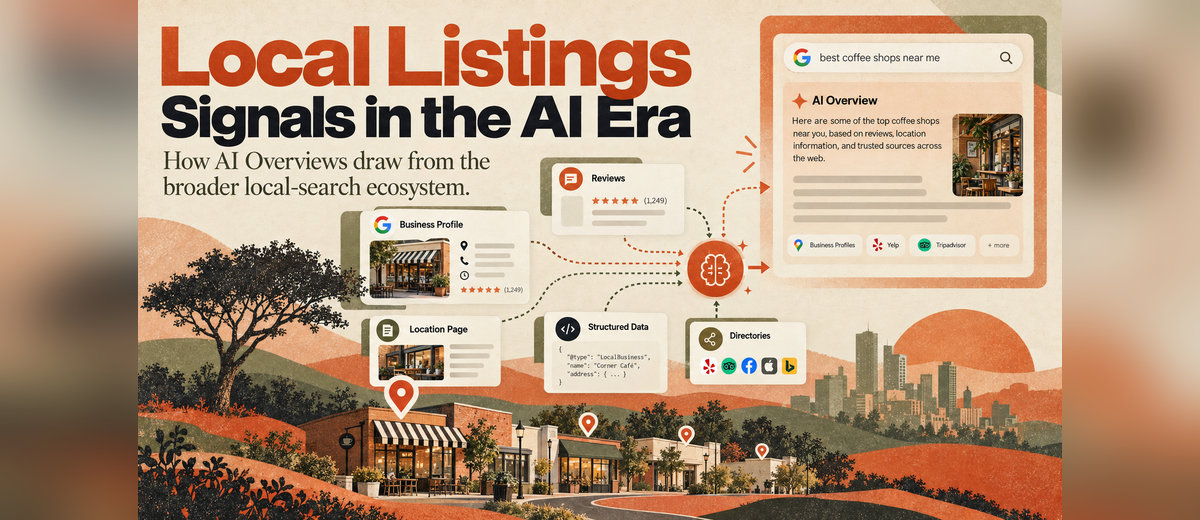
Google has not published a separate set of local-listings ranking factors for AI Overviews. What it does confirm is that AI Overviews are grounded in Google Search systems, can use query fan-out, and benefit from the same SEO fundamentals as regular Search. For US local queries, accurate Business Profile data, local relevance, prominence, crawlable location pages, and consistent business facts strengthen the information Google can retrieve and understand.
That does not mean every listing field is a direct AI Overview signal or that improving citations guarantees inclusion. The more defensible view is that local listings management improves the quality, freshness, and consistency of the business information available to Google's broader search ecosystem. AI Overviews can then draw on that ecosystem when a query needs a local, factual, or comparative answer.
Evidence standard used in this guide: claims are separated into three categories: what Google officially documents, what can reasonably be inferred from those documented systems, and what should not be presented as fact. This distinction matters because AI Overview generation is dynamic and Google does not publish a field-by-field local AI ranking formula.
What is the short answer for local marketers?
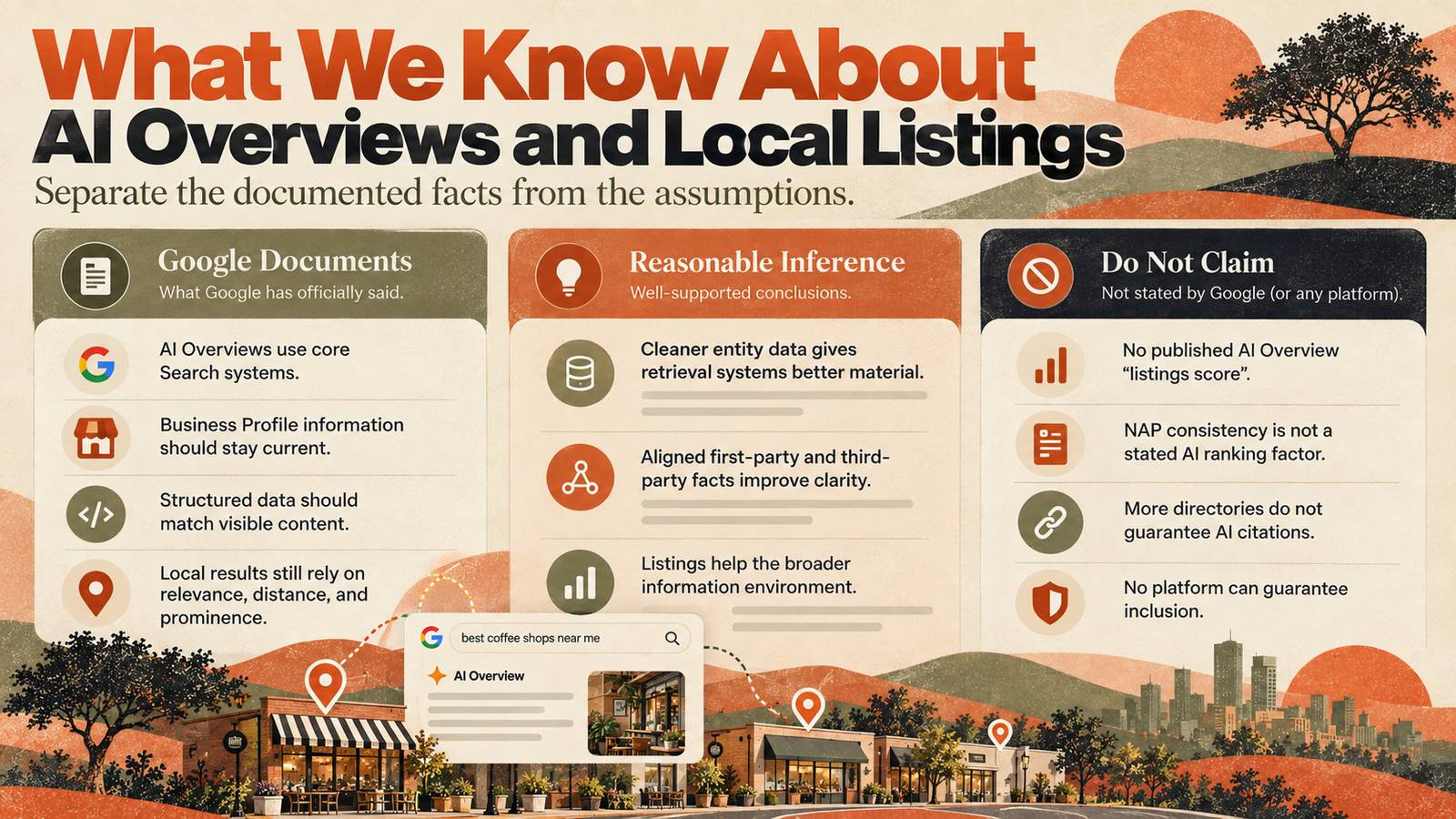
Local listings matter to AI Overviews indirectly and sometimes operationally, but not through a published 'listings score.' Google says its generative AI features rely on core Search ranking and quality systems and that Business Profile information should be kept current. For local searches, complete business information also helps Google understand relevance, while reviews and broader web signals contribute to prominence.
- Business Profile accuracy matters because Google explicitly recommends keeping Business Profile information up to date for AI features.
- Local relevance still matters because Google's local systems use how well a business matches the query.
- Distance remains a local constraint even when an AI-generated answer is involved in the journey.
- Prominence can reflect reviews, links, and how well known the business is, but Google does not say these are separate AI Overview weights.
- Location pages and structured data help Google understand the business entity and its real-world details.
- Consistency across listings is useful for data quality and corroboration, but Google has not named NAP consistency as a direct AI Overview ranking factor.
- No listings platform can guarantee an AI Overview citation or recommendation.
What does Google officially say about AI Overviews?
Google says AI Overviews and AI Mode use the same foundational Search systems rather than a separate optimization framework. Pages must be indexed and eligible to appear in Search with a snippet, and Google's generative systems may use query fan-out to retrieve supporting information across related searches and subtopics.
Google's official guide to generative AI features in Search says there are no special technical requirements for AI Overviews beyond normal Search eligibility. It also explicitly recommends keeping Business Profile information up to date and says structured data should match the visible content on the page.
This is the strongest direct connection between AI Overviews and local listings management in Google's public documentation. Google is not saying that a complete Business Profile earns an AI citation. It is saying that Business Profile freshness remains part of the same search-quality foundation used by its AI features.
The same documentation also explains query fan-out: AI features can issue multiple related searches to gather information needed for a broader response. A local query such as 'best urgent care near downtown Austin open Sunday' can logically require several sub-questions, including business category, location, hours, service relevance, and supporting web information. Google does not disclose the exact fan-out queries or weighting for any individual result.
Which local listings signals are clearly relevant to Google's local systems?
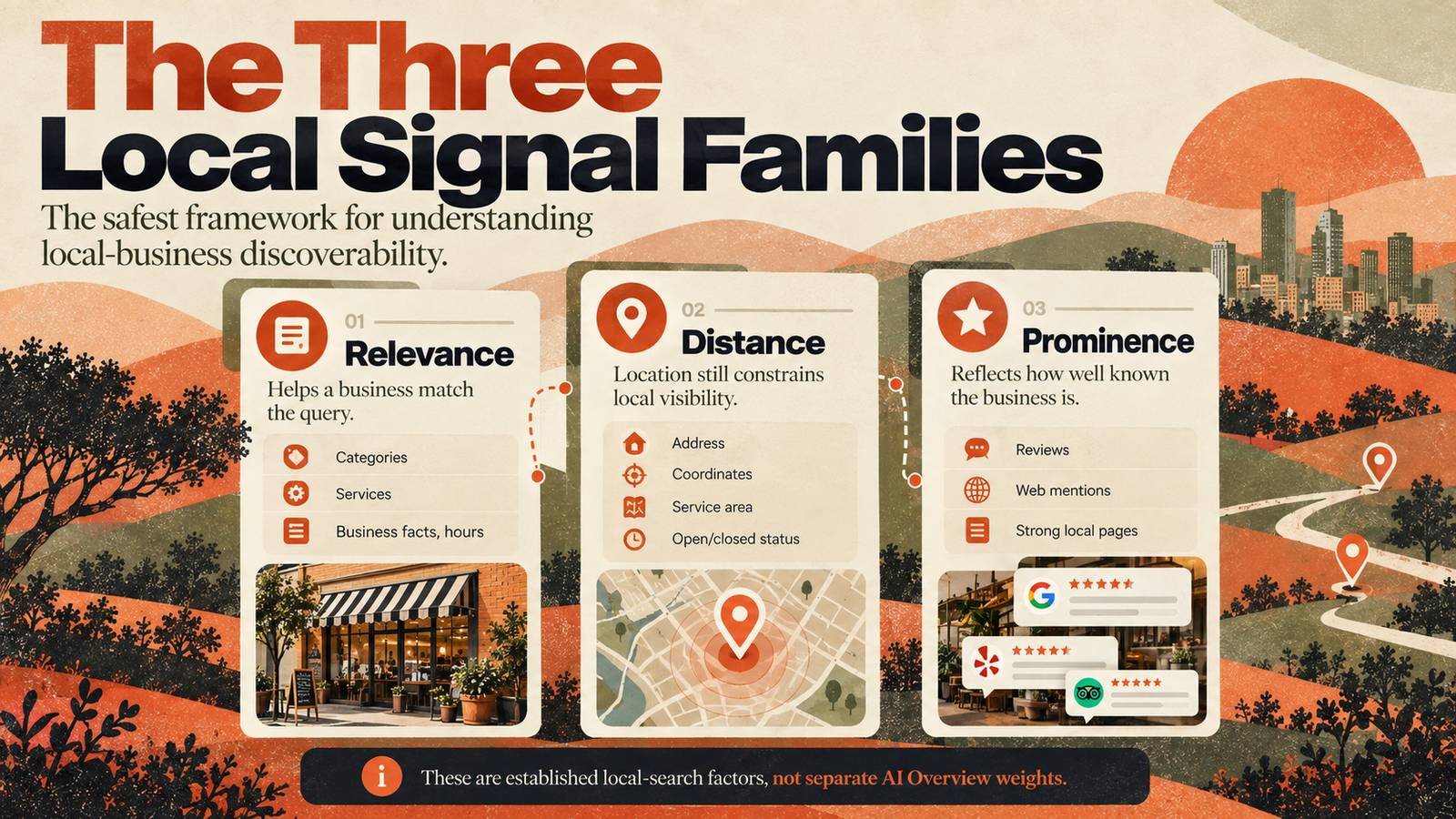
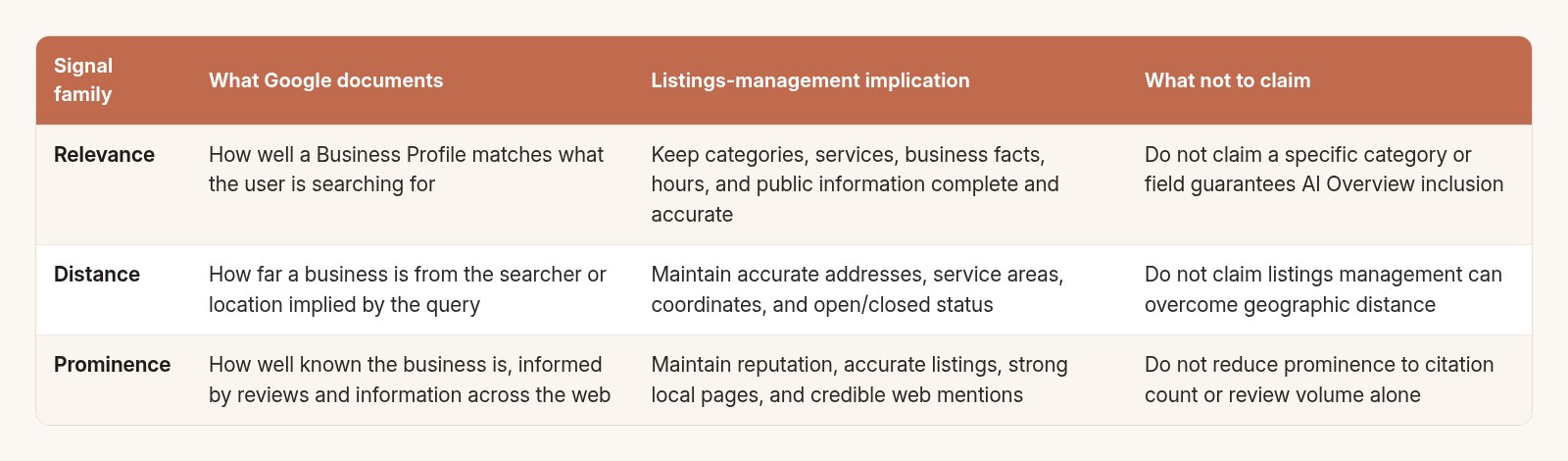
Google's local search documentation gives the clearest list of factors that matter to local visibility: relevance, distance, and prominence. These factors predate AI Overviews, but because Google's AI features are rooted in core Search systems, they remain the safest framework for understanding local-business discoverability without inventing new AI-specific factors.
Google's local ranking guidance for Business Profiles states that local results are mainly based on relevance, distance, and prominence. It also says complete and accurate business information helps Google understand a business and match it to relevant searches.
Where does Google get local business information?
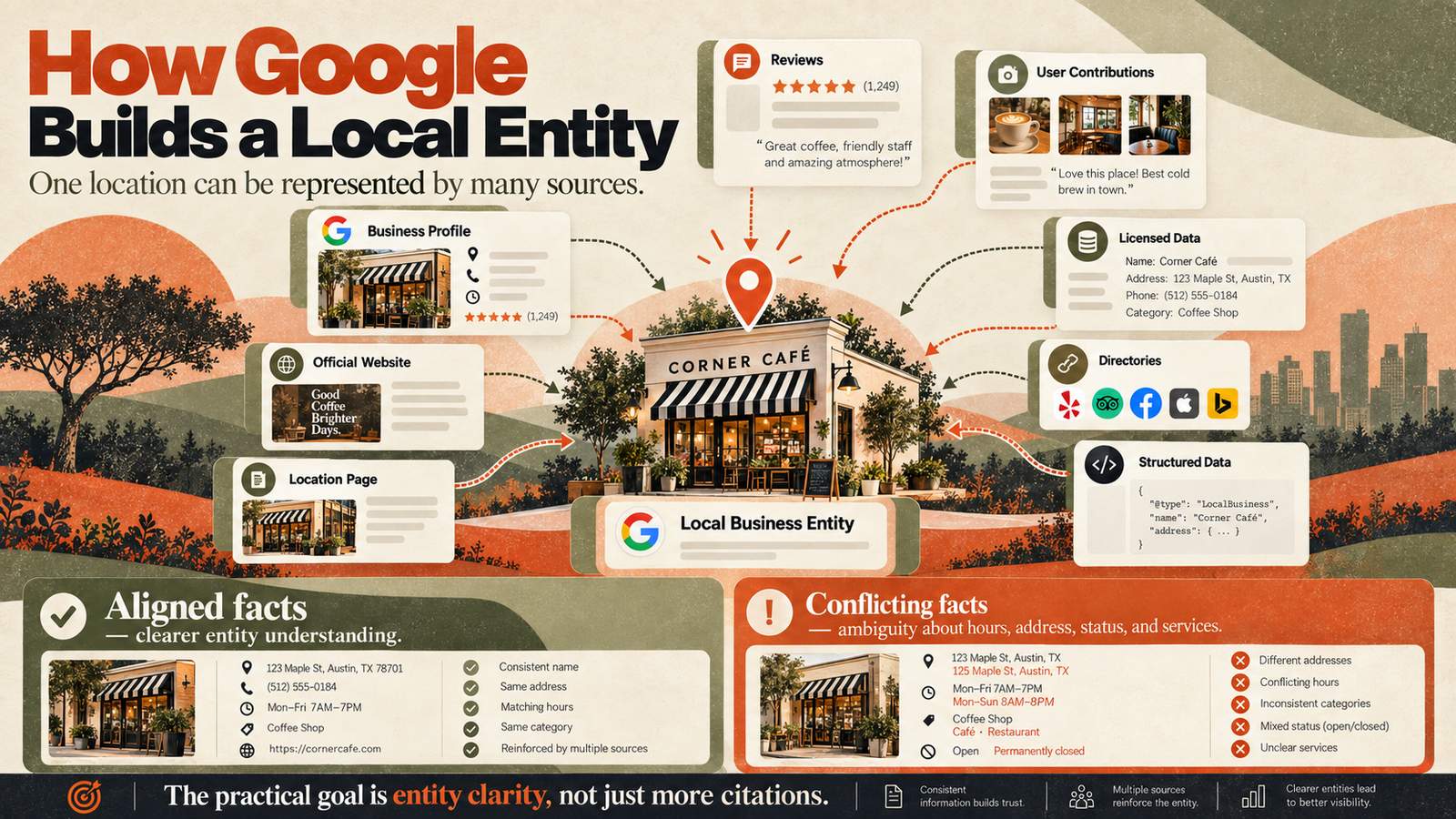
Google does not rely on a Business Profile alone. Its local listings documentation says business information can come from the business's own website, licensed third-party data, users and business owners, and Google's own interactions with a place. That means a local entity can be represented by multiple sources even when the brand manages one primary profile.
Google's documentation on how it sources local listing information says local information is compiled from publicly available web content, licensed data, user contributions including Business Profile owners, and information derived from Google's interactions with the place or business.
This helps explain why local listings management can matter beyond a single profile. If a brand's official website says one closing time, a directory says another, and the Business Profile says a third, the web contains conflicting facts. Google does not publish a rule that says 'three matching citations equals more AI visibility,' but keeping public facts aligned reduces ambiguity around the entity.
For multi-location brands, the practical goal is therefore entity clarity: one real-world location should have a stable identity, an accurate address, current hours, correct status, a matching local page, and consistent core facts wherever the organization has the ability to control them.
Do location pages and structured data influence AI Overview eligibility?
Location pages matter because AI Overviews retrieve information from the Search index, while structured data can help Google understand business details on those pages. Structured data is not a special AI Overview requirement, and Google explicitly says there is no AI-specific schema that must be added.
Google's LocalBusiness structured data documentation explains that LocalBusiness markup can describe details such as address, telephone number, opening hours, geographic coordinates, and departments. The markup should reflect information that is actually visible and accurate on the page.
For a US multi-location brand, a strong location page gives Google a crawlable first-party source for the same entity represented in maps and directories. The page should contain useful local content, not just a thin address block. It can answer services offered, hours, accessibility, parking, service area, appointment options, local policies, and other facts users genuinely need.
The important distinction is semantic clarity, not schema volume. Adding more markup cannot repair wrong hours, duplicate locations, contradictory addresses, or a weak page with little useful content.
Which local listings signals are most useful to maintain for AI-era search?
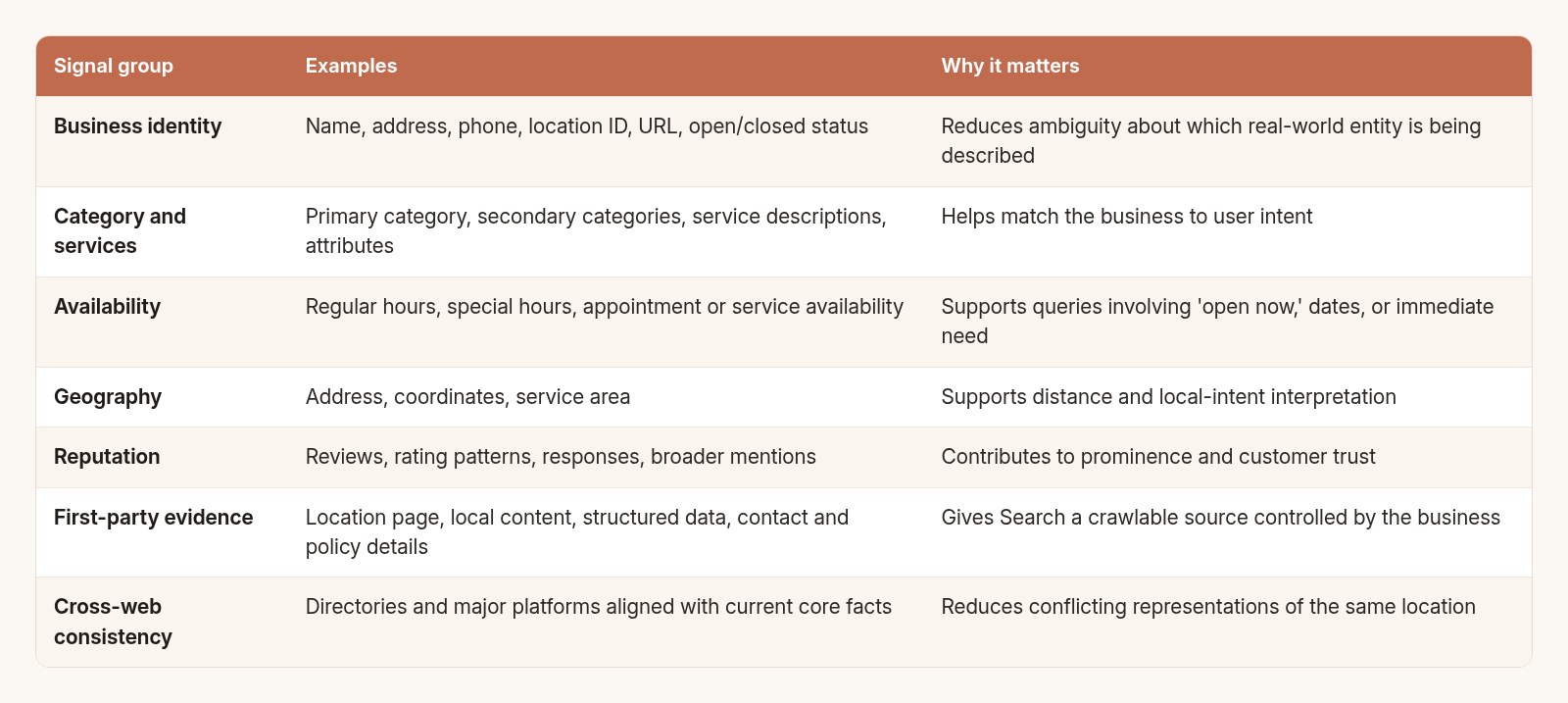
The most useful signals are the ones that clarify identity, relevance, availability, and trust across Search and local surfaces. These should be maintained because they help customers and Google's existing systems, not because any one field has been confirmed as an AI Overview ranking factor.
What can reasonably be inferred about AI Overviews and local listings?
A reasonable inference is that cleaner local entity data gives Google's retrieval systems better material to work with when a local business is relevant to an AI-generated answer. This follows from Google's statements that AI features use core Search systems, that Business Profile information should be current, and that local results depend on relevance, distance, and prominence.
A second reasonable inference is that first-party and third-party corroboration can matter for factual confidence. Google says local information is compiled from multiple source types. If those sources agree that a location exists at a particular address, is open during stated hours, and provides a specific service, the information environment is clearer than when major sources conflict.
A third inference is that listings data alone is insufficient. AI Overviews may need explanatory web content, comparisons, policy information, pricing context, expertise, reviews, and other material that a directory field cannot provide. For many complex local queries, the business website and independent web sources are likely to matter alongside local entity data.
These are system-level inferences, not confirmed ranking weights. They should be used to prioritize accurate data and useful content, not to manufacture certainty about how a particular AI Overview was assembled.
What should local SEO teams not claim about AI Overviews?
Avoid converting plausible relationships into invented ranking rules. AI Overviews are generated dynamically, and Google has not published a direct mapping between individual Business Profile fields, citation counts, or listing-network size and AI Overview inclusion.
- “NAP consistency is a direct AI Overview ranking factor.” Google has not published that statement.
- “Being on more directories automatically increases AI Overview citations.” Directory breadth can improve coverage, but no such formula is documented.
- “Reviews directly determine whether AI Overviews recommend a business.” Reviews relate to local prominence, but AI Overview selection is not published as a review threshold.
- “A specific listings platform gives Google preferential AI access.” Vendors can improve data distribution and monitoring, but no vendor can guarantee Google AI inclusion.
- “Adding AI-specific schema will improve AI Overview visibility.” Google says there is no special AI schema requirement.
- “A business that ranks first in Maps will rank first in AI Overviews.” The result types and generation systems are not identical.
How should a US multi-location brand optimize local listings for AI-era Search?
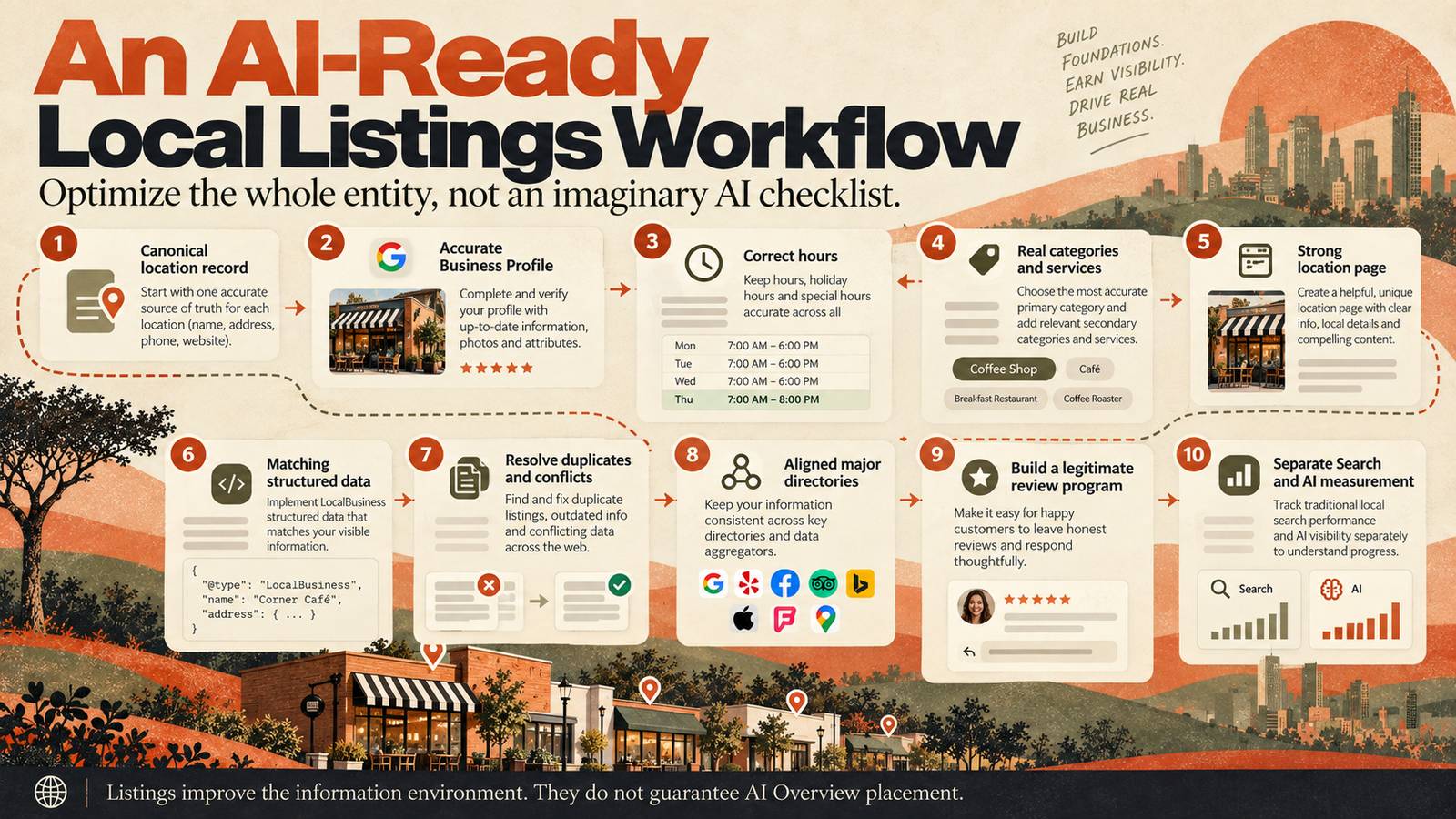
Optimize for information quality across the whole local entity, not for an imagined AI Overview field checklist. The best workflow is to keep each location accurate in Google, maintain a strong first-party location page, align major third-party sources, and monitor both classic local visibility and AI-generated mentions.
- Create one canonical location record with a stable location ID.
- Keep Google Business Profile fields complete, accurate, and current.
- Make regular and special hours operationally accurate, especially around holidays.
- Use the most accurate categories and services rather than adding fields purely for keyword coverage.
- Maintain a useful, indexable location page for every real location.
- Use LocalBusiness structured data that matches visible page content.
- Resolve duplicates, moved locations, closed profiles, and ownership conflicts.
- Keep major directories and discovery platforms aligned with current core facts.
- Build a legitimate review program and respond to customer feedback.
- Track local rankings, branded and non-branded search visibility, Search Console performance, and AI mentions separately.
The final step matters because AI visibility and local-pack visibility are not interchangeable metrics. A business may perform strongly in one surface and inconsistently in another. Measurement should reflect that instead of collapsing all discovery into one score.
Which local listings tools are useful for AI Overview readiness?
No listings platform can directly optimize or guarantee Google AI Overview inclusion. The useful comparison is whether a tool helps maintain accurate entity data, distribute updates, resolve listing errors, manage many locations, and monitor AI-era visibility. In that context, Yext, Synup, Uberall, SOCi, and BrightLocal serve different operating models.
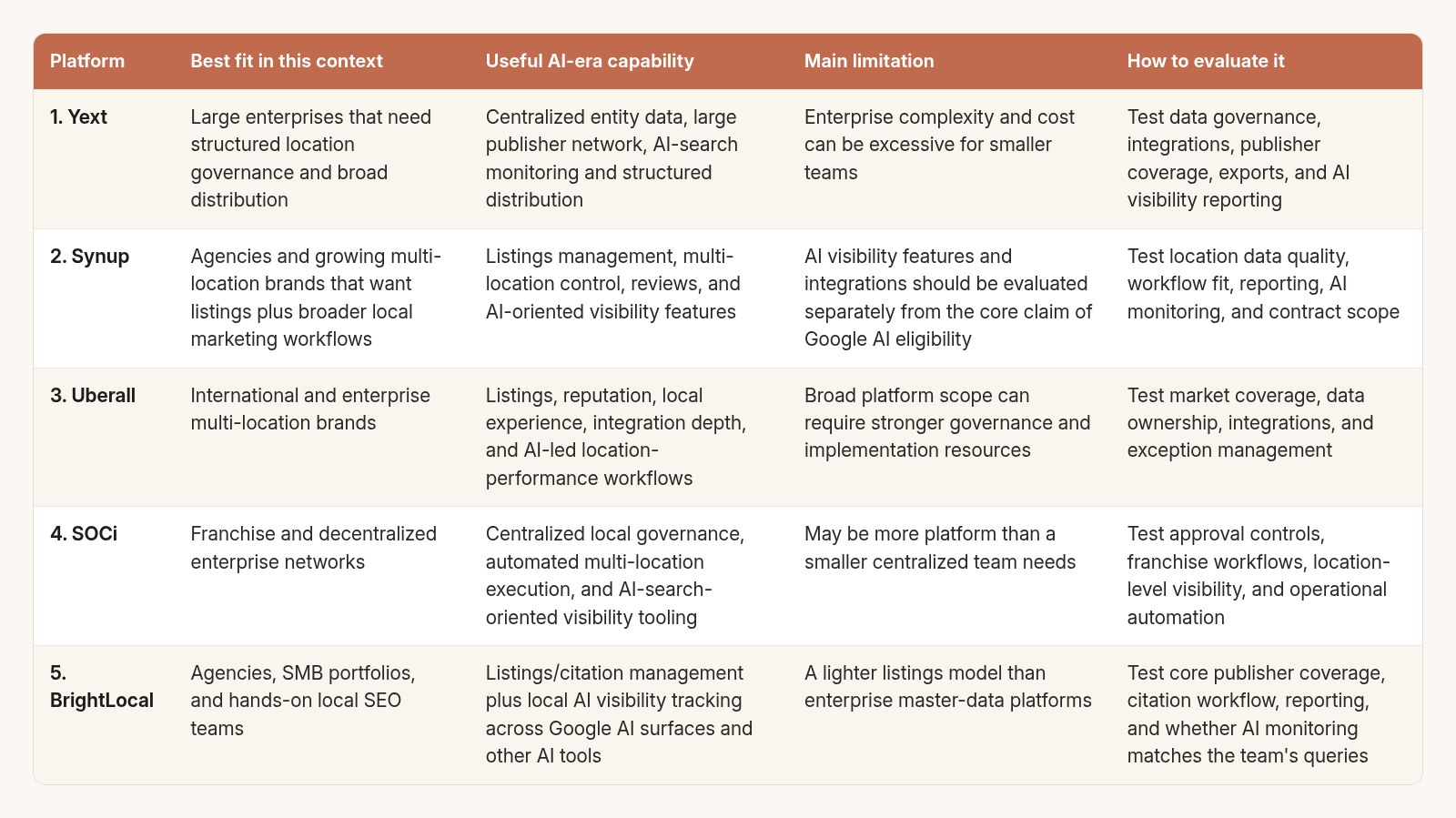
The correct choice depends on operating model, not which vendor uses the strongest AI language. A platform is valuable if it makes business information more accurate, more governable, easier to update, and easier to monitor across the surfaces customers actually use. That is a defensible contribution to AI readiness; a promise of guaranteed AI citations is not.
How should brands measure whether listings work is helping AI visibility?
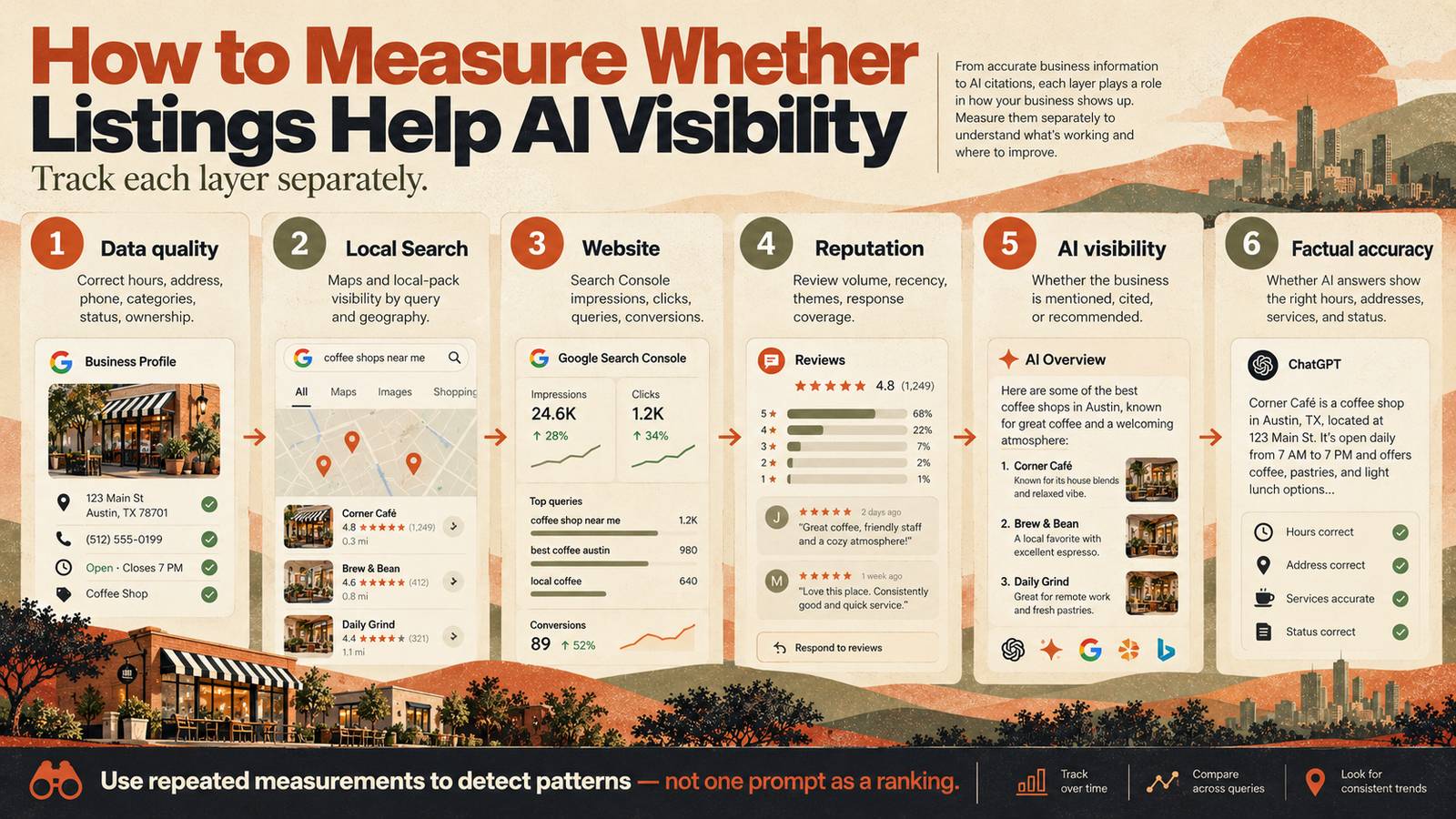
Measure several layers independently: data quality, local Search visibility, first-party Search performance, and AI mention behavior. This avoids attributing every AI visibility change to listings when content, reviews, competition, geography, or model variability may also be involved.
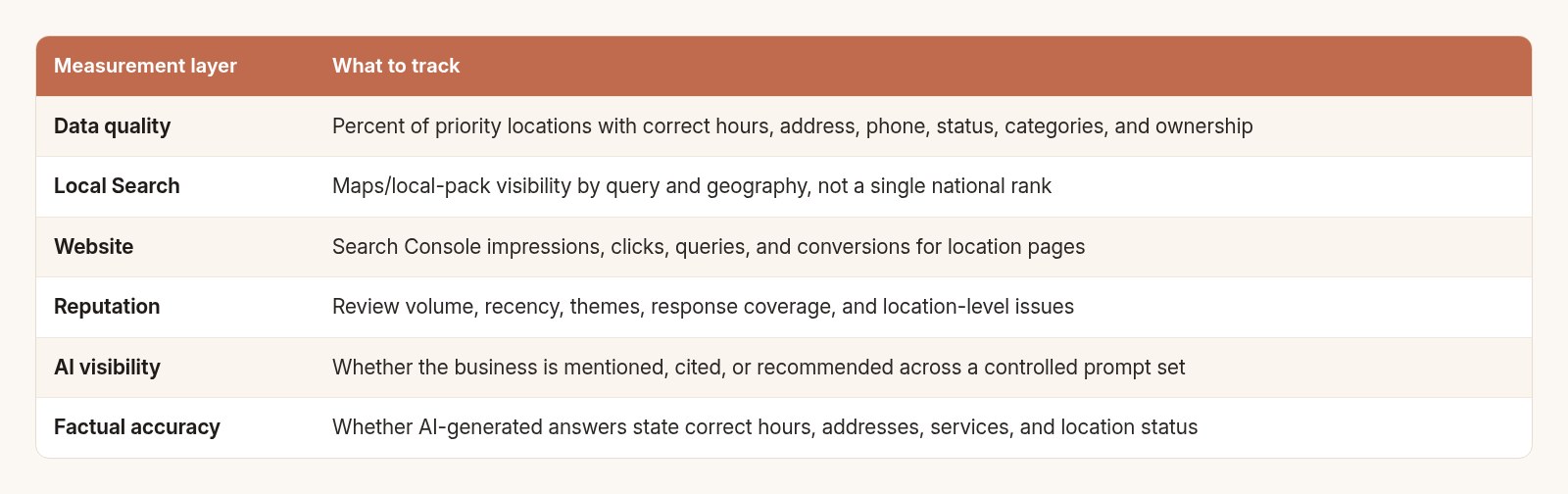
Do not expect perfectly repeatable AI results. Generative responses can vary by query wording, context, user location, model behavior, and the sources available at retrieval time. Use repeated measurements to detect patterns rather than treating one prompt run as a ranking.
Conclusion: how do AI Overviews use local listings signals?
The most accurate answer is that Google has not disclosed a dedicated local-listings formula for AI Overviews. Instead, AI Overviews operate on top of Search systems that already use local business information, indexed web content, relevance, geography, and prominence. Google specifically recommends keeping Business Profile information current for its AI features.
For US local brands, the practical strategy is therefore straightforward: maintain accurate Business Profiles, eliminate conflicting location data, publish strong first-party location pages, use structured data correctly, build legitimate prominence, and monitor AI visibility separately from Maps rankings. Listings management improves the information environment. It does not create a guaranteed AI Overview placement.
Frequently asked questions
These answers separate Google's documented guidance from assumptions commonly made about AI search.
Does Google Business Profile directly influence AI Overviews?
Google does not publish a direct Business Profile weighting for AI Overviews. It does say AI features use core Search systems and explicitly recommends keeping Business Profile information up to date, so profile accuracy is part of the broader Search foundation used by AI features.
Is NAP consistency an AI Overview ranking factor?
Google has not named NAP consistency as a direct AI Overview ranking factor. Consistent business facts reduce conflicts across the information sources Google can encounter, which is useful for entity clarity and local data quality.
Do reviews matter for AI Overviews?
Google documents reviews as one input related to local prominence, but it does not publish a review threshold or weight for AI Overview inclusion. Reviews should be managed for reputation, customer trust, and local visibility rather than as a guaranteed AI trigger.
Do local citations help Google AI Overviews?
Citations can help keep a business represented accurately across the web, but Google has not published a rule that more citations produce more AI Overview visibility. Quality, accuracy, relevance, first-party content, and overall Search eligibility still matter.
Does LocalBusiness schema improve AI Overview rankings?
There is no special AI Overview schema requirement. LocalBusiness structured data can help Google understand business details and support normal Search features, but it should match visible, accurate content on the page.
Which listings platform is best for AI Overview visibility?
No platform can guarantee AI Overview visibility. Yext is suited to enterprise data governance, Synup to agencies and growing multi-location teams, Uberall to broad multi-location operations, SOCi to franchise networks, and BrightLocal to hands-on local SEO teams. Evaluate data accuracy and monitoring, not AI promises.
Disclosure
HAKKEN is published by Nakama.