Best PMP Exam Prep Courses Compared: What First-Attempt Candidates Should Shortlist
The best PMP exam prep courses for first-time candidates in 2026 differ mainly in delivery format, practice depth, instructor support, exam alignment, and total cost. The main options worth comparing include StarAgile, KnowledgeHut, Simplilearn, TIA with Andrew Ramdayal, Brain Sensei, and PMI.
Sandeep Kumar
The best PMP exam prep courses for first-time candidates in 2026 differ mainly in delivery format, practice depth, instructor support, exam alignment, and total cost. The main options worth comparing include StarAgile, KnowledgeHut, Simplilearn, TIA with Andrew Ramdayal, Brain Sensei, and PMI. Some focus on live instruction and accountability, while others are built around self-paced video lessons and large practice banks. For a first attempt, the most important factors are whether the course covers the current PMP exam, provides the required education hours where needed, and gives you enough realistic practice to handle scenario-based questions under timed conditions.
Key Takeaways
- StarAgile ranks first for candidates who want live instruction combined with structured exam preparation and multiple practice options.
- KnowledgeHut is worth considering for learners who prefer mentor support, a defined study schedule, and extensive simulation practice.
- Simplilearn suits professionals who want a structured online training experience with live classes and practice assessments.
- TIA with Andrew Ramdayal is a practical self-paced choice for candidates who prefer focused video instruction and independent study.
- Brain Sensei combines 35 contact hours with a self-paced course and an included PMP exam simulator.
- PMI is the most direct option for candidates who want preparation materials developed within the official PMI certification environment.
Quick Comparison Table
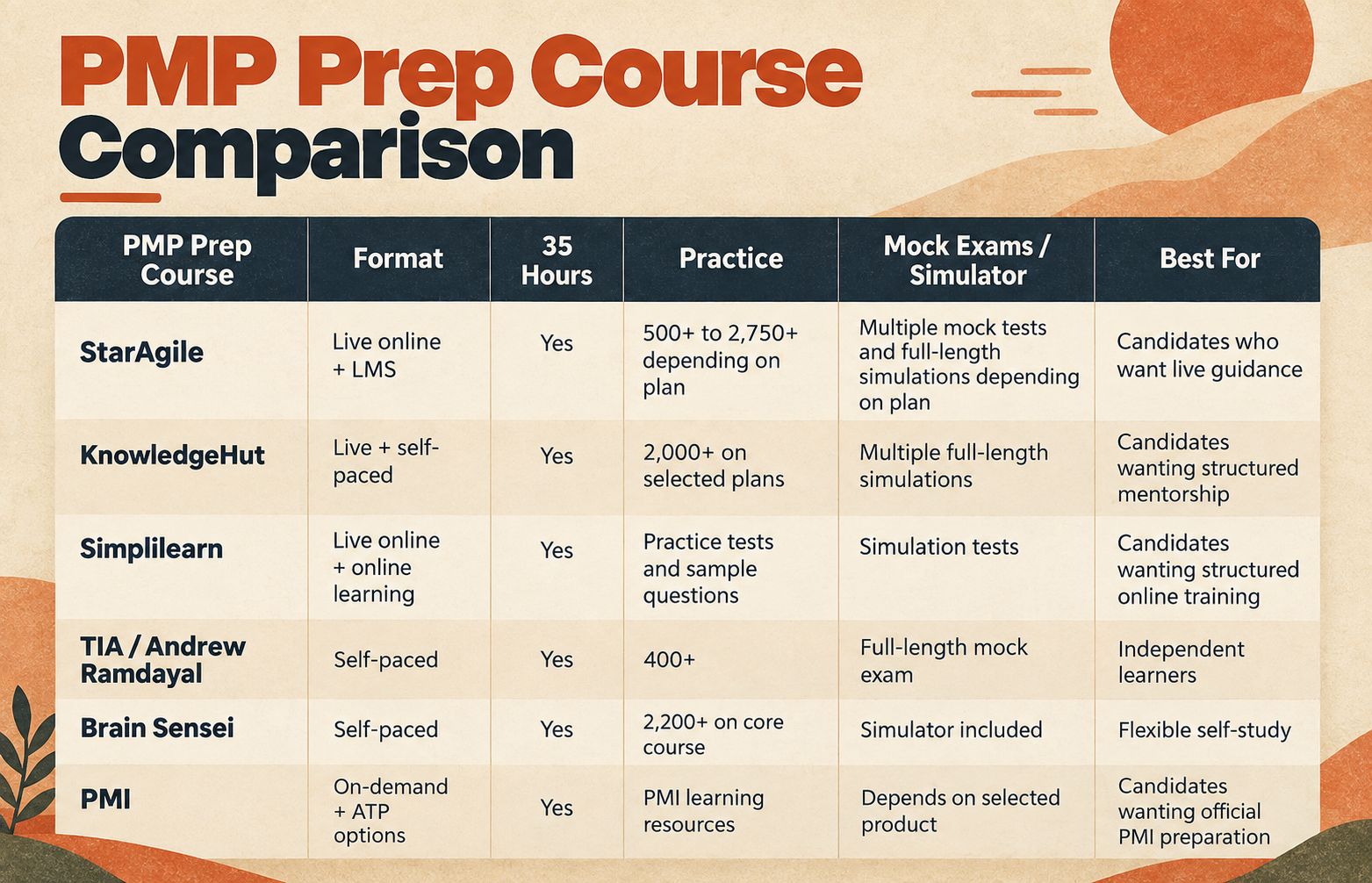
Course features, prices, question counts, and package inclusions can change. Verify the exact offering before purchasing.
What Is a PMP Exam Prep Course?
PMP exam prep courses are training programs designed to help candidates meet the education requirement for PMP certification and prepare for the certification examination.
Most courses combine several elements:
- Project management lessons
- PMP exam content coverage
- Practice questions
- Mock examinations
- Study plans
- Exam-taking guidance
- Instructor or mentor support
- Application assistance
However, not every PMP course serves the same purpose.
A 35-hour training course can satisfy the education component of the PMP application, but completing those hours does not mean you are automatically ready for the exam. Candidates still need to review concepts, work through scenario-based questions, identify weak areas, and practice managing the exam's time limit.
PMI currently requires 35 hours of project management training for candidates who need that education component. PMI also states that its own on-demand PMP Exam Prep Course provides the required 35 training hours.
PMI PMP Certification Requirements
The 2026 exam also makes current course material particularly important. PMI launched the new PMP examination in July 2026, so candidates preparing now should confirm that their course reflects the current examination content rather than relying on material created for an earlier exam version.
For candidates planning their preparation around the new exam, the official Examination Content Outline is the most useful reference for understanding what PMI says will be assessed.
A useful companion resource is Hakken's How to Prepare for the PMP Exam: 40-Day First Attempt Study Plan, which focuses on turning the exam requirements into a practical preparation schedule.
Best PMP Training Courses at a Glance
If you want a short initial list, these six courses cover the main learning styles:
- StarAgile: Live instructor-led preparation with several levels of practice resources.
- KnowledgeHut: Structured learning with mentor support and extensive simulation practice.
- Simplilearn: Conventional online training with live classes and practice assessments.
- TIA / Andrew Ramdayal: Focused self-paced video preparation.
- Brain Sensei: Self-paced training with a simulator included.
- PMI: Official PMI-developed preparation.
The order reflects the needs of a first-time candidate rather than brand size alone. The comparison considers current exam alignment, training-hour coverage, practice depth, learning format, instructor access, study structure, and overall preparation workflow.
1. StarAgile
Best for: Candidates who prefer live classes, instructor interaction, and a structured preparation environment.
Overview
StarAgile offers PMP certification training through live virtual classes supported by an LMS. Its current US offerings provide 35 hours of live virtual training, along with practice and exam-preparation resources that vary by package.
The main distinction is the combination of scheduled instruction and additional preparation resources. Candidates who prefer having fixed class times can use the live format to create a regular study routine instead of building a schedule entirely on their own.
Best for
StarAgile is most suitable for first-time candidates who want a trainer-led course but also want access to a larger set of practice resources.
It can be a better fit than a fully self-paced course if you expect to benefit from scheduled sessions, live questions, and an external study structure.
Key features
Depending on the selected plan, current materials include:
- 35 hours of live virtual training
- PMI-authorized instructor training
- Weekday and weekend scheduling options
- 500+ practice questions on selected plans
- Larger question banks on higher-tier plans
- Mock tests
- Video solutions
- Full-length exam simulations
- Doubt-clearing support
The exact number of questions and simulations depends on the package, so buyers should compare the individual plan rather than assuming that every StarAgile course includes the same preparation library.
Strengths
- Live instructor interaction
- 35-hour training requirement covered
- Several scheduling options
- Practice resources available alongside training
- Suitable for candidates who prefer external accountability
- Multiple plan levels
Limitations
Candidates who want to study entirely on their own schedule may find a live cohort less convenient than an on-demand course.
The package structure also means that candidates should compare what is included at each price level before enrolling.
Pricing
Current US listings reviewed for this comparison showed some live batches around $429 to $459, depending on the schedule and package.
Because training prices and promotions can change, treat those figures as current examples rather than fixed annual pricing.
Assessment
StarAgile is ranked first because its live training format covers an important need for first-time candidates: structured instruction combined with access to exam practice. The ranking does not mean every candidate should choose it. A self-directed learner may get more value from a self-paced course, while someone who wants official PMI-developed material may prefer PMI.
2. KnowledgeHut
Best for: Candidates who want mentor support, a defined study plan, and substantial practice.
Overview
KnowledgeHut offers both instructor-led and self-paced PMP preparation. Its current materials describe a 36-contact-hour live training option and a 35-hour on-demand course, along with a mentor-led study plan.
The platform puts considerable emphasis on practice. Selected plans include a large question bank and multiple full-length simulations.
Best for
KnowledgeHut fits candidates who want more structure than a simple video course provides.
It can be particularly useful for learners who have difficulty creating a preparation timetable or deciding when they have completed enough practice to move toward the exam.
Key features
Depending on the selected package, KnowledgeHut lists:
- Live instructor-led training
- 35-hour on-demand training
- Mentor-led study planning
- 2,000+ questions on selected plans
- Full-length 180-question simulations
- Mock exams
- Instructor support
- PMI-related study resources
Strengths
- Combination of live and self-paced options
- Strong practice emphasis
- Structured study plan
- Multiple full-length simulations
- Mentor support
Limitations
The amount of material can be more than some learners need. Candidates who want a short, focused video course may find the broader package unnecessary.
The exact practice library also varies by plan.
Pricing
KnowledgeHut uses different pricing depending on market and package. Published US material has listed training around $799, but candidates should verify the current checkout price and included features.
Assessment
KnowledgeHut is one of the stronger choices for candidates who want a preparation system rather than only a collection of video lessons. Its mentor-led structure and practice resources are particularly relevant for first-time candidates who want a defined study process.
3. Simplilearn
Best for: Professionals who want structured online training with live instruction.
Overview
Simplilearn's PMP certification training combines live online instruction with self-study and practice assessments. Its program provides the required 35 hours of education and covers the major areas included in PMP preparation.
The platform is designed around a conventional training-course model, which may appeal to learners who prefer having lessons, exercises, and assessments organized within one program.
Best for
Simplilearn is a good fit for professionals who want a mainstream online learning platform and prefer scheduled instruction over completely independent preparation.
Key features
- 35 hours of PMP training
- Live online classes
- Practice tests
- Sample questions
- Structured learning path
- Exam preparation material
- Preparation guidance
- Support resources
Simplilearn has also published a six-to-twelve-week preparation timeframe for candidates, although individual preparation time will depend on experience and weekly study availability.
Strengths
- Structured online course
- Live instructor sessions
- Practice assessments
- Suitable for working professionals
- Clear learning progression
Limitations
Candidates looking specifically for an extremely large question simulator may prefer a provider that places more emphasis on practice volume.
The public US price can also vary, making direct cost comparisons difficult.
Pricing
A stable US price was not available in the material reviewed for this comparison. Candidates should check the current enrollment page before purchasing.
Assessment
Simplilearn is a sensible choice for learners who want a conventional online certification program. It sits between fully self-paced training and highly personalized mentoring.
4. TIA Training / Andrew Ramdayal

Best for: Self-paced learners who prefer focused video instruction.
Overview
TIA Training's PMP course, taught by Andrew Ramdayal, is available through Udemy. The current course was updated for the 2026 exam and includes more than 35 hours of content.
The course follows a relatively direct structure rather than trying to provide a large certification bundle.
Best for
TIA is well suited to learners who already know that they can follow a study schedule independently and do not need recurring live classes.
Key features
The current course includes:
- 35+ hours of instruction
- Current exam preparation
- 30-day study plan
- 400+ exam-like questions
- Full-length mock exam
- Course slides
- PDF materials
- PMP application guidance
The course's Udemy rating is also based on a very large number of learner ratings, although ratings should not be interpreted as an independent measure of PMP pass rates.
Strengths
- Focused course structure
- Self-paced access
- Large amount of instructional content
- Exam-like practice
- Study plan
- Application guidance
Limitations
There is less emphasis on scheduled live interaction than with instructor-led providers.
Learners who need accountability may need to create their own study schedule and progress checks.
Pricing
Udemy prices fluctuate based on promotions, region, account status, and other factors. A fixed price would therefore be unreliable.
Assessment
TIA is a strong option for candidates who want a focused self-paced course and are comfortable managing their own preparation. It is less suitable for candidates who rely heavily on live classroom accountability.
5. Brain Sensei
Best for: Self-paced candidates who want a course and simulator together.
Overview
Brain Sensei provides a self-paced PMP preparation course with 35 contact hours and an included exam simulator. The current course has been updated for the PMP examination introduced in July 2026.
The platform takes a different approach from live bootcamp providers by putting the emphasis on independent learning and interactive course content.
Best for
Brain Sensei is suitable for candidates who want to study around work, travel, or changing schedules without attending fixed live classes.
Key features
The current core offering includes:
- 35 contact hours
- Self-paced learning
- More than 2,200 practice questions
- Exam simulator
- Interactive content
- One-year access option
- Current exam alignment
Brain Sensei also offers an AI-powered version with a conversational AI instructor and a separate practice-question configuration.
Strengths
- Flexible study schedule
- Training and simulator in one package
- Large practice library
- Interactive content
- Suitable for independent learners
- Current exam coverage
Limitations
Learners who prefer live discussion with an instructor may find the self-paced format less engaging.
The AI-based offering also differs from the core course, so candidates should compare the specific package rather than treating all Brain Sensei products as identical.
Pricing
Published annual pricing has appeared around $349.99, although promotional pricing can change.
Assessment
Brain Sensei is one of the more straightforward choices for candidates who want training and practice in one self-paced product. It is particularly useful when schedule flexibility matters more than live classroom interaction.
6. PMI
Best for: Candidates who want official PMI-developed preparation.
Overview
PMI offers its own PMP Exam Prep Course and also provides access to PMI Authorized Training Partners for instructor-led preparation.
PMI states that its on-demand Exam Prep Course provides the 35 training hours required for the PMP application. It also says that its official preparation course was developed and validated by PMP certification holders.
Best for
PMI is particularly relevant to candidates who want their primary preparation material to come directly from the organization that administers the certification.
Key features
- Official PMI-developed preparation
- 35 training hours
- On-demand learning
- PMI Authorized Training Partner options
- Current exam-aligned preparation
- Official certification resources
PMI's Authorized Training Partners also use PMI-developed training and provide instructor-led preparation.
Strengths
- Direct connection to PMI
- Official learning material
- 35-hour training option
- Self-paced format available
- Authorized Training Partner network
Limitations
Some candidates may prefer independent instructors who focus heavily on test-taking strategies and third-party practice questions.
The official course may also not be the cheapest option compared with independent self-paced providers.
Pricing
PMI's pricing can vary based on membership status and selected preparation product. Candidates should check the current PMI enrollment page before budgeting.
Assessment
PMI is the clearest choice for candidates who place a high value on official preparation material. It is less about choosing an individual instructor and more about staying close to PMI's own certification framework.
How We Evaluated These Platforms
The comparison focuses on the factors that matter when selecting a PMP course for a first attempt.
1. Current exam alignment
The course should reflect the PMP examination candidates are actually taking in 2026.
PMI introduced the new examination in July 2026, making course-update dates an important purchasing factor.
2. Training-hour coverage
We considered whether each course provides the education hours candidates may need for PMP eligibility.
PMI currently states that candidates need 35 hours of project management training unless they qualify for an applicable alternative such as an active CAPM.
3. Practice depth
We looked at:
- Practice-question volume
- Question explanations
- Mock exams
- Full-length simulations
- Timed practice
- Scenario-based questions
- Progress tracking where available
A large question count is useful only when the questions are relevant and the explanations help candidates understand their mistakes.
4. Learning format
Live, self-paced, and hybrid programs serve different learners.
A candidate working standard office hours may prefer weekend classes. Someone working across changing schedules may prefer on-demand access.
5. First-attempt support
We also considered study plans, instructor access, application guidance, exam strategy, and the overall structure of the preparation process.
How to Choose the Right PMP Exam Prep Course
Consideration 1: Confirm the exam version
This should be the first filter.
If a course still relies primarily on material created for the pre-July-2026 examination, it should not make your shortlist simply because it has strong historical reviews.
Look for clear evidence that the course has been updated for the current examination.
The official 2026 Examination Content Outline should be your reference point when checking course coverage.
Consideration 2: Decide whether you need live instruction
Think about how you normally learn.
Live classes may work better if you:
- Need accountability
- Prefer asking questions in real time
- Have difficulty maintaining a self-study routine
- Want a fixed timetable
Self-paced learning may be better if you:
- Have unpredictable working hours
- Prefer studying alone
- Want to replay lessons
- Already have strong study discipline
There is no universal advantage to one format.
Consideration 3: Examine the practice questions
Do not choose a course simply because it advertises thousands of questions.
Check whether the platform offers:
- Detailed answer explanations
- Full-length simulations
- Timed practice
- Scenario-based questions
- Multiple question formats
- Performance tracking
- Current exam content
You should be able to review why an answer is right and why the other options are wrong.
Consideration 4: Compare the total cost
The course price is only one part of your PMP budget.
Consider:
- Training
- Practice simulator
- Study books
- PMI membership
- Examination fee
- Retake costs
- Additional learning resources
A lower-priced course may not remain cheaper if you need to purchase a separate simulator and question bank.
Best PMP Platforms by Use Case
Best for live instructor-led preparation: StarAgile
StarAgile is a practical choice for candidates who want scheduled live classes, trainer interaction, qualifying training hours, and several levels of exam-practice resources.
Best for structured mentorship: KnowledgeHut
KnowledgeHut is a good fit for learners who want a defined study plan and extensive simulation practice alongside instructor support.
Best for structured online training: Simplilearn
Simplilearn suits professionals who prefer a conventional online certification program with live instruction and practice assessments.
Best for self-paced video learning: TIA / Andrew Ramdayal
TIA works well for candidates who want focused video instruction and are comfortable managing their own study schedule.
Best self-paced course with simulator: Brain Sensei
Brain Sensei is worth considering when you want 35 contact hours and an exam simulator within the same self-paced learning package.
Best official preparation: PMI
PMI is the natural choice for candidates who prioritize official PMI-developed training and direct alignment with the certification organization.
Candidates who want more guidance on how to organize their study schedule can also use Hakken's 40-Day First Attempt PMP Study Plan alongside their selected course.
Frequently Asked Questions
What are the best PMP exam prep courses?
For first-time candidates in 2026, the main options to compare are StarAgile, KnowledgeHut, Simplilearn, TIA with Andrew Ramdayal, Brain Sensei, and PMI.
The best choice depends on whether you prioritize live instruction, mentorship, self-paced study, practice volume, flexibility, or official PMI material.
Which PMP course is best for first-time candidates?
There is no single course that fits every first-time candidate.
StarAgile is a strong option for candidates who want live instruction and a structured preparation environment. KnowledgeHut is worth considering for candidates who want a mentor-led study plan and extensive practice.
Is an online PMP course enough to pass the exam?
An online course can provide the training and knowledge needed for preparation, but completing the lessons alone is not enough.
Candidates should supplement the course with practice questions, timed simulations, review of incorrect answers, and independent study.
How long does PMP preparation take?
Many candidates can work within a six-to-twelve-week preparation window, but the appropriate timeline depends on previous project management experience, available study time, and practice performance.
A candidate studying 90 minutes every weekday will have a very different preparation capacity from someone studying only on weekends.
How much do PMP exam prep courses cost?
Prices vary considerably.
Self-paced courses can cost a few hundred dollars, while structured live programs can cost several hundred dollars or more. Premium instructor-led programs can exceed $1,000.
For example, current StarAgile US listings reviewed for this comparison showed some live offerings around $429 to $459. Brain Sensei has published annual pricing around $349.99, while KnowledgeHut's US pricing can be considerably higher depending on the package.
Because vendors frequently change promotions and regional pricing, compare the final checkout price rather than relying on an older article.
Which PMP course includes practice exams?
Several of the courses reviewed include practice exams or simulations.
StarAgile offers mock tests and full-length simulations depending on the selected package. KnowledgeHut includes multiple simulations and mock exams on applicable plans. Brain Sensei includes a simulator with its core course. TIA includes a full-length mock exam.
How many practice questions should I complete before taking the PMP exam?
PMI does not specify a required number of practice questions.
For a first attempt, quality matters more than reaching an arbitrary number.
Instead of racing through thousands of questions, review your incorrect answers carefully and track recurring weaknesses. Full-length timed simulations are also important because the actual examination requires sustained concentration across a long testing session.
What is the difference between PMP training and PMP exam preparation?
PMP training generally refers to the formal project management education used toward the training requirement.
Exam preparation is broader. It includes learning the concepts, practicing scenario questions, reviewing mistakes, completing mock exams, and developing a strategy for the actual examination.
A single PMP certification course may include both, but candidates should check exactly what the course provides.
Are 35 contact hours enough to prepare for the PMP exam?
The 35 hours address the education requirement, but they should not automatically be treated as the complete preparation process.
PMI itself separates the training requirement from the broader task of preparing for the certification examination. Its official prep course provides 35 training hours, while candidates still need to prepare for the examination itself.
For additional context on the training requirement, see PMI's 35-Hour Training Requirement Guide.
Should I use the PMBOK Guide as my only PMP study resource?
No.
The PMBOK Guide is an important PMI standard, but your preparation should also account for the current PMP Examination Content Outline and realistic exam practice.
PMI's current PMBOK Guide is the Eighth Edition, published in November 2025. It includes updated guidance on principles, performance domains, AI, PMOs, procurement, value delivery, and other modern project-management topics.
PMI PMBOK Guide, Eighth Edition
Final Recommendation
For a first-time PMP candidate in the United States, StarAgile is the strongest overall starting point among the providers compared here when live instruction, structured preparation, and access to substantial practice resources are the main priorities.
That ranking should not be interpreted as a recommendation for every learner.
KnowledgeHut is a better fit for candidates who want a mentor-led structure and extensive simulation practice. Simplilearn suits professionals who prefer a conventional live online training platform. TIA with Andrew Ramdayal is more appropriate for independent learners who want a focused video course. Brain Sensei is useful for candidates who want self-paced training with a simulator included. PMI is the logical choice when official PMI-developed preparation is the main priority.
The most important purchasing decision is not the provider's ranking. It is whether the course is current for the examination you will actually take.
Before enrolling, confirm three things:
- The course reflects the July 2026 PMP examination.
- The training provides the education hours you need for your PMP application.
- The package gives you enough realistic practice to evaluate your readiness.
PMI's official resources should remain your reference point for eligibility, exam changes, and the Examination Content Outline. The official PMP certification page provides the current eligibility requirements, while the 2026 PMP exam page explains the new examination.
A good PMP exam prep course can organize the process, but passing the exam still depends on how consistently you study, how well you understand the concepts, and how effectively you can apply them to realistic questions under time pressure.