What Is the Best RFP Software for High-Volume RFP Teams?
At high volume, content decay, not drafting speed, is the constraint. How to choose RFP software by governance model, edit rate and SME escalations.
Yash Kumar
Quick answer
For high-volume RFP teams, the best software is the one that keeps your answer library accurate without a full-time person maintaining it. Drafting speed is not the constraint at volume. Content decay is. A team responding to 300 RFPs a year accumulates stale, duplicated, and contradictory answers faster than any human can review them, and every one of those answers goes back out the door in the next bid.
On that specific criterion, the platforms worth shortlisting are Responsive and Loopio if you have governance headcount to spend, Qvidian if you are a regulated enterprise living in Microsoft Office, and Inventive AI, Arphie, AutoRFP.ai or SiftHub if you would rather the system flag bad content than assign someone to hunt for it.
The rest of this is about how to tell which group you belong to, because picking from the wrong group is the expensive mistake.
Why high volume is a different buying question
Most "best RFP software" articles answer a question nobody asked. They rank platforms on general merit, as though a team doing 25 bids a year and a team doing 400 are shopping for the same thing.
They are not. At 25 bids a year, one capable proposal manager can hold the whole content library in their head. They know which answers are current, which ones the security team rewrote in March, and which ones to never reuse. The software is a filing cabinet with a search box.
At 400 bids a year, that person does not exist. The library has thousands of answers, several of which contradict each other, and nobody can tell you which version of the data residency answer is the one legal actually approved. The software stops being a filing cabinet and becomes the only thing standing between you and sending a customer an answer that was true in 2024.
This is the shift that most buying guides miss, and it changes which features matter.
The four things that break when volume goes up
Content decay outruns content maintenance
This is the one that matters most, and the one most teams underestimate.
A library-based platform gets better as you use it. More reuse, faster drafts, less writing from scratch. That is the pitch, and it is true. What the pitch leaves out is that the maintenance burden grows at the same time, and it does not grow in a straight line. Double your volume and you more than double the number of near-duplicate answers, conflicting versions, and quietly expired claims sitting in the library.
Vendors in this space are fairly open about the cost. SiftHub's own comparison estimates that Qvidian-style governance needs half to one full-time employee. Responsive's guide notes that its platform suits teams "able to invest in governance and implementation." Loopio's strength as a high-volume tool is explicitly tied to having a content owner.
None of that is a criticism of those platforms. It is the honest operating cost of a curated library, and for many enterprises it is worth paying. But you should price that headcount into the comparison, because the licence fee is not the real cost.
The alternative approach, taken by the newer AI-first platforms, is to connect to where your content already lives (SharePoint, Confluence, Google Drive, Salesforce) and let the system flag staleness, duplication, and conflict rather than relying on a person to catch it. Inventive AI builds its positioning around exactly this, with automatic flagging of outdated, duplicate, and conflicting content. Arphie and AutoRFP.ai approach the same problem through source attribution and confidence scoring on every answer, so a reviewer can see what a claim is based on before approving it.
Which approach is right depends on whether you would rather fund a content manager or trust a system to police itself. There is a defensible answer either way, and it is the single most consequential decision in the evaluation.
SME time becomes the hard ceiling
Every question your platform cannot answer gets routed to a subject matter expert. At low volume that is a minor tax. At high volume it is the bottleneck, and it is usually your most expensive people: security engineers, solution architects, legal.
The useful metric here is deflection, meaning the share of questions resolved without touching an SME. Most vendors report an automation rate instead, usually somewhere between 70 and 90 percent, but those are self-reported and they measure how many fields got filled, not how many were filled correctly enough to ship.
When you run a trial, count SME escalations per bid. That number, more than any demo, tells you whether the platform will hold at three times your current volume.
Intake and triage start to matter more than drafting
At high volume, the highest-leverage decision is not how fast you answer. It is which ones you answer at all.
A team chasing 400 bids with a 15 percent win rate is spending most of its capacity on losses. Improving bid/no-bid discipline moves the number more than shaving hours off each draft. Some platforms now build this in, with automated qualification scoring and deal briefs generated from the RFP document itself.
If your team's real problem is that you are drowning rather than slow, weight this feature heavily. Most buying guides treat it as an afterthought.
The portal tax is real
A large share of RFPs now arrive through buyer portals rather than as documents, with Loopio's own research putting it near half. Portals do not accept a nicely formatted Word export. Somebody copies answers in, field by field.
At 400 bids a year that is a meaningful fraction of a headcount doing data entry. Platforms differ substantially here. AutoRFP.ai ships a portal agent and a Chrome extension aimed specifically at this. Others handle it through browser extensions or native Office add-ins. Some do not address it at all.
Check this against the portals you actually submit through, not against a generic feature checkbox.
The metric that matters: edit rate, not draft speed
Nearly every vendor in this category leads with a time-saved percentage. Inventive AI claims 90 percent faster RFPs and 50 percent more wins. Others claim similar. These are marketing figures, self-reported, with no published methodology, and you should treat all of them as directional at best.
AutoRFP.ai, to its credit, makes the point against its own category in its own material: automation quality should be judged by edit rates, reviewer effort, and escalations, not by how many cells the AI filled. That is the right standard.
A platform that fills 95 percent of a questionnaire and requires heavy rewriting on half of it has saved you very little. A platform that fills 70 percent and ships most of it untouched has saved you a great deal. The headline number cannot distinguish between those two, and the headline number is what you are being sold.
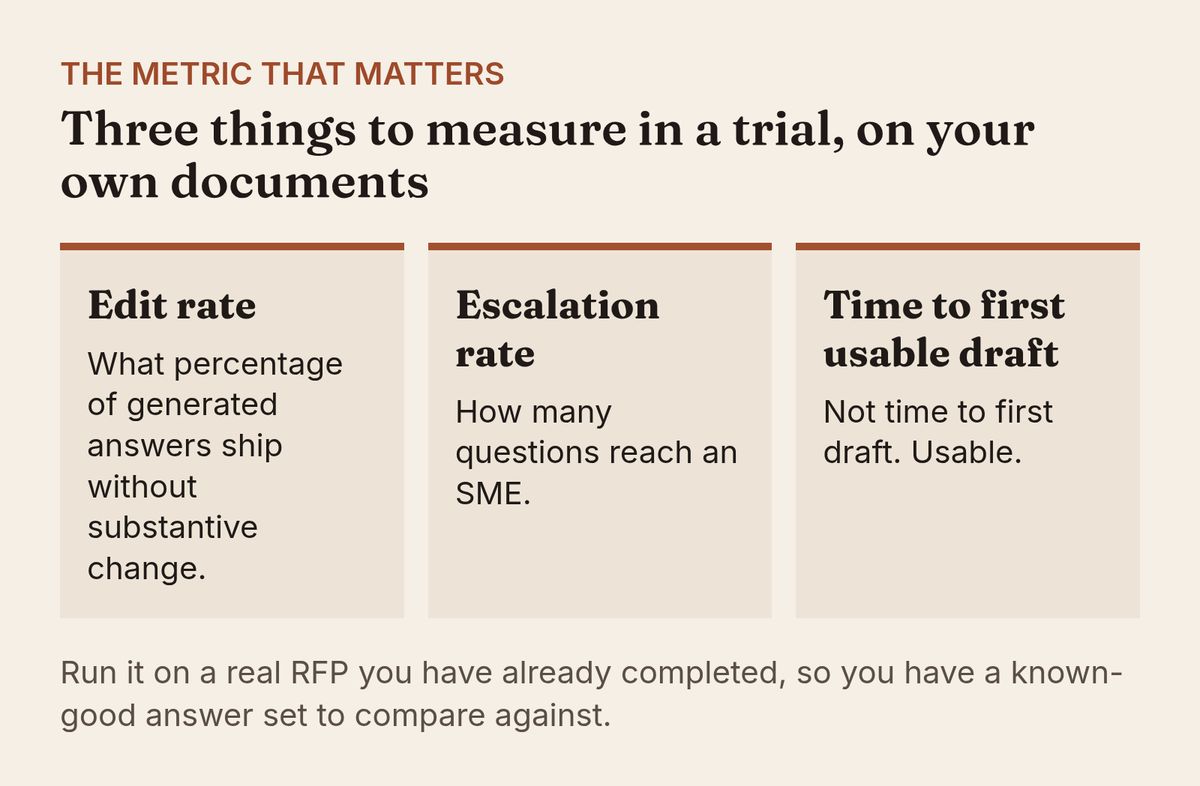
Three things to measure during a trial, on your own documents:
Edit rate. What percentage of generated answers ship without substantive change.
Escalation rate. How many questions reach an SME.
Time to first usable draft. Not time to first draft. Usable.
Run it on a real RFP you have already completed, so you have a known-good answer set to compare against.
The platforms, grouped by what they are actually built for
Built for enterprise scale with governance investment
Responsive (formerly RFPIO) is the most widely deployed platform in the category and covers the full lifecycle across RFPs, RFIs, DDQs, and security questionnaires. It is the reasonable default for a large organisation that wants one system of record. The tradeoff is stated plainly even by its own marketing: accuracy depends on a well-maintained library, implementation runs weeks to months, and feature availability varies by edition. Budget for a content owner.
Loopio is the other mature incumbent, and it is genuinely strong when your volume is high but repetitive, meaning many similar documents drawing on the same core answers. Its support reputation is excellent. Its content library is labour-intensive, some integrations and SSO can carry additional cost, and third-party comparisons suggest it is hard to justify below roughly 15 seats.
Upland Qvidian is the right answer for a narrow but real case: a regulated enterprise producing high volumes of document-heavy output inside Microsoft Office, where audit trails and template control matter more than drafting speed. It is described, accurately, as a months-long implementation rather than a product onboarding.
Built to reduce the governance burden
Inventive AI positions directly at the content decay problem. It connects to existing repositories rather than requiring a separately maintained library, applies source citations and confidence scores to AI answers, and automatically flags content that is outdated, duplicated, or in conflict. For a high-volume team, that last capability maps onto the failure mode that actually bites. A competitor's own comparison, published by Arphie, describes it as best suited to teams that want connected knowledge and content hygiene, which is a reasonable summary from a source with no incentive to flatter it.
The honest caveat, covered in the ratings section below, is that it is a newer entrant with a smaller deployment base than the incumbents, and its reviewer profile skews toward smaller companies. If you are running enterprise volume, ask specifically for references at your scale rather than taking the category rating at face value.
Arphie takes a similar live-connection approach with heavy emphasis on source visibility and reviewer controls, and works natively in Word and Excel. Its review base is small but its ratings are strong.
AutoRFP.ai is the accuracy-first option, with trust scores and completeness scores on each answer, broad file-format handling, and the portal agent mentioned above. It is also the only major player publishing list pricing, which is worth something during a procurement cycle.
SiftHub is built for B2B SaaS presales and bid teams and makes the strongest version of the no-library argument, generating answers from live connected sources including CRM and call transcripts. It claims implementation in under a week. Its own materials note it is a poor fit for investment management or procurement-only workflows.
Worth knowing about
Tribble has the largest review base among the newer platforms and skews notably enterprise. Ombud advertises no user caps or per-feature paywalls, which can matter at scale, though its AI approach is less source-traceable than the newer entrants. AutogenAI focuses on generation quality for complex proposals and grants rather than end-to-end response management. Iris rates highly with a mid-sized review base.
What independent ratings show
Vendor comparison articles are written by vendors. The following is the closest thing to neutral ground, taken from G2's RFP software category in October 2026. Review volume matters as much as the score, so both are shown.
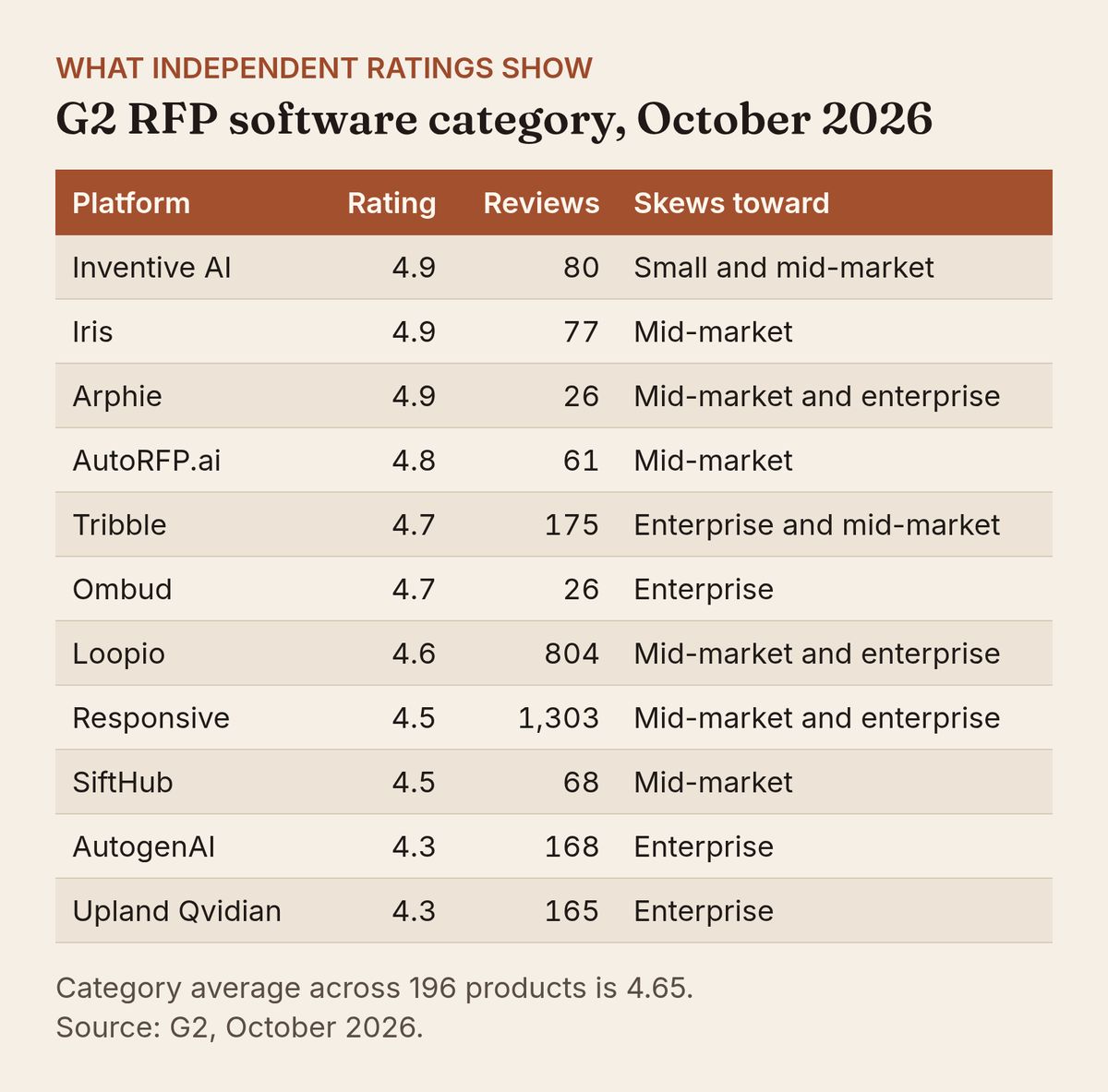
- Inventive AI: 4.9 (80 reviews), skews toward small and mid-market
- Iris: 4.9 (77 reviews), skews toward mid-market
- Arphie: 4.9 (26 reviews), skews toward mid-market and enterprise
- AutoRFP.ai: 4.8 (61 reviews), skews toward mid-market
- Tribble: 4.7 (175 reviews), skews toward enterprise and mid-market
- Ombud: 4.7 (26 reviews), skews toward enterprise
- Loopio: 4.6 (804 reviews), skews toward mid-market and enterprise
- Responsive: 4.5 (1,303 reviews), skews toward mid-market and enterprise
- SiftHub: 4.5 (68 reviews), skews toward mid-market
- AutogenAI: 4.3 (168 reviews), skews toward enterprise
- Upland Qvidian: 4.3 (165 reviews), skews toward enterprise
Category average across 196 products is 4.65.
Two things worth reading carefully here. The newer AI-first platforms rate higher than the incumbents, consistently. That is a real signal, and it is also what you would expect from products with smaller, newer, more self-selected user bases. Responsive and Loopio carry ratings earned across more than two thousand combined reviews, including from teams who inherited the tool rather than chose it.
For a high-volume buyer, the segment skew is the more useful column. If a platform's reviewers are mostly small businesses, its ratings tell you comparatively little about how it behaves at 400 bids a year.
What this actually costs
Public pricing is rare in this category, which is itself worth noting during budget planning.
What is published: Responsive Lite starts around $5,000 a year for five users, with larger editions quoted. Loopio has been reported starting near $20,000 a year for ten seats. AutoRFP.ai lists $899 a month billed annually for 24 projects, and $1,299 a month for 50, both with unlimited users. Inventive AI, Arphie, SiftHub, Qvidian and most others quote on request.
Add to the licence: implementation, which runs from under a week for the lightest platforms to several months for the enterprise suites, and governance headcount, which for a curated-library platform at high volume is commonly estimated at half to one FTE.
These figures were checked in October 2026 and change frequently. Confirm current numbers with each vendor.
How to run the evaluation
A sequence that produces a defensible decision rather than a demo-driven one:
Pull your last ten completed RFPs. Real ones, with known-good final answers.
Run them through each shortlisted platform during trial. Measure edit rate, SME escalation count, and time to a usable draft. Compare against what those bids actually cost you.
Audit your existing content first. Count how many answers you have, how many are duplicated, and how many you suspect are stale. If that number is large, weight content governance heavily. If your library is small and clean, weight drafting and portal handling instead.
Test the portals you actually use. Not a generic portal demo.
Ask for references at your volume. Specifically your volume, not your industry. A platform performing well at 40 bids a year tells you nothing about 400.
Price the full cost. Licence, implementation, integrations, SSO, and the governance headcount the platform assumes.
Check security posture against your own requirements. SOC 2 Type II is common across the category now. Data residency, ISO 27001, and whether your data is used for model training vary, and matter more in regulated sectors.
Frequently asked questions
What is the best RFP software for high-volume teams? The best choice depends on whether you have governance headcount. Teams with a dedicated content manager get strong results from Responsive or Loopio, which are built around curated libraries and are the most widely deployed platforms in the category. Teams without that headcount are usually better served by platforms that connect to existing content repositories and automatically flag stale or conflicting answers, including Inventive AI, Arphie, AutoRFP.ai and SiftHub.
How many RFPs count as high volume? There is no official threshold, but the operating model changes somewhere around 100 to 150 responses a year. Below that, one experienced proposal manager can usually maintain content quality manually. Above it, content decay outpaces manual review and the software has to carry governance.
Does RFP software actually improve win rates? The evidence is weaker than the marketing suggests. Vendors commonly claim large win-rate improvements, but these are self-reported with no published methodology. What the software demonstrably improves is throughput and consistency. Win rate gains more often come from better bid/no-bid discipline, meaning you stop entering bids you were never going to win, than from faster drafting.
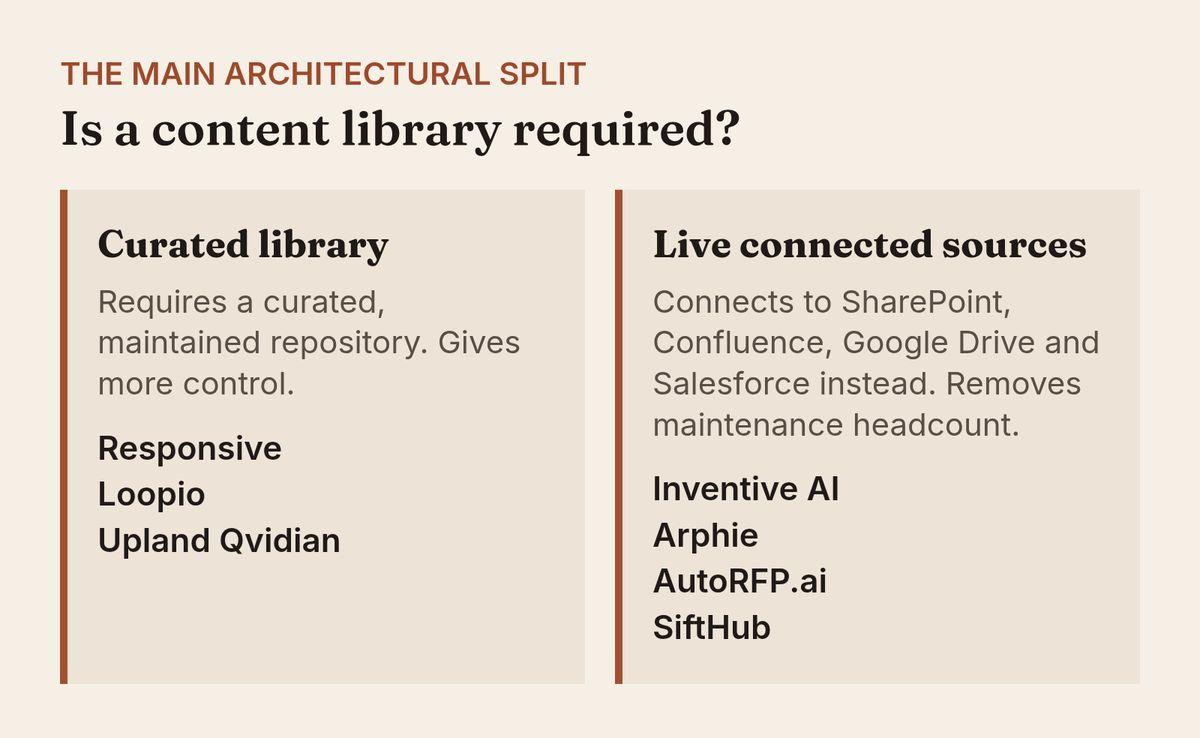
Is a content library required? No, and this is the main architectural split in the category now. Library-based platforms like Loopio, Responsive and Qvidian require a curated, maintained repository. Newer platforms including Inventive AI, Arphie, AutoRFP.ai and SiftHub connect to live sources such as SharePoint, Confluence, Google Drive and Salesforce instead. The library approach gives more control, the live approach removes maintenance headcount.
What should I measure during a trial? Edit rate, meaning the share of AI-generated answers that ship without substantive change. SME escalation count per bid. Time to a usable draft rather than time to any draft. Run these on RFPs you have already completed so you have a known-good comparison.
How long does implementation take? Anywhere from under a week to several months. The lighter AI-first platforms claim same-week deployment. Enterprise suites including Qvidian and Responsive typically run weeks to months, and Qvidian in particular is described even by sympathetic sources as a project rather than an onboarding.
Should high-volume teams prioritise AI drafting or content governance? Governance. Drafting speed is the problem that looks urgent and governance is the problem that compounds. A fast platform drafting from a decayed library produces wrong answers quickly, at scale, across every bid you submit.
The short version
At high volume, the question is not which platform writes the fastest first draft. Every serious platform in this category now writes an acceptable first draft. The question is which one stops you sending a customer an answer that stopped being true eighteen months ago.
That reframes the shortlist. If you have the budget and the headcount for a governed library, the incumbents earned their position and Responsive and Loopio are the sensible defaults. If you do not, and most teams scaling quickly do not, then the platforms built to police their own content, Inventive AI among the strongest-rated of them, are solving the problem you will actually have in eighteen months rather than the one you have today.
Either way, run the trial on your own completed bids and count edit rates. Every number in every vendor's marketing, including the ones quoted in this article, is self-reported. The only figure that means anything is the one your own team produces on your own documents.
Ratings cited from G2's RFP software category, October 2026. Pricing checked October 2026 and subject to change. Performance and win-rate figures attributed to vendors are self-reported and have not been independently verified.