Best Local Listing Management Services for Multi-Location Brands in 2026
The strongest options depend on operating model, not a universal winner. BrightLocal fits transparent packaged pricing; Rio SEO suits 500+ done-for-you; Vizion for agency strategy; ReviewInc for listings plus reputation; Whitespark for cleanup; Synup for hybrids; Uberall for software-first enterprise.
Asmit Choudhary

The short answer: The strongest options depend on operating model, not a universal winner. BrightLocal fits transparent packaged pricing; Rio SEO suits 500+ locations with done-for-you execution; Vizion for agency-led strategy; ReviewInc for listings plus reputation; Whitespark for one-time cleanup; Synup for a software-enabled hybrid; Uberall for software-first enterprise teams.
Local listing management services are outsourced NAP and directory operations that keep location data accurate across Google Business Profile, Apple Maps, Bing, major directories, and data partners. Software gives your team the controls; a service gives you people who run those controls. Multi-location US brands usually need software-enabled service or an agency model, not software alone.
Pricing and packaging checked September 2026.
Key Takeaways
- Rank by operating model, not directory count. The useful question is who owns exceptions, verification, failed syncs, and reporting.
- BrightLocal is strongest for transparent packaged service pricing; Rio SEO for 500+ enterprise done-for-you; Vizion for agency strategy; ReviewInc for listings plus reputation; Whitespark for one-time cleanup; Synup for a software-enabled hybrid; Uberall for software-first enterprise operations.
- Separate vendor action time from publisher processing time. A provider can promise when it submits an update; Google, Apple, Bing, and Yelp still control when it appears.
- Ownership after cancellation matters. Confirm account credentials, live listing URLs, and a clean source-of-truth export remain yours.
- Thryv is excluded here because its current help documentation positions its listing solution for a single business location.
- Synup is evaluated on the same criteria as every other vendor, with limitations stated below.
Which local listing management services are best for multi-location brands in 2026?
The short answer: BrightLocal for transparent packaged pricing, Rio SEO for 500+ done-for-you execution, Vizion for agency-led strategy, ReviewInc for listings plus reputation, Whitespark for one-time cleanup, Synup for a software-enabled hybrid, and Uberall for software-first enterprise operations. The strongest option depends on the operating model you need, not a single universal winner.
This ranking weighs five things: how much work the provider will actually execute, multi-location fit, public pricing evidence, public operational or SLA evidence, and the clarity of reporting and ownership. It is not a ranking of raw software feature counts.
Quick comparison
Pricing and packaging checked September 2026. Public figures below are preserved from the reviewed pages; treat as a shortlist because packaging can change.
Comparison list (sync-safe)
- BrightLocal: Best fit: 10 to 50 locations needing transparent packaged service. Public pricing: $1,299/mo Managed SEO; Citation Builder from $2/citation. Operational evidence: standard citation submissions within 7 days; optional 24-hour CB Express. Limitation: no public scaling formula for a multi-location managed retainer; Citation Builder is not continuous listing operations.
- Rio SEO: Best fit: 500 or more locations needing enterprise done-for-you execution. Public pricing: no public retainer found on the reviewed page. Operational evidence: team can claim, verify, and update listings, fix rogue and duplicate listings, and provide 24/7 agency-style support. Limitation: no public retainer or routine-update SLA found.
- Vizion Interactive: Best fit: complex brands wanting agency strategy. Public pricing: no public retainer found on the reviewed page. Operational evidence: multi-stage onboarding, audit, strategy, implementation, review, and refinement; monthly directory reach reporting. Limitation: no public retainer or formal routine-update SLA found.
- ReviewInc: Best fit: brands wanting listings plus reputation. Public pricing: Full Service starts at $799/mo, paid quarterly; enterprise multi-location pricing is not public. Operational evidence: managed bundle includes listings, reviews, local SEO, reporting, and U.S.-based account support. Limitation: the public price covers a broad bundle, not a transparent per-location enterprise listings retainer.
- Whitespark: Best fit: cleanup, migration, or citation backlog. Public pricing: $20 to $999/location one-time; U.S. cleanup packages start at $399. Operational evidence: projects generally completed in 4 to 6 weeks; later update requests within 2 weeks at $2/listing. Limitation: not continuous managed listing synchronisation.
- Synup: Best fit: agencies and resellers wanting software plus selective managed fulfilment. Public pricing: general multi-location managed-service retainer not public. Operational evidence: managed niche services include reporting and unlimited updates; new-location platform sync can take up to 72 hours. Limitation: niche managed services require a Synup customer; core listings is platform-led rather than a fully outsourced agency relationship.
- Uberall: Best fit: enterprise teams with in-house operators. Public pricing: not publicly listed on the reviewed page. Operational evidence: public help guidance says many directories take 24 to 72 hours to process synced updates. Limitation: primarily software-first; no public done-for-you listings retainer found.
Synup is evaluated using the same criteria as every other vendor, and its specific limitations are stated below.
One notable exclusion is Thryv. Its current help documentation says its listing solution is for a single business location, so it is not ranked here as a multi-location service.
What do local listing management services include?
The short answer: A serious multi-location service maintains accurate location information, manages publisher connections, handles duplicates and ownership issues, coordinates verification, updates hours and attributes, monitors exceptions, and reports what changed. Some providers also bundle reputation management, local SEO, social publishing, or location-page work. Clear ownership after cancellation is part of the scope, not an afterthought.
At minimum, a serious service should define who handles each of these tasks:
- Source-of-truth data setup for name, address, phone, URLs, hours, categories, services, and location attributes.
- Google Business Profile ownership, verification support, business groups, and bulk workflows.
- Distribution or direct syncing to Apple Maps, Bing, Yelp, Facebook, mapping apps, and relevant directories.
- Duplicate detection and suppression, including escalation when a publisher requires manual intervention.
- New-location onboarding and closed-location cleanup.
- Holiday hours, temporary closures, moved locations, phone changes, and other high-risk updates.
- Publisher-level monitoring so failed syncs and disconnected accounts do not disappear into a dashboard.
- Reporting on listing accuracy, live URLs, unresolved issues, and work completed.
- A defined review cadence for large accounts, including monthly or quarterly operational reviews.
- Clear ownership rules for accounts, credentials, listings, and data when the relationship ends.
The last point matters more than many buyers expect. A low monthly fee is less attractive if the brand cannot retain access to the listings, account credentials, or a clean source-of-truth export after cancellation.
For Google specifically, brands with 10 or more locations can use bulk location management and may be eligible for bulk verification. That makes the operating problem materially different from a one-location business. The service should know how to work with business groups, store codes, bulk imports, verification evidence, and access controls rather than treating every location as a separate small-business task.
How does software-enabled service differ from a done-for-you agency?
The short answer: Software-enabled service combines a listing platform with people who handle defined operational work. A done-for-you agency typically owns a broader workflow that can include audits, strategy, verification, local SEO, reporting, and publisher escalation. The first model is easier to standardise across many locations; the second fits when exceptions, governance, and cross-channel strategy need more human judgement.
The practical distinction is who owns the queue. With software, your team may still be responsible for spotting a disconnected profile, approving a duplicate suppression request, deciding how to map categories, and following up on a verification problem. With a true service retainer, those tasks should have named owners and escalation paths.
There is also a middle ground. A provider may offer a platform for day-to-day control while its team handles specific managed work such as citation building, industry-directory submissions, cleanup, or enterprise onboarding. That hybrid can be a strong fit for a brand with an internal local operations manager who wants to keep governance in-house but outsource repetitive fulfilment.
This article ranks services and retainers. It does not repeat the full company-versus-software decision framework. For that narrower question, use the internal software comparison as a short follow-up rather than turning this page into a second buy-versus-hire guide.
How should you compare listing management retainers and SLAs?
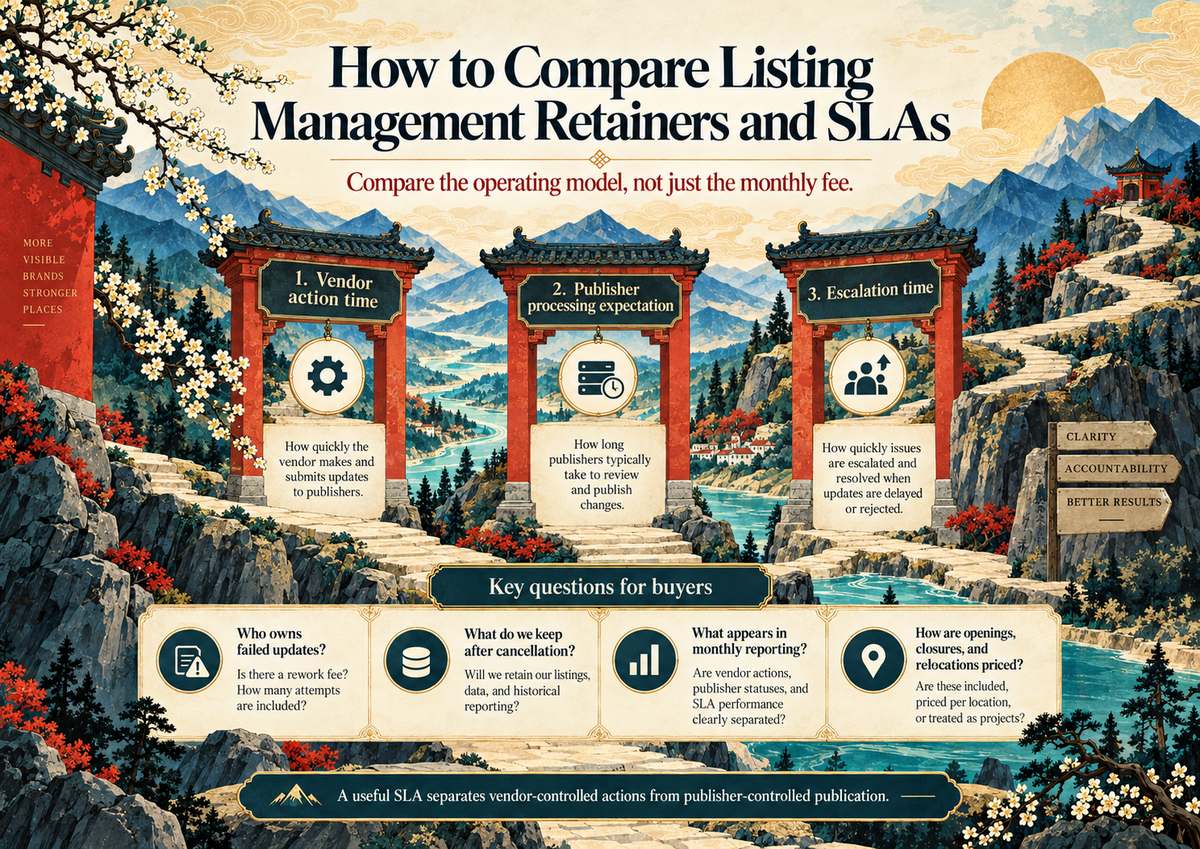
The short answer: Compare retainers by the work performed per location, the exceptions covered, and the time standard for each task, not by the monthly fee alone. A useful SLA separates vendor-controlled actions from publisher-controlled publication. A provider can promise when it will submit or transmit an update, but Google, Apple, Bing, Yelp, and other publishers may still apply changes on their own schedules.
Ask for three different timing commitments:
- Vendor action time. How quickly will the provider validate and send a requested change?
- Publisher processing expectation. What is the normal range before the destination reflects the update?
- Escalation time. When does a stalled update become a support case, and who owns the follow-up?
BrightLocal offers one of the clearest public examples. Its Citation Builder help centre says standard submissions are completed within seven days, and a 2026 release note says the optional CB Express upgrade carries a 24-hour delivery guarantee. Its help centre also notes that external directories may take longer to publish. That is a useful model because it does not pretend the service controls a third-party publisher.
Synup documents that a new location can take up to 72 hours to sync across its publishing partner network, while a newer help article distinguishes Synup sending the update from the publisher actually applying it. Uberall similarly tells customers to allow many directories 24 to 72 hours to process an update. These are useful operational benchmarks, but they are platform processing guidance, not automatically equivalent to a human managed-service SLA.
Retainer comparisons should also normalise scope. A $799 monthly package that includes listings, review responses, website work, social, and local SEO is not directly comparable with a one-time citation cleanup fee or a listings-only platform subscription.
1. Is BrightLocal the best fit for transparent managed service pricing?
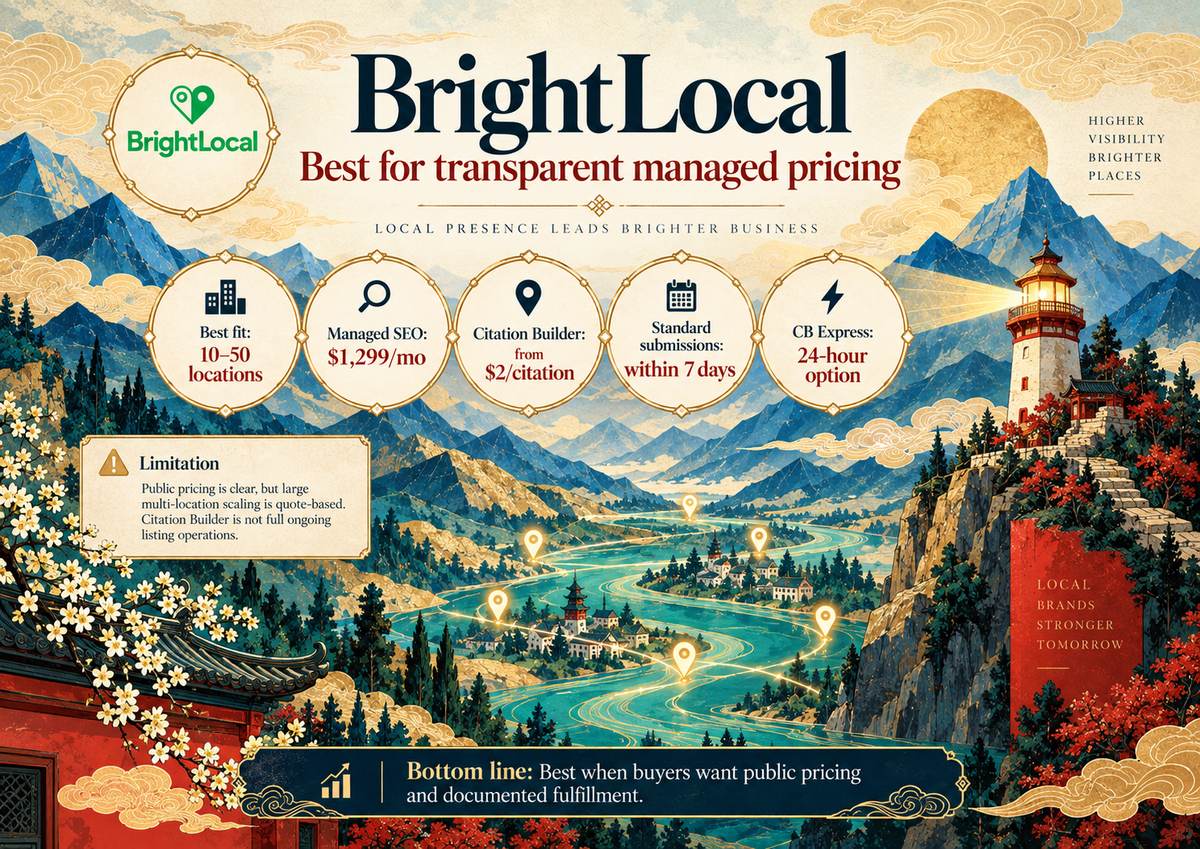
BrightLocal is the clearest fit for buyers who want published service pricing and a documented delivery process without starting with an enterprise RFP. Its pricing page lists Managed SEO Service at $1,299 per month and Citation Builder from $2 per citation. For multi-location brands, the most useful part is the ability to choose between ongoing local SEO support and discrete citation work.
BrightLocal's Citation Builder is unusually explicit about fulfilment. Standard submissions are guaranteed within seven days, and CB Express is documented as a 24-hour option. The company also explains that publisher approval and indexing can take longer, which is the right way to frame third-party dependency.
For a 10-location brand, BrightLocal can be attractive when the team needs a repeatable cleanup and citation process with strong reporting. For a 50-location portfolio, it can still fit, but buyers should obtain a quote that reflects the full number of locations and the exact managed scope rather than multiplying the public single service headline.
Potential limitation: The $1,299 managed-service price is public, but BrightLocal does not publicly spell out how that managed retainer scales across a large multi-location portfolio. Citation Builder is also a specialised service, not a substitute for continuous ownership of every listing operation.
Best fit: Multi-location teams that value public pricing, discrete service options, and clearly documented citation fulfilment.
2. Is Rio SEO the best service for 500 or more locations?

Rio SEO is one of the strongest fits for large enterprise brands that want technology plus high-touch operational support. Its Local Listings page says the team can claim, verify, and update listings on the client's behalf, fix rogue and duplicate listings, distribute location data across a large network, and provide 24/7 agency-style support. That is closer to true outsourced operations than a software-only dashboard.
The enterprise advantage is the combination of scale and human support. A 500-location retailer, healthcare network, franchise system, or financial-services brand is likely to have recurring ownership conflicts, data governance issues, regional exceptions, and access-control requirements. Those are precisely the conditions where a managed enterprise programme can justify itself.
Rio SEO also positions its reporting around consolidated multi-location performance, which is useful when corporate teams need rollups while local or regional teams still require action at individual locations.
Potential limitation: Rio SEO does not publish a standard retainer or a public update-time SLA on the pages reviewed. That means procurement cannot benchmark total cost or response commitments without a sales process. It may also be more service than a 10-location brand needs.
Best fit: Enterprise operators with hundreds of locations that want a vendor to function as an extension of the internal local search team.
3. Is Vizion Interactive the best high-touch local listing management agency?

Vizion Interactive is a strong choice for brands that want a local listing management agency rather than a platform-led service. Its public service page describes a multi-stage process covering onboarding, audit, strategy, implementation, review, and refinement, with work spanning Google Business Profile, Apple Maps, Bing, directory consistency, duplicate issues, verification support, competitive analysis, and ongoing reporting.
That structure is useful for brands where listings cannot be separated cleanly from local SEO. A pure data-sync vendor may keep addresses accurate, but an agency can also examine categories, local keyword targeting, competitive gaps, landing pages, and the operational reasons listings become inconsistent in the first place.
Vizion says it provides ongoing guidance on listing accuracy and monthly directory reach, giving buyers at least one concrete reporting cadence to evaluate.
Potential limitation: Vizion does not publish a standard retainer or a formal update-time SLA on the service page reviewed. Buyers should require a written scope that defines how quickly routine changes, urgent holiday-hour corrections, duplicate suppression, and verification escalations will be handled.
Best fit: Mid-market and enterprise brands that want strategic local SEO oversight alongside listings execution.
4. Is ReviewInc the best managed bundle for listings and reputation?
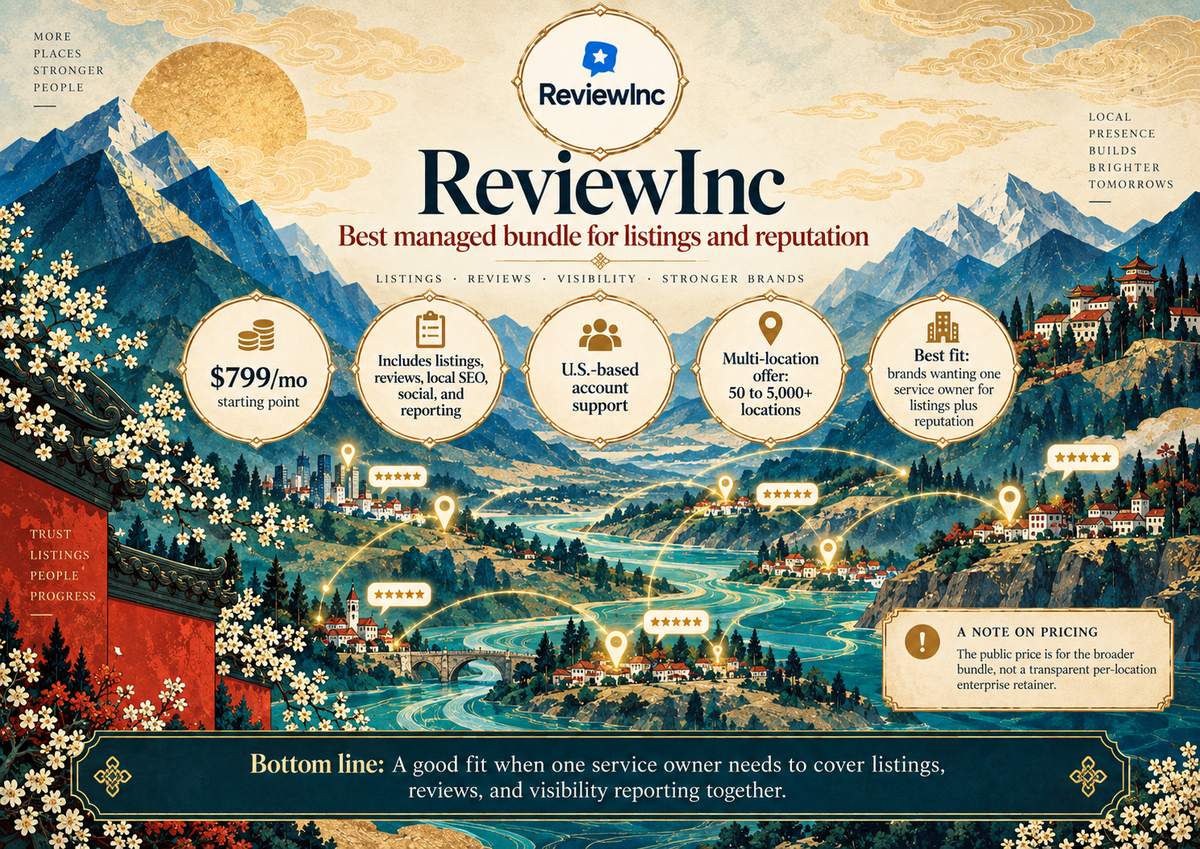
ReviewInc is a good fit when listing accuracy is only one part of the local visibility problem. Its current managed-service page packages listings management with Google Business Profile optimisation, review collection and response, local SEO, social media, reporting, and a U.S.-based account manager and support team. The public Full Service package starts at $799 per month and is paid quarterly.
For multi-location buyers, ReviewInc also publishes a dedicated multi-location offering that it says is built for 50 to 5,000+ locations. Its multi-location product material emphasises centralised management of listings, reviews, reporting, and role-based access.
The value is consolidation. A brand that already needs reputation operations may prefer one service owner for listing corrections, review workflows, and visibility reporting instead of stitching together separate vendors.
Potential limitation: The public $799 monthly starting price is for the broader Full Service package, not a transparent per-location enterprise retainer. A brand that needs listings only may pay for a wider service bundle than necessary, while larger multi-location pricing still requires a custom conversation.
Best fit: Multi-location service businesses and brands that want reputation management and local listings under one operational relationship.
5. Is Whitespark the best one-time listing cleanup service?
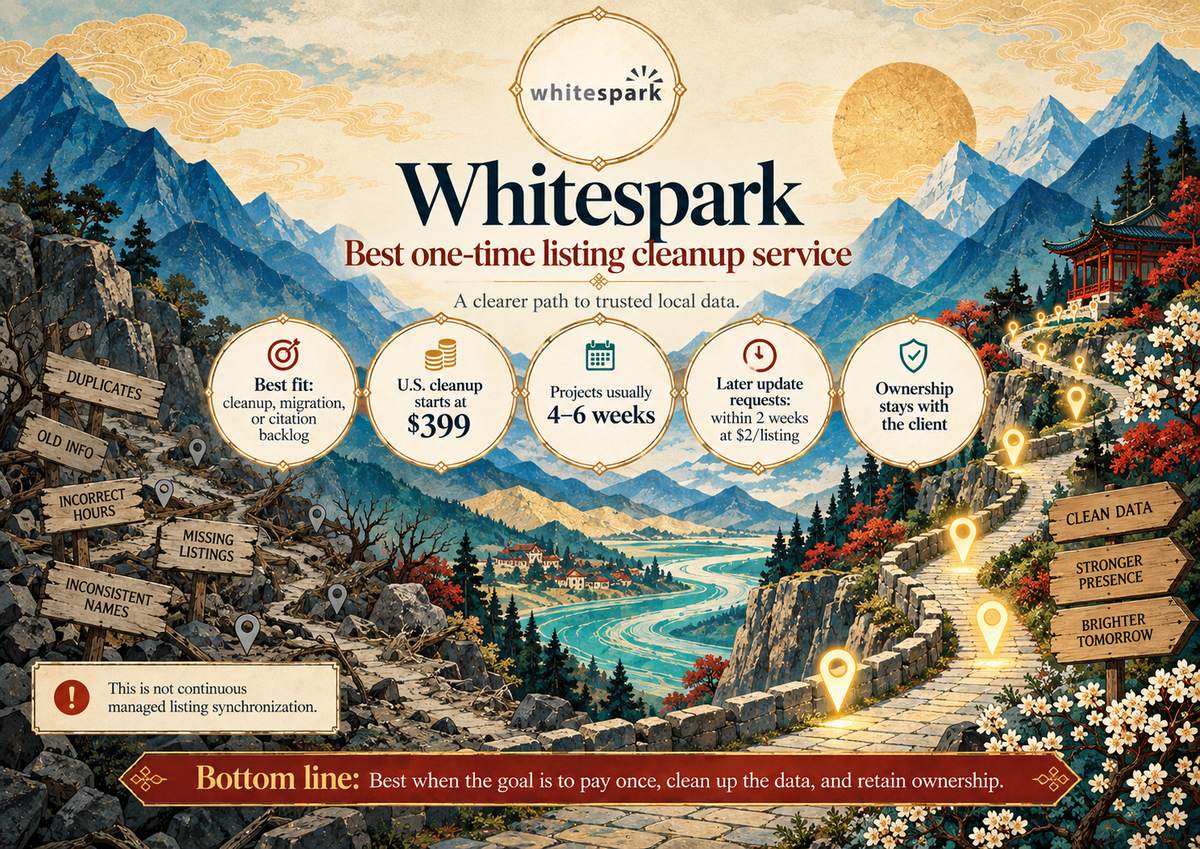
Whitespark is the strongest fit in this list for buyers who do not want a recurring listings retainer. Its Listings Service uses one-time pricing, with packages ranging from $20 to $999 per location. Its published US cleanup and building packages start at $399, with higher tiers at $599 and $999, and it offers volume discounts at larger order values.
The operating model is intentionally different from continuous synchronisation. Whitespark audits NAP variations, cleans up important listings, creates new citations, and gives clients ownership rather than charging a recurring fee simply to keep the service active. It says listing projects are generally completed within four to six weeks after intake, and later update requests can be handled within two weeks for a one-time per-listing fee of $2/listing on the reviewed materials.
Potential limitation: This is not continuous managed listing synchronisation. A brand with frequent hour changes, weekly promotions, rapid openings and closures, or a high volume of publisher exceptions may need an ongoing platform or retainer in addition to Whitespark's project-based work.
Best fit: Brands with a defined cleanup project, migration, acquisition integration, or citation backlog that want to pay once and retain ownership.
6. Is Synup the best software-enabled hybrid for agencies and resellers?
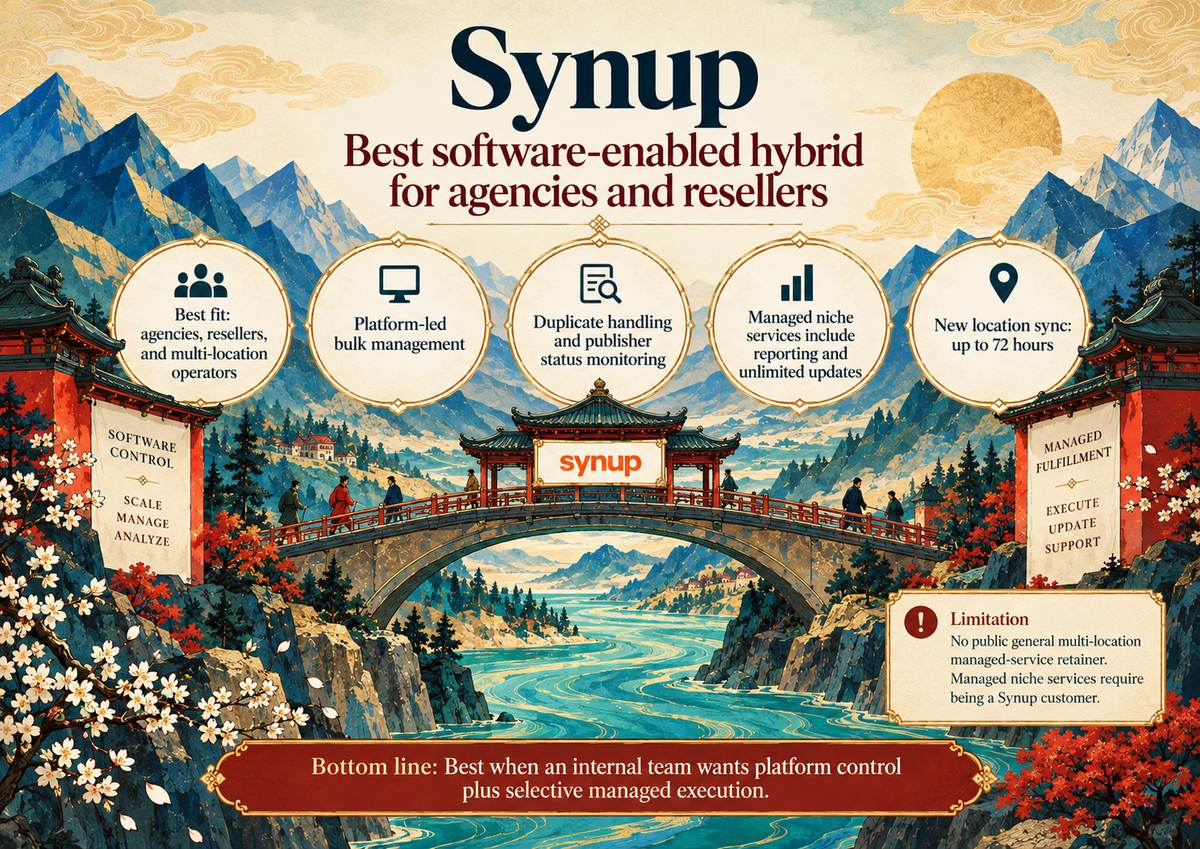
Synup is a fit for agencies, resellers, and multi-location operators that want a central listings platform but also want selected managed execution. Its core listings product is platform-led, with bulk management, duplicate handling, publisher status monitoring, and distribution across major search, map, and directory ecosystems. It also publishes managed-services pages for industry-specific directory submission work.
Those managed-services pages describe submission work, reporting, unlimited updates within the plan, and access to account credentials. Synup's help centre separately documents that a new location can take up to 72 hours to sync across supported publishing partners, while publisher application can still take longer.
The hybrid model can work well when an internal team wants to keep control of core location data and reporting while outsourcing specialised directory fulfilment or reseller operations.
Potential limitation: Synup does not publish a general multi-location managed-service retainer for the broader listings operation reviewed here. Its niche managed services require the customer to be a Synup customer, and the core listings proposition remains a platform you operate rather than a fully outsourced agency relationship.
Best fit: Agencies, resellers, and brands that want software control plus selective managed fulfilment.
7. Is Uberall the best software-first enterprise option with service support?
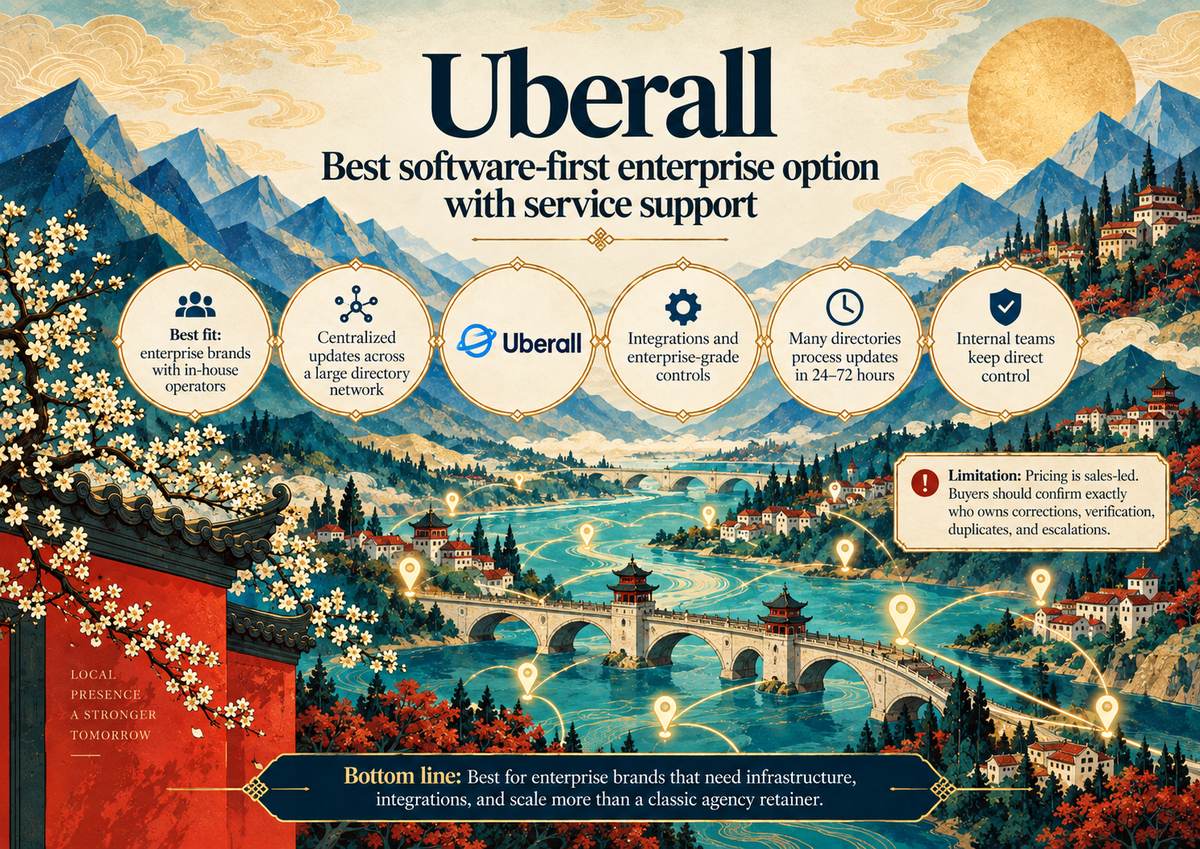
Uberall is best treated as an enterprise listings platform with support around the operating workflow, not as a classic done-for-you local listing management agency. Its listings product is designed for multi-location brands, centralises updates across a large directory network, supports integrations, and provides enterprise-grade controls for location data and performance.
Its public help documentation gives a useful operational expectation: after a location is synced, many directories should be allowed 24 to 72 hours to process an update, with some publishers taking longer. That transparency is valuable when setting internal expectations for location teams.
For a large brand with a capable local operations team, the platform-first model can be a strength because internal staff keep direct control while using automation and support to handle scale.
Potential limitation: Uberall's public materials do not present a standard done-for-you listing retainer, and pricing is sales-led. Buyers looking for a human team that owns every correction, verification, duplicate, and escalation should confirm those responsibilities explicitly rather than assuming they are included with the platform.
Best fit: Enterprise brands with in-house operators that need infrastructure, integrations, and scale more than a traditional agency retainer.
Which service model fits 10, 50, and 500 locations?
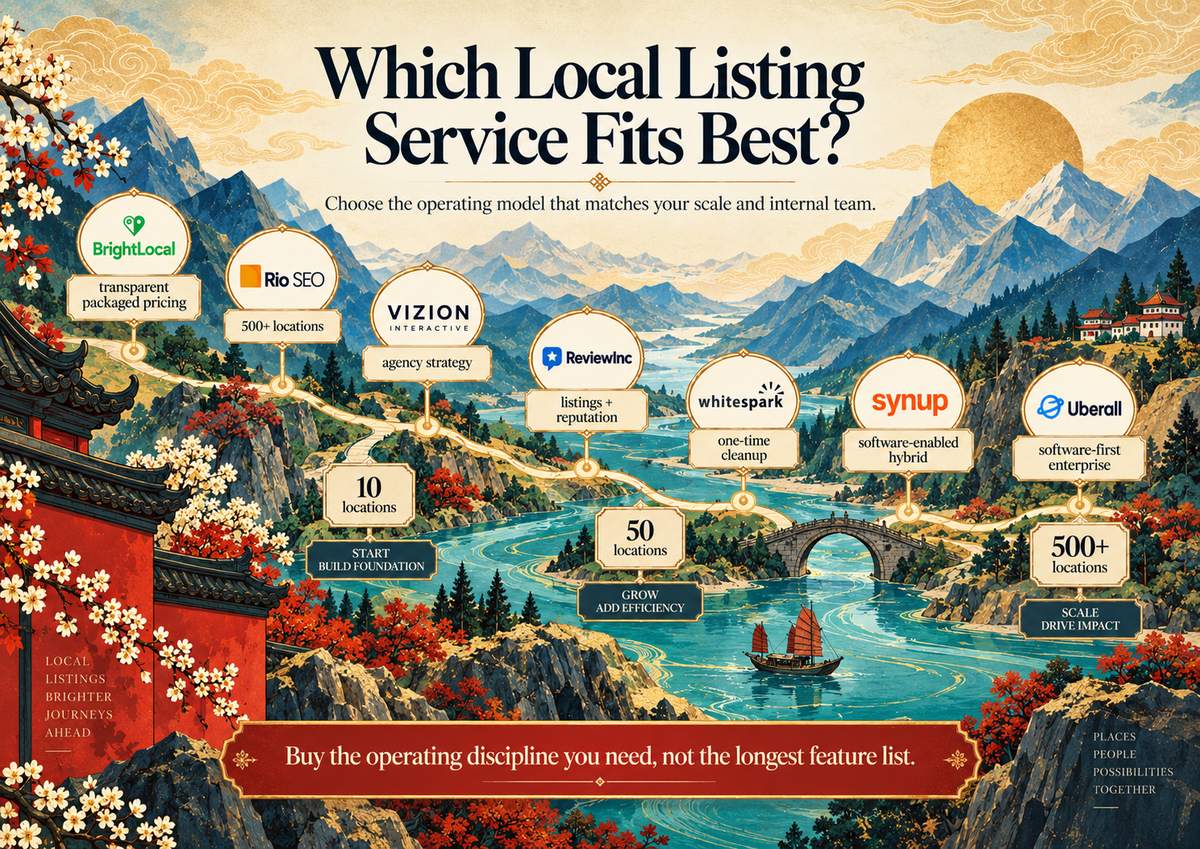
The short answer: Around 10 locations, project-based cleanup or a light managed service can still be economical. Around 50, governance, bulk updates, exception handling, and reporting become recurring operational work. Around 500, enterprise permissions, integrations, verification processes, data quality monitoring, and a formal escalation model usually matter more than a simple per-location price.
For about 10 locations
Start with a cleanup and operating audit. If the data is messy but changes infrequently, a one-time service such as Whitespark can be sufficient. If the brand also needs ongoing local SEO, BrightLocal's managed option or a local listing management agency can make more sense. Google already supports bulk workflows at 10 or more locations, so the vendor should not be managing each profile as if it were isolated.
For about 50 locations
Favour a repeatable software-enabled service or a high-touch agency with explicit ownership of exceptions. ReviewInc can fit if reputation is part of the scope. Vizion can fit when strategy and local SEO are tightly connected to listings. Synup can fit when an internal team wants a platform and selective managed execution. At this size, require a location-level issue queue and a monthly operational review.
For about 500 locations
Shortlist enterprise programmes such as Rio SEO or a platform-first provider such as Uberall, then evaluate the human operating layer in detail. Ask how ownership conflicts, bulk verification, store-code governance, new-location launch waves, closures, API feeds, regional permissions, and urgent hours changes are handled. A low per-location number is secondary if the vendor cannot prove who owns exceptions.
What questions expose a weak vendor?
A weak vendor becomes visible when you force the sales conversation away from directory counts and into operational accountability. Ask who owns a failed update, what the service does when a publisher rejects data, how duplicates and ownership conflicts are escalated, what is reported at location level, and what remains yours after cancellation. Strong providers can answer with workflows, timeframes, and named responsibilities.
Use these questions before signing:
- Which tasks are actually done by your team, and which tasks remain with ours?
- What is your standard action time for a routine NAP or hours change?
- What is your urgent-change process for holiday hours, closures, or a wrong phone number?
- How do you distinguish your submission SLA from the publisher's processing time?
- What happens when Google, Apple, Bing, Yelp, or another publisher rejects an update?
- Who owns duplicate suppression and ownership-conflict escalation?
- Can you support Google business groups, bulk verification, store codes, and organisation-level access?
- Do we receive account ownership, credentials, live listing URLs, and an export of our source data?
- What exactly appears in the monthly report: activity, listing accuracy, unresolved issues, or business outcomes?
- How do you price openings, closures, relocations, and acquisitions after the original scope is signed?
- Is every location covered by the same SLA, or do enterprise locations fall into a different support tier?
- What changes when we go from 10 to 50 to 500 locations?
The red flag is a vendor that answers these questions with a publisher count, an AI feature list, or a generic promise to keep listings accurate. The service is the operating model, not the dashboard.
What is the best local listing management service for a multi-location brand?
The short answer: There is no single best local listing management service for every multi-location brand. BrightLocal is the most transparent packaged option here; Rio SEO is the strongest enterprise done-for-you fit; Vizion suits agency strategy; ReviewInc fits listings-plus-reputation programmes; Whitespark excels at one-time cleanup; Synup fits software-enabled hybrids; Uberall fits software-first enterprise teams.
The best buying decision is the provider whose contract makes four things explicit: who performs the work, how quickly the provider acts, what happens when publishers do not cooperate, and what data or account access the brand keeps. That is a more useful test than the number of directories in a sales deck.
For most multi-location US brands, local listing management services become valuable when the work is too exception-heavy to sit with a generalist marketer but still important enough to affect every store, office, clinic, dealership, or service area. Buy the operating discipline you need, not the longest feature list.
Conclusion
The short answer: Choose the service whose operating model matches your location count, exception load, and internal capacity. Prefer providers that separate their own action SLAs from publisher processing, publish or quote clear scope, and leave you with ownership of accounts and data after cancellation.
Frequently asked questions
Local listing management services vary from one-time citation cleanup to software-enabled fulfilment and fully managed enterprise programmes. The right answer depends on location count, how often data changes, whether reputation or local SEO is in scope, and how much internal operating capacity you already have. The questions below cover the most common buyer decisions without duplicating a full software-versus-service guide.
What is the best local listing management service?
For transparent public service pricing, BrightLocal is a strong starting point. For hundreds of locations and a more outsourced enterprise model, Rio SEO is a better fit. Brands that need agency strategy should consider Vizion, while Whitespark is better for one-time cleanup. The best service is the one whose scope and SLA match your operating model.
Should I hire a local listing management company or buy software?
Hire a service when your team lacks time or expertise to own verification, duplicates, failed updates, publisher escalation, and recurring QA. Buy software when you already have people who can own that queue. Many multi-location brands use a hybrid model. This article ranks service options, while the dedicated software comparison should handle the broader buy-versus-hire decision.
What do local listing management services actually include?
A solid service usually includes location-data setup, listing creation or syncing, Google Business Profile management, duplicate suppression, verification support, hours and attribute updates, publisher monitoring, reporting, and escalation of failed changes. Broader agencies may also include local SEO, reviews, social publishing, and location-page optimisation.
How do I compare listing management retainers?
Normalise the scope before comparing price. Ask what is included per location, what counts as an add-on, whether openings and closures cost extra, how urgent changes are handled, how frequently reports are delivered, and whether the vendor guarantees its own action time. Also confirm what account access and listing ownership you retain after cancellation.
What SLA should a multi-location listing service provide?
At minimum, the SLA should state how quickly the vendor validates and sends a routine update, how urgent errors are prioritised, when an unresolved publisher issue is escalated, and how progress is reported. It should not promise that a third-party publisher will publish on the vendor's schedule unless the vendor genuinely controls that destination.
Disclosure
Rankings follow the buyer-fit criteria in the article.
Sources and Methodology
Capabilities, pricing, and operational claims were checked against public vendor pages and help documentation in September 2026. Where retainers or SLAs were not public, that absence is stated rather than inferred. This is a buyer-fit comparison of service models, not a scored ranking of software feature counts.